Act I
Every evening, when the sky turned orange over the runway, the dog came back.
He sat beside the chain-link fence at the edge of the airport perimeter, huge and still, his tan-golden coat glowing faintly in the sunset. Planes roared above him. Service trucks blinked across the tarmac. Wind pushed through the fence and lifted the soft edges of his floppy ears.
But he never chased the sound.
He only watched.
The airport workers had started calling him Atlas, because he looked like he was carrying the whole sky on his back.
No one knew where he slept. No one knew who fed him, though someone must have, because his coat was clean and his body strong. He was not wild. He did not bark at strangers. He did not beg at the food carts or follow children with snacks in their hands.
He waited.
That was all.
He waited as the departures climbed into the bright edge of evening. He waited until the roar faded and the plane became a silver dot swallowed by clouds. Then, as if following a private schedule no one else could read, he turned away from the fence and walked toward the terminal.
Security had tried to stop him at first.
Three months earlier, a guard had waved his arms and shouted, “No dogs inside!”
Atlas had simply sat down.
Not afraid. Not defiant. Just patient.
Then an older janitor named Peter Bell stepped out from the maintenance corridor and said, “Leave him be.”
“He can’t just sit in arrivals,” the guard said.
Peter looked at the dog.
Then at the bright glass doors of the international terminal.
“He’s not sitting,” Peter said quietly. “He’s looking.”
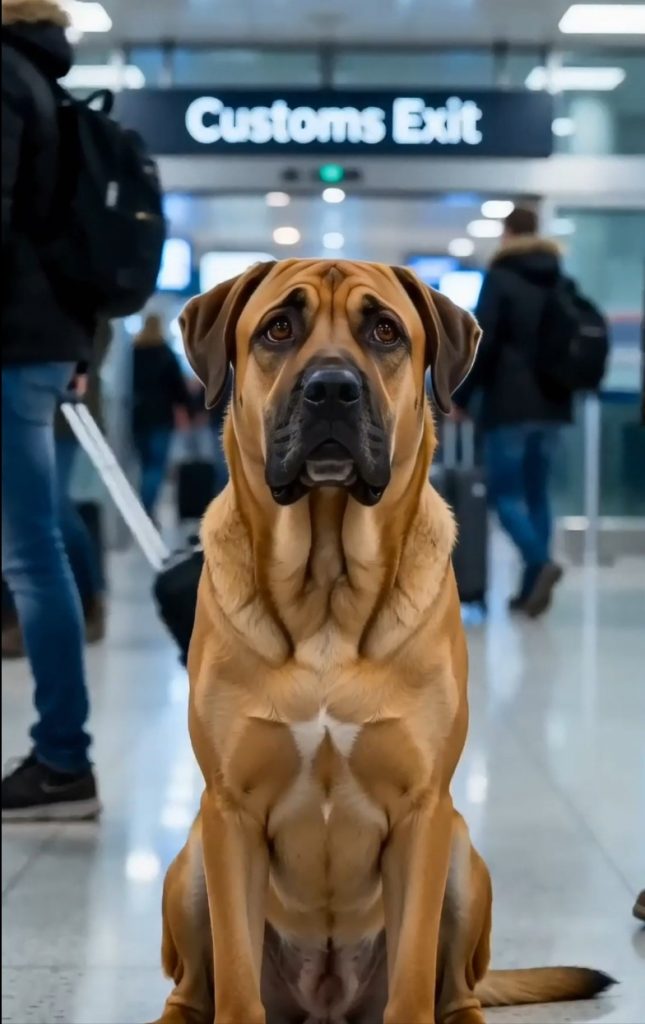
That night, Atlas took his place beneath the overhead sign that read CUSTOMS EXIT.
Travelers flowed around him with rolling suitcases and tired faces. Families hugged. Drivers held signs. Children ran into open arms. Businessmen checked their phones before they even cleared the doors.
Atlas watched every person.
His deep brown eyes moved from face to face, searching for one shape, one voice, one scent in the flood of strangers.
People noticed him, of course.
Some smiled. Some took pictures. Some whispered that it was sweet, or sad, or probably a publicity stunt. A little girl once knelt and tried to pet him, but Atlas only lowered his head politely before lifting his gaze back to the exit.
He was not waiting for kindness.
He was waiting for someone specific.
On the ninety-second evening, as the sunset burned behind the windows and the piano music from a nearby cafe softened beneath the airport announcements, Atlas sat exactly where he always sat.
Still.
Silent.
Heartbreakingly certain.
Then an old woman pushing a luggage cart came through Customs, stopped dead, and dropped her passport on the floor.
The dog’s ears lifted.
The woman covered her mouth with both hands.
“Oh my God,” she whispered. “That’s Mara’s dog.”
For the first time in three months, Atlas stood.
Act II
Before the airport became a place of waiting, it had been a place of reunion.
Mara Voss used to arrive through those same glass doors every Friday night at 9:40, carrying one blue suitcase, wearing a navy coat no matter the season, and smiling before she even saw him.
Atlas always heard her first.
Peter Bell would be mopping near the arrivals hall, pretending not to watch, when the huge dog suddenly rose from beside the vending machines. His ears would tilt forward. His tail would move once, then twice, then faster, until Mara appeared beneath the Customs Exit sign.
“Atlas,” she would call.
Then the dog would forget his size.
He would rush toward her, all paws and joy, stopping only at the last second because Mara had trained him not to knock people over unless love absolutely required it.
She had adopted him two years earlier from a roadside rescue outside Lisbon.
Back then, he was thinner, nervous around loud noises, and far too big for most people to imagine as gentle. Mara had sat on the shelter floor for almost an hour while he watched her from the corner.
She did not coax him.
She did not reach too soon.
She simply opened a book and read aloud in a soft voice until he came closer on his own.
The shelter worker had laughed. “You know he’s not a lapdog.”
Mara looked at the enormous head slowly settling onto her knee.
“He disagrees.”
Mara worked as a translator for international medical teams. She traveled often, always leaving Atlas with Peter when she was gone. Peter was her uncle, though she called him “Uncle Pete” only when she wanted something from him.
He had no wife, no children, and no patience for most people.
Atlas changed that.
The dog slept at Peter’s feet in the little apartment above the airport maintenance offices. He followed him during quiet night shifts, keeping close as Peter changed trash bags and wiped coffee stains from chrome counters. Airport staff learned to love him. Travelers learned to recognize him.
But Atlas never belonged to the airport.
He belonged to Mara.
Every time she left, she knelt in front of him and held his face between both hands.
“I come back,” she would say.
Atlas would stare at her.
“Always,” she would add.
And she did.
Until the night she didn’t.
The last time Peter saw Mara, the terminal was crowded with storm-delayed passengers. She had been called overseas after an earthquake hit a coastal city, her medical team short on translators who could speak three local dialects.
She was tired but excited, moving fast, her blue suitcase rolling behind her.
Atlas pressed against her leg as if he already disliked the trip.
Mara crouched.
“Hey,” she whispered. “Don’t look at me like that.”
Atlas leaned his heavy head into her chest.
Peter stood nearby with his hands in his pockets, pretending the moment did not bother him.
Mara looked up at him. “I’ll be back in nine days.”
“You said that last time and came back in twelve.”
“So feed him like I’ll be gone twelve.”
Peter grunted. “Bossy.”
Mara smiled, then slipped something into Atlas’s collar.
A small silver charm shaped like a compass.
“For bravery,” she told him.
The boarding call echoed above them.
Atlas watched her walk away.
At the security line, Mara turned back and lifted her hand.
“I come back!” she called.
Atlas stood perfectly still until she disappeared.
Nine days passed.
Then twelve.
Then eighteen.
Peter called every number he had.
The aid organization said communication had been disrupted after the second quake. Then they said several workers had been transferred to different hospitals. Then they said Mara Voss was listed as missing during an evacuation convoy.
Missing.
Not confirmed gone.
Not safe.
Just missing.
Peter stopped sleeping.
Atlas stopped eating unless Peter sat beside him.
On the twenty-first night, while Peter was cleaning near Customs Exit, Atlas pulled free and ran to the doors as an international flight emptied into arrivals.
He searched every face.
Mara was not there.
The next night, he did it again.
Then again.
Eventually, Peter stopped trying to explain.
Because some forms of hope are not foolish.
Some are the only thing keeping a heart alive.
Act III
The woman who recognized Atlas was named Elise Renard.
She had silver hair pinned beneath a dark scarf and the stiff posture of someone who had spent a long flight holding herself together. Her suitcase had tipped sideways when she stopped, and one wheel spun uselessly against the terminal floor.
Atlas took one step toward her.
Then another.
He did not run.
He sniffed the air, uncertain, his whole body tense with a fragile kind of hope.
Elise began to cry.
Peter saw it from across the hall and dropped the trash bag in his hand.
“Atlas?” he called.
The dog ignored him.
Elise knelt slowly, though her knees shook. From inside her coat, she pulled a blue fabric strap.
The strap was old, frayed at one edge, and stitched with tiny white letters.
ATLAS.
The dog made a sound Peter had never heard from him before.
Not a bark.
Not a whine.
A broken, breathless cry.
Atlas pushed his head into Elise’s hands, sniffing the strap, the sleeves of her coat, the old leather bag at her side. His tail moved once, then stopped as if he did not dare trust what he smelled.
Peter reached them, breathing hard.
“Where did you get that?”
Elise looked up at him.
“You’re Peter Bell,” she said.
His face went pale.
“How do you know my name?”
“Mara talked about you.”
The terminal noise seemed to fall away.
Suitcase wheels rolled past. Announcements echoed overhead. Travelers hugged and moved on with their lives.
Peter did not move.
Elise held the strap tighter.
“I was with her after the second quake.”
Peter’s hand went to the back of a nearby chair.
“Was?”
“She survived,” Elise said quickly. “Please. She survived.”
Atlas lifted his head.
Peter closed his eyes as if the word hurt.
“Where is she?”
Elise’s face changed.
Not into grief.
Into something more complicated.
Fear. Guilt. Exhaustion.
“She was brought to a field hospital under the wrong name,” Elise said. “No documents. No phone. She had injuries, confusion. For weeks she didn’t know who she was.”
Peter stared at her.
“But she remembered him.”
Elise looked at Atlas.
“She kept drawing the same dog on the backs of medical forms. A huge golden dog with a black muzzle. She couldn’t remember her own address, but she kept saying, ‘He waits where the planes come home.’”
Peter covered his mouth.
Atlas pressed closer to Elise’s coat, breathing fast now, searching for more of the scent that clung to her.
Elise reached into her bag and pulled out a folded photograph.
It showed Mara in a hospital courtyard.
Thinner.
Hair shorter.
One arm in a sling.
But alive.
In her lap was a notebook. On the page, drawn in shaky lines, was Atlas sitting beneath a sign.
CUSTOMS EXIT.
Peter’s eyes filled before he could stop them.
“Why didn’t anyone tell us?”
Elise looked down.
“Because someone did not want her found.”
The sentence landed like a door slamming shut.
Peter’s grief sharpened into something cold.
“Who?”
Elise hesitated.
Then she looked past him, toward the glass wall overlooking the runway.
“Mara’s husband.”
Act IV
Mara had been separated from her husband for almost a year before she disappeared.
His name was Julian Voss, and he had the kind of charm people mistook for goodness when they did not have to live with it. He smiled beautifully at fundraisers. He spoke softly to elderly donors. He told stories about Mara’s bravery as if her courage belonged to him because he had married it.
But behind closed doors, Julian treated her work like an insult.
Every trip was an abandonment. Every patient she helped was proof she cared more about strangers than him. Every time she returned home and Atlas ran to her first, Julian’s smile tightened.
Peter had never liked him.
Atlas hated him.
Dogs know the difference between a raised voice and a dangerous silence.
The night Mara left for the earthquake response, Julian had appeared at the terminal minutes after she passed through security. He told Peter he was there to apologize to her before the flight. Peter did not believe him then.
Now he understood.
Elise explained in a low voice while Atlas sat pressed against her knees, trembling.
After Mara was found alive, confused, and undocumented, aid officials tried to contact her listed emergency number.
Julian answered.
He told them Mara had no living relatives who could travel. He said her uncle was ill. He said she had a history of leaving without notice. He offered to manage her care remotely and requested that no information be released publicly because of “family privacy.”
Then he stopped answering.
By the time Elise realized something was wrong, Mara had already been transferred twice under different administrative files.
“Why come now?” Peter asked.
Elise’s eyes filled again.
“Because yesterday she remembered your name.”
Peter gripped the back of the chair.
“And Atlas?”
Elise gave a sad smile.
“That was the first name she remembered.”
Atlas suddenly turned toward the arrivals doors.
Peter turned too.
A man in a charcoal coat was standing near the far pillar.
Julian Voss.
He had aged in three months, but not in the way grief aged a person. He looked thinner, sharper, impatient. His gaze moved from Elise to Peter, then to the dog.
Atlas stood.
A low sound rose in his throat.
Julian lifted both hands, smiling too quickly.
“Peter,” he said. “I can explain.”
Peter stepped in front of Atlas.
“No.”
Julian’s eyes flicked to Elise. “You had no right coming here.”
“She had every right,” Peter said.
People were starting to look now. A security guard moved closer. The busy terminal slowed around the edges as tension gathered beneath the fluorescent lights.
Julian lowered his voice.
“You don’t understand what Mara was like after the accident. She was unstable. Confused. I was protecting her.”
Elise stood.
“You abandoned her.”
Julian’s smile vanished.
“I managed a situation you people know nothing about.”
Peter looked at him then, truly looked at him, and saw the whole ugly shape of it.
Mara missing meant Julian controlled everything. Her apartment. Her accounts. Her medical decisions. Her foundation contracts. Her story. The brave wife who vanished overseas made him sympathetic. A living wife asking for divorce made him exposed.
Atlas lunged forward one step and barked.
The sound cracked through the terminal.
Julian flinched.
From inside Elise’s bag, a phone began to ring.
She looked at the screen.
Her hand shook.
Then she answered and put it on speaker.
For a moment, there was only static and airport noise.
Then a woman’s voice came through.
Weak.
Raspy.
But unmistakable.
“Peter?”
Peter’s face crumpled.
“Mara?”
Atlas froze.
The dog’s ears lifted so sharply his whole body seemed to stop breathing.
On the phone, Mara began to cry.
“Is he there?”
Peter could not answer.
He lowered the phone toward Atlas.
Mara’s voice broke.
“Atlas,” she whispered. “I come back.”
The dog let out a cry so raw that travelers turned from every direction.
Then the Customs Exit doors opened again.
Act V
Mara Voss came through in a wheelchair pushed by an airport medical assistant.
For one impossible second, nobody moved.
Not Peter.
Not Elise.
Not even Julian.
Mara looked smaller than the woman in Peter’s memories, wrapped in a gray travel blanket, her face pale with exhaustion. But her eyes were clear. They searched the terminal once, twice, then found the dog.
Atlas ran.
This time, no training stopped him.
He crossed the arrivals floor with a force that made suitcase wheels scatter and strangers step back. Just before reaching her, he slowed, as if some deep part of him understood she was fragile now.
Then he lowered his enormous head into her lap.
Mara folded over him.
The sound she made was not a word.
It was every night she had survived without knowing where home was. Every unanswered question. Every dream of airport lights and a golden dog waiting beneath a sign she could not fully remember.
Atlas pressed himself against her knees, shaking.
Mara buried both hands in his wet-looking golden fur and whispered his name again and again.
“I’m here,” she said. “I’m here. I’m so sorry.”
Peter turned away, wiping his face with his sleeve.
Elise cried openly.
Around them, the terminal had gone quiet in patches. People who had hurried through life seconds earlier now stood still, watching a reunion too honest to interrupt.
Julian tried to leave.
Atlas noticed first.
His head lifted.
A growl rumbled low in his chest.
Mara looked up and saw her husband stepping backward toward the side exit.
“No,” she said.
Her voice was weak, but it carried.
Security moved before Julian could disappear into the crowd.
He argued, of course. Men like Julian always did when control began slipping through their fingers. He claimed misunderstanding. Stress. Medical confusion. He said he had intended to bring Mara home when the time was right.
Mara held Atlas’s collar and watched him without blinking.
“You told them I had no one,” she said.
Julian’s face tightened.
Mara’s hand moved to the small silver compass charm still hanging from Atlas’s collar.
“You forgot he knew where home was.”
The investigation would take months.
There would be lawyers, statements, hospital records, phone logs, charity documents, and questions Julian could no longer bury beneath polished grief. Mara would have to heal in public and private at the same time. She would have to rebuild strength in a body that had been through too much and trust in a world that had failed to look hard enough for her.
But that night, she went home with Atlas.
Peter drove slowly through the city, glancing into the rearview mirror every few seconds.
Mara sat in the back seat with the dog’s head across her lap. Atlas refused to sleep. His eyes stayed fixed on her face, as if he feared memory itself might take her away again.
“I’m not leaving,” she whispered.
His tail tapped once against the seat.
At the apartment above the airport maintenance offices, everything was almost as she had left it. Peter had not moved her books. Her blue mug still sat in the cabinet. Atlas’s bed was beside the radiator, though he had clearly not used it much.
Mara stood in the doorway for a long time.
Then she saw the wall.
Peter had taped dozens of printed airport stills beside the kitchen window. Each one showed Atlas beneath the Customs Exit sign on a different night.
Waiting.
Watching.
Believing.
Mara touched the first photograph.
Then the last.
“He went every night?” she asked.
Peter nodded.
“Every night.”
Her mouth trembled.
Atlas leaned against her leg.
Mara sank to the floor with him, and this time there was no glass, no ocean, no locked system, no lie between them. Only the old apartment, the humming radiator, Peter pretending not to cry in the kitchen, and the dog who had kept her place in the world warm by refusing to stop looking.
Months later, after Mara could walk through the terminal without needing to rest, she returned to the airport at sunset.
Not to leave.
To watch.
Atlas sat beside her near the perimeter fence, his ears lifting as a plane roared into the orange-blue sky. Mara rested a hand on his back and felt the steady rise and fall of his breathing.
The aircraft climbed higher.
Atlas followed it with his eyes.
Then, for the first time, he turned away before it vanished.
He looked at Mara instead.
She smiled through tears.
“I told you,” she whispered. “I come back.”
Atlas pressed his shoulder against her.
Behind them, the terminal lights glowed. Ahead of them, the runway stretched into evening. And somewhere between the planes that left and the doors that opened, a dog’s impossible patience had done what the world could not.
It had brought her home.