Act I
The scream wasn’t what made the street go silent.
It was the fall.
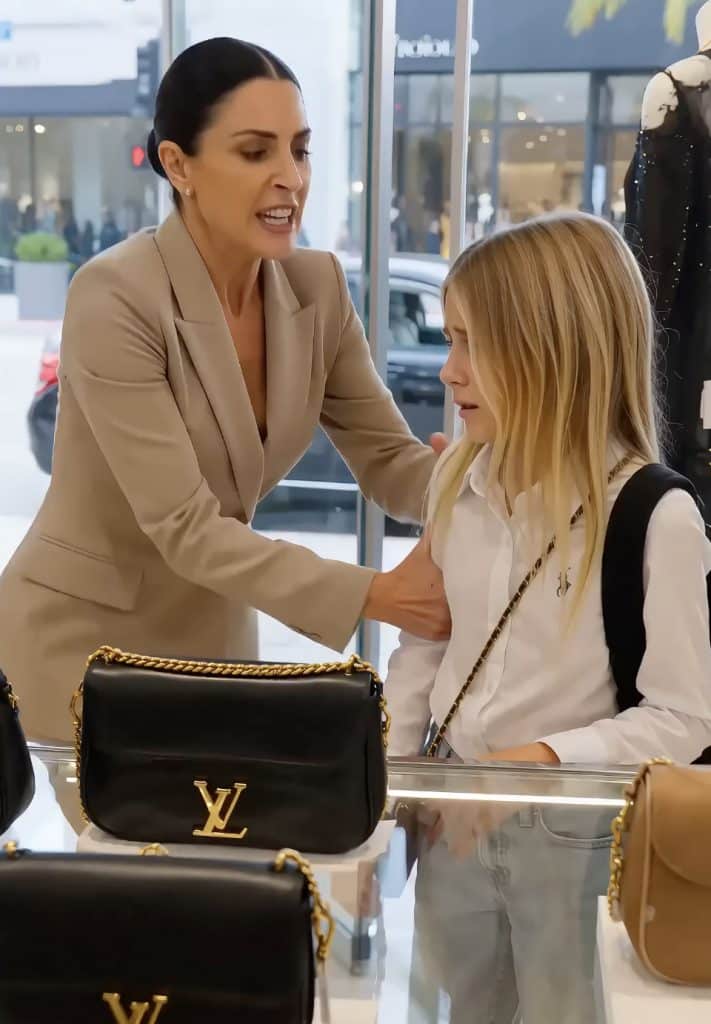
One moment, the little girl was standing near a display table inside the luxury boutique, her freckled face filled with curiosity as she admired a row of designer handbags.
The next, she was flying through the glass doorway.
Her small body hit the concrete sidewalk hard.
A backpack slid across the pavement.
Her crossbody bag tumbled after it.
Several shoppers gasped.
A woman near the entrance covered her mouth.
Nobody expected what they had just witnessed.
The boutique manager stood in the doorway like a queen protecting a castle.
Her dark hair was pulled into a perfect bun.
Her tailored black suit looked expensive enough to pay someone’s monthly rent.
And her expression carried the certainty of someone who believed she had the right to decide who belonged and who didn’t.
“Get your hands off that display and get out!” she snapped.
Her finger pointed toward the child.
“Girls like you don’t belong near luxury like this!”
The little girl stared back in shock.
She couldn’t have been older than eleven.
Maybe twelve.
Her oversized beige shirt hung loosely from her shoulders.
Her sneakers were dusty.
Her backpack looked worn from years of use.
To the manager, that was all the evidence she needed.
Poor.
Out of place.
Unwelcome.
The girl slowly pushed herself off the pavement.
Her knees hurt.
Her palms were scraped.
But she didn’t cry.
That surprised everyone.
Most children would have.
Instead, she quietly gathered her belongings.
As if she had experienced moments like this before.
As if being underestimated had become something she expected.
The manager folded her arms.
Smug.
Certain.
Victorious.
Then a black SUV pulled up to the curb.
And everything changed.
Act II
The girl’s name was Charlotte Sinclair.
Very few people knew it.
That was intentional.
Her father had spent years trying to keep her life as normal as possible.
A difficult task when your last name appeared on luxury storefronts across three continents.
The Sinclair family owned one of the largest fashion groups in the world.
Designer labels.
Luxury boutiques.
Jewelry houses.
Fragrance companies.
Entire shopping districts carried brands under their umbrella.
Money had never been a problem.
Privacy had.
Charlotte’s mother died when she was seven.
After that, her father became fiercely protective.
He refused to let wealth define his daughter.
No private entourages at school.
No public displays of privilege.
No special treatment.
He wanted her to understand people.
To see the world honestly.
And more importantly, to learn how people treated others when they believed nobody important was watching.
So Charlotte often visited stores without announcing who she was.
Sometimes she wore simple clothes.
Sometimes she traveled with minimal security nearby.
Sometimes she simply observed.
Her father called it education.
His executives called it dangerous.
Charlotte called it revealing.
Because people showed their true character when they thought someone had no power.
That morning she had entered the boutique alone.
The store was one of the company’s highest-performing locations.
Its manager consistently received awards.
Outstanding leadership.
Exceptional customer service.
Elite performance.
At least on paper.
Charlotte wanted to see the store for herself.
Nobody recognized her.
That was exactly the point.
Within ten minutes, she discovered something annual reports never mentioned.
Fear.
Arrogance.
Cruelty.
And a manager who confused luxury with superiority.
The lesson was painful.
But it was about to become unforgettable.
Act III
The SUV door opened.
A large man stepped onto the sidewalk.
His black suit fit like armor.
His expression remained calm.
Controlled.
Professional.
The moment he saw Charlotte standing outside the store, something changed in his eyes.
Relief.
The shoppers noticed it immediately.
The manager noticed it too.
The bodyguard walked directly toward the girl.
Not hurriedly.
Not angrily.
With purpose.
The crowd watched.
The manager smirked.
Perhaps she assumed the man was there to remove the child completely.
Perhaps she believed she had won.
Then the bodyguard stopped in front of Charlotte.
And bowed.
A deep, formal bow.
The kind reserved for royalty.
The kind that instantly silenced every conversation nearby.
Charlotte stood perfectly still.
The manager’s smile vanished.
The bodyguard lowered his head.
“Owner’s daughter,” he said quietly. “Forgive our late arrival.”
The world stopped.
Nobody moved.
Nobody spoke.
Even the traffic outside seemed to disappear.
The words echoed through the storefront.
Owner’s daughter.
The manager blinked.
Once.
Twice.
Surely she had misunderstood.
But the bodyguard remained bowed.
Completely serious.
Completely respectful.
And suddenly every shopper in the store was staring at Charlotte with entirely different eyes.
Not because she had changed.
Because their assumptions had.
Act IV
The manager felt her stomach drop.
A cold sensation spread through her chest.
Owner’s daughter.
There was only one owner family.
Only one surname connected to every boutique in the district.
Only one family whose approval determined careers.
Sinclair.
The realization hit like a freight train.
Her legs felt weak.
Charlotte calmly brushed dust from her shirt.
No anger.
No tears.
No dramatic outburst.
That somehow made everything worse.
The bodyguard glanced toward the store entrance.
His expression hardened.
“What happened?”
Nobody answered immediately.
The silence itself became an accusation.
Then one shopper stepped forward.
An older woman carrying several luxury shopping bags.
“I saw everything.”
Another customer nodded.
“So did I.”
A third joined.
“And the security cameras did too.”
The manager’s face turned pale.
Every witness had the same story.
The child hadn’t stolen anything.
Hadn’t damaged anything.
Hadn’t caused a disturbance.
She had merely looked at a display.
The manager looked desperately toward Charlotte.
Searching for some sign that this could still be fixed.
But Charlotte’s calm gaze revealed something terrifying.
She had already made up her mind.
Not out of revenge.
Out of understanding.
She now knew exactly how the boutique was being run.
And no explanation could erase what had happened.
Because the problem wasn’t that the manager had mistreated the owner’s daughter.
The problem was that she believed an ordinary child deserved to be treated that way.
Act V
An hour later, the boutique was closed.
Employees stood quietly inside.
Corporate executives arrived from headquarters.
Statements were collected.
Security footage was reviewed.
The facts were undeniable.
Yet Charlotte remained surprisingly quiet throughout the process.
She spent most of her time speaking with sales associates.
Reception staff.
Cleaning personnel.
People rarely asked for their opinions.
What she heard disturbed her.
The manager’s behavior wasn’t new.
Many employees had witnessed similar incidents.
Customers judged by clothing.
Visitors dismissed because of appearance.
People treated differently depending on how wealthy they looked.
The culture had existed for years.
The shove was merely the moment it became impossible to ignore.
That evening, Charlotte’s father arrived.
By then, the entire situation had been explained.
He listened carefully.
Watched the footage.
Then sat beside his daughter.
“Are you alright?”
Charlotte nodded.
“My knees will heal.”
Her father smiled softly.
She sounded so much like her mother.
Then she said something that surprised him.
“I don’t want people punished because of who I am.”
He waited.
“I want them held accountable because of what they did.”
The distinction mattered.
And it became the foundation for everything that followed.
Over the next months, company policies changed.
Training programs were rewritten.
Customer treatment standards were expanded.
Managers were evaluated not only by sales numbers but by how they treated people.
Every person.
No exceptions.
Years later, Charlotte would remember the fall.
The scrape on her hands.
The humiliation.
The shocked faces.
But most of all, she would remember standing on that sidewalk when everyone thought she was powerless.
Because that was the moment she learned something her father had been trying to teach her all along.
True character reveals itself when no one thinks you’re important.
And sometimes the most valuable person in front of a luxury store is the one everyone else mistakes for someone who doesn’t belong.