Act I
The dog stood alone in the prison courtyard, barking at a window too high for any hope to reach.
Rain had darkened the asphalt beneath his paws. The concrete wall rose above him like a cliff, gray and cold, broken only by a small barred window near the top. Behind those bars, a man pressed his face into the narrow space and sobbed like he had been waiting years to be seen by anything that still remembered him.
The guards should have moved the dog away.
They did not.
Three of them stood near the base of the wall in dark blue uniforms, their caps wet from the drizzle, their hands still at their sides. Prison guards were trained not to react. Not to soften. Not to let the pain inside the walls become personal.
But the dog was making that impossible.
He barked once more, sharp and desperate, the sound bouncing off the concrete. Then his voice broke into a whimper.
High above, the prisoner gripped the bars.
“Buddy,” he choked out. “Oh God… Buddy.”
The dog’s ears lifted at the name.
His whole body trembled.
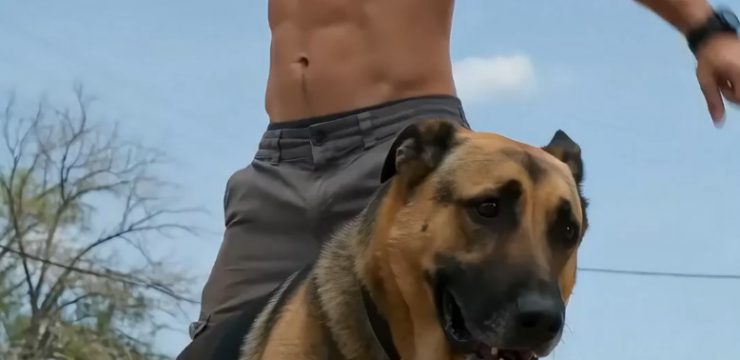
He was small beneath that massive wall, tan fur damp, black collar tight around his neck, amber eyes locked upward. He did not look lost. He did not sniff the ground or search for an exit.
He knew exactly where he was.
And he knew exactly who was behind that window.
The female guard in the center, Officer Claire Bennett, swallowed hard. She had seen inmates scream, beg, threaten, collapse, pray. She had seen families leave visitation rooms with their faces emptied of hope.
But she had never seen a dog find a man through concrete.
“Who let him in?” the male guard beside her muttered.
No one answered.
The prison courtyard was sealed by two gates, a metal detector entrance, and cameras on every corner. A stray dog should not have made it past the outer fence, much less into the yard beneath Block C.
Yet there he was.
And the prisoner above him was breaking apart.
Officer Bennett took one slow step toward the dog.
He did not run.
He only looked at her for half a second, then turned his face back to the barred window and gave a soft, pleading cry.
That was when she noticed the collar.
A strip of black leather. Worn at the edges. Buckled carefully.
And hanging from it, beneath the rain, was a small metal tag.
Not a name tag.
A key.
Act II
The man in the window was Caleb Rourke, inmate number 41782.
That was how the prison knew him.
Before that, the world had known him as a murderer.
Eight years earlier, Caleb had been a mechanic in a coastal town where everyone knew the sound of his truck before they saw it. He fixed engines for fishermen, single mothers, retired teachers, anyone who could not afford dealership prices. He kept a jar of dog treats on the counter because every child in town seemed to bring a dog to his shop sooner or later.
His own dog, Buddy, was famous there.
Buddy had been a half-grown rescue when Caleb found him behind the garage during a storm, skinny, shaking, and too stubborn to let anyone touch him. Caleb sat outside for two hours with a sandwich in one hand until the dog finally came close enough to take a bite.
After that, Buddy followed him everywhere.
To the shop.
To the pier.
To the little blue house Caleb shared with his younger sister, Anna.
Anna was the center of Caleb’s life. Their parents died when she was seventeen, and Caleb became brother, father, driver, emergency contact, and late-night pancake maker. He paid her college fees one engine repair at a time.
Anna had wanted to become a lawyer.
“Somebody in this town needs to read contracts before signing them,” she used to say.
Then she disappeared.
For three days, the town searched.
On the fourth day, police arrested Caleb.
The evidence looked damning because someone had designed it that way. His truck was found near the abandoned warehouse. His fingerprints were on a crowbar discovered inside. Anna’s necklace was located under a loose floorboard in Caleb’s garage.
He said he had been framed.
No one believed him.
People wanted a monster, and Caleb was close enough to the pain to be painted as one.
Only Buddy refused to accept the new story.
When officers took Caleb away, Buddy chased the patrol car down the road until his paws bled. For weeks, he slept outside the locked garage. Then, when Caleb’s house was sold and the shop closed, Buddy vanished.
Some said he died.
Some said he was taken in by a family inland.
Caleb stopped asking.
In prison, asking hurt too much.
The first year, he fought. The second year, he wrote appeals. By the fourth, his letters came back unopened. By the sixth, the town had forgotten his name except as a warning.
By the eighth, Caleb had learned to survive by feeling less.
Then, on a wet Thursday afternoon, a bark rose from the courtyard.
Not any bark.
That bark.
The one that used to echo through his garage whenever a delivery truck pulled in. The one that used to wake him before dawn because Buddy believed breakfast was a legal right.
Caleb climbed onto the narrow ledge beneath the barred window and looked down.
At first, he thought grief had finally broken something in his mind.
Then Buddy barked again.
And Caleb Rourke, who had survived eight years in a cell without crying where anyone could hear, pressed his forehead to the bars and sobbed.
Because the dog was alive.
And he had not come empty.
Act III
Officer Bennett called the warden before she touched the key.
“Ma’am,” she said carefully into her radio, “we have a situation in the east courtyard.”
The warden did not like situations.
Especially ones involving inmates crying out of windows and unauthorized animals appearing in secure spaces.
Within minutes, the courtyard filled with tension. More guards arrived. A supervisor ordered everyone to keep distance. Buddy stood exactly where he was, soaked and shaking, but still staring up at Caleb.
“Get animal control,” the supervisor said.
Caleb’s voice cracked from above. “Please. Don’t hurt him.”
“No one is hurting the dog,” Bennett said, surprising herself with how quickly she answered.
She crouched near Buddy.
He looked at her, wary but not aggressive. Around his collar, the key glinted beneath the rain. It was old brass, taped to the tag ring with fraying black electrical tape.
Bennett reached slowly.
Buddy allowed her to take it.
The moment the key came free, he whined and nudged her wrist, as if one message was not enough.
Attached behind the key, folded tight in a waterproof sleeve, was a strip of paper.
Bennett opened it.
The handwriting was jagged, rushed, and faded in places.
Locker 19. North Harbor Bus Depot. Caleb didn’t kill Anna. Ask why Judge Harrow sealed the witness report.
Bennett read it twice.
Then a third time.
Her stomach tightened.
Judge Harrow was not just any judge. He was the judge who had sentenced Caleb Rourke. A man celebrated for being tough on crime. A man whose photograph still hung in the prison’s administrative hallway after his appointment to the state appeals court.
The supervisor stepped closer.
“What is it?”
Bennett folded the paper in her palm.
“Evidence,” she said.
His face hardened. “That is not your call.”
“No,” Bennett said, standing. “But it is someone’s.”
Above them, Caleb was silent now.
Not calm. Not hopeful.
Terrified.
Hope is dangerous to a man who has been punished for believing truth mattered.
The warden arrived in a black raincoat, her mouth set in a line. She took the note, read it, and looked up at Caleb’s window.
“You know anything about this?” she called.
Caleb gripped the bars.
“No.”
“Then why did the dog bring it to you?”
Caleb looked down at Buddy.
His answer was barely audible.
“Because Anna trained him to find me.”
The courtyard went still.
Caleb swallowed hard.
“My sister used to play this game with him. She’d hide my keys, then tell him, ‘Find Caleb.’ He always did.”
Bennett looked at the brass key in her hand.
The game had become a message.
The dog had not only found the prison.
He had delivered the first crack in a wall built eight years ago.
Act IV
The locker was opened three hours later.
Not by the prison.
By state investigators.
Officer Bennett made three calls that changed everything. One to the internal affairs liaison. One to the state public defender’s conviction review unit. One to her brother, who worked at the North Harbor Bus Depot and confirmed that Locker 19 had been paid in cash every six months by someone using Anna Rourke’s old student ID number.
Inside the locker was a blue backpack.
Inside the backpack was Anna’s truth.
There were photographs of a local property deal. Copies of contracts. A flash drive. A recorder with a cracked screen. And a notebook full of Anna’s careful handwriting.
She had been investigating illegal evictions tied to the waterfront redevelopment project. Families were being pushed out of homes through forged notices and fake debt claims. The company behind it had friends in court, friends in the police department, and one powerful judge willing to make problems disappear.
Anna had become a problem.
Caleb had become the solution.
The witness report sealed by Judge Harrow told the rest. A dockworker had seen Caleb’s truck being driven by someone else the night Anna vanished. The witness later recanted after being threatened, but the original statement still existed.
Hidden.
Buried.
Marked inadmissible.
By morning, Caleb Rourke’s case was no longer a forgotten conviction.
It was a scandal.
News vans gathered outside the prison gates by noon. The warden refused interviews. Judge Harrow issued a statement calling the accusations “deeply irresponsible.” The retired detective who handled Caleb’s case claimed he could not remember key details.
But Buddy remembered.
In every video clip, there he was in the courtyard, soaked beneath the prison wall, refusing to move until someone listened.
Caleb was brought to a private interview room that evening. Not the visitation room. Not the hearing room. A small gray space with a table, two chairs, and a camera blinking in the corner.
Officer Bennett stood outside the glass.
Buddy sat beside her.
When Caleb entered, shackled at the wrists, the dog shot to his feet.
The guard holding Caleb paused.
Caleb did not ask permission. His face already had too much pain in it.
Bennett opened the door.
Buddy crossed the room in a blur of tan fur and trembling devotion. He leapt against Caleb’s legs, whining, circling, pressing his face into Caleb’s hands as if checking every missing year.
Caleb dropped to his knees.
The chains clinked softly.
“I’m sorry,” he whispered into the dog’s wet fur. “I’m sorry, boy. I didn’t know you were still looking.”
Buddy licked his face and cried.
Behind the glass, Bennett turned away.
Not because she was embarrassed.
Because some reunions are too sacred to watch straight on.
Later, when investigators asked Caleb whether he had any idea who could have sent Buddy, he gave them the only name he could think of.
“Mrs. Vale.”
Anna’s old neighbor.
A retired librarian with bad knees, sharp eyes, and no patience for powerful men.
They found her in a nursing home forty miles away.
She was ninety-one.
She had kept Buddy for eight years.
And she had kept Anna’s backpack even longer.
“I promised that girl,” Mrs. Vale told the investigators from her bed. “I promised if something happened, I’d get it to Caleb. But then they locked him away, and everyone said he was dangerous.”
Her thin hand rested on Buddy’s head.
“So I waited until I was sure the right person would listen.”
Bennett asked why she sent Buddy to the prison now.
Mrs. Vale smiled faintly.
“Because I’m old, Officer. And that dog was tired of waiting.”
Act V
Caleb Rourke walked out of prison on a cold morning beneath a sky the color of wet stone.
There were no cheering crowds inside the gate. No dramatic music. No speech that could give eight years back.
There was only a man in borrowed clothes standing very still as the final door opened.
Buddy waited on the other side.
So did Officer Bennett.
The dog saw Caleb first and pulled so hard on the leash that Bennett had to let go. He ran across the pavement, paws slipping slightly, and crashed into Caleb with all the force his aging body could manage.
Caleb folded around him.
For a long time, he did not stand.
The cameras outside the outer fence caught part of it: the freed man on his knees, the dog pressed against his chest, the prison wall behind them, enormous and suddenly powerless.
But the cameras did not catch Caleb’s words.
Only Buddy heard them.
“You brought me home.”
Caleb did not return to the town immediately.
He went first to see Mrs. Vale.
She was waiting by the window of her nursing home room, wrapped in a lavender blanket, Buddy’s old leash folded neatly in her lap. When Caleb entered, her eyes filled, but her voice stayed firm.
“You look too thin,” she said.
Caleb laughed once, and it broke halfway through.
“Yes, ma’am.”
She reached for his hand.
“I’m sorry it took so long.”
Caleb shook his head.
“You kept him alive.”
“I kept Anna’s promise,” she said. “There’s a difference.”
Caleb sat beside her bed, Buddy resting between them, and for the first time in eight years, he spoke of his sister without a wall between them.
The case did not end with Caleb’s release.
It widened.
Judge Harrow resigned before he could be removed. Two former detectives were indicted. The redevelopment company collapsed under federal investigation. Families who had lost homes came forward with documents that matched Anna’s notes.
Anna Rourke’s name, once buried under lies and old headlines, returned to the world as something clean.
Not a victim in a forgotten file.
A young woman who had found the truth and hidden it well enough for a dog to carry it home.
Months later, Caleb stood in front of the old garage.
The sign was faded. The windows were dusty. Weeds pushed through cracks in the lot.
Buddy limped to the door and sat down like he had never left.
Caleb unlocked it with the brass key from his collar.
The hinges groaned.
Inside, the air smelled of old oil, wood, and memory. A jar of ancient dog treats still sat on the counter, empty except for crumbs. On the wall hung a photograph of Anna in her college sweatshirt, grinning like she knew she was smarter than everyone in the room.
Caleb stood beneath it.
“I’m back,” he said quietly.
Buddy leaned against his leg.
The garage reopened in spring.
Not as it had been before. Nothing ever returns exactly. But the lifts were repaired, the floors swept, the sign repainted. People came slowly at first, ashamed of what they had believed. Some apologized. Some could not find the words.
Caleb accepted what he could.
He rejected what arrived too easily.
Forgiveness, he learned, was not something owed to anyone simply because truth had become inconvenient.
Officer Bennett visited on the first day the garage reopened. She brought coffee, a bag of dog biscuits, and a new collar for Buddy. Black leather, like the old one, but softer.
The tag was silver.
On the front, it read:
BUDDY.
On the back:
HE FOUND THE TRUTH.
Caleb turned the tag over in his palm and looked away for a moment.
Bennett pretended not to notice.
Buddy wore it proudly.
Every afternoon after that, when the work slowed and the sun moved low over the harbor, Caleb sat outside the garage with Buddy at his feet. Sometimes he spoke to him. Sometimes he spoke to Anna’s photograph through the open door. Sometimes he said nothing at all.
Silence felt different now.
It no longer had bars in it.
One evening, rain began to fall, soft and steady, darkening the pavement just like it had in the prison courtyard. Buddy lifted his head, ears twitching.
Caleb reached down and rested a hand between them.
“You don’t have to look for me anymore,” he said.
Buddy sighed and settled against his boot.
Across town, the old prison wall still stood gray and cold, with its small barred window high above the courtyard.
But Caleb was not behind it.
He was home.
And the dog who once cried beneath unreachable bars had finally done what love does when the world refuses to listen.
He stayed.
He remembered.
And he led the truth back to the man everyone else had left behind.