Act I
The plate shattered before the veteran ever touched the food.
One second, the eggs, toast, and hash browns sat steaming in front of him beneath the blue-red glow of the diner’s neon sign. The next, the manager’s hand slammed the table so hard the coffee jumped in its cup, and the plate spun off the edge.
Ceramic broke across the tile.
The whole diner went silent.
Rain battered the windows, running in silver lines down the glass. Outside, thunder rolled over the empty street. Inside, every customer turned toward the back booth where the soaked man sat motionless in his ripped utility jacket, his hands still resting on the table as if he was afraid to move them.
The waitress flinched.
Her name was Emily Carter. She was twenty-four, tired from a double shift, and still holding the coffee pot in one hand when her manager stepped between her and the booth.
“This trash doesn’t deserve food!” Brad Nolan shouted.
The veteran lowered his eyes.
That somehow made it worse.
He did not argue. He did not curse. He did not defend himself. He just looked down at the ruined meal spreading across the floor like he had expected kindness to be taken away the moment it appeared.
Emily’s throat tightened.
Brad turned on her.
“You’re fired,” he said. “Both of you. Out.”
A woman in a corner booth covered her mouth. A trucker at the counter slowly set his fork down. Behind the register, the cook stood frozen with a towel in his hand.
Emily looked at the man in the booth.
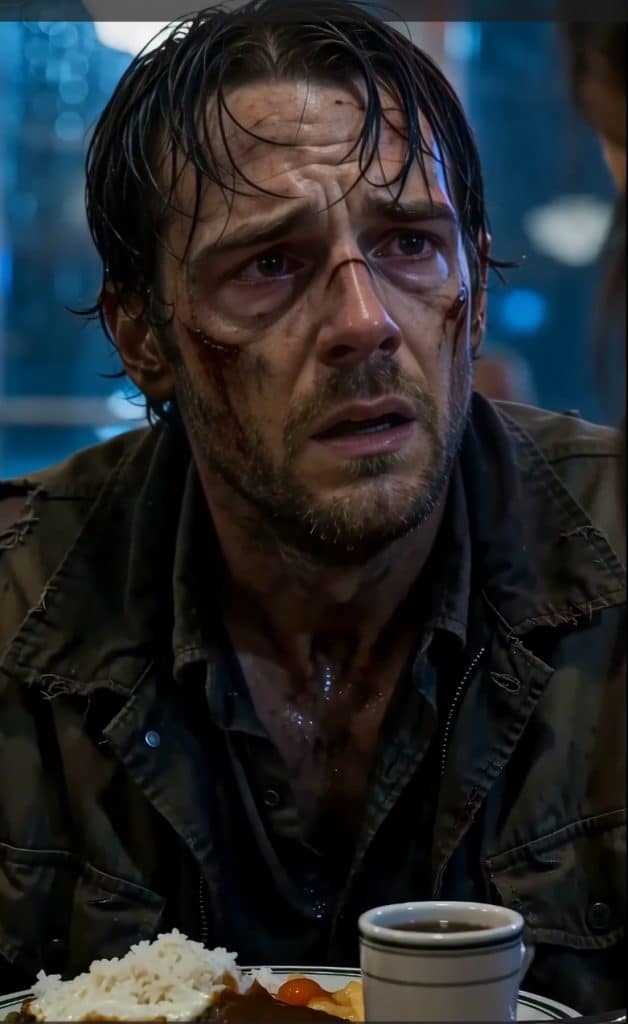
He was maybe in his forties, but hardship had aged him strangely. His dark hair was soaked flat to his forehead. Grime streaked his face. His jacket was torn at one sleeve, and his jeans were muddy from the knees down.
But his eyes were what had made her bring the food.
Not hunger.
Not shame.
Exhaustion so deep it looked like surrender.
He had come in from the storm without asking for anything. Just sat in the booth farthest from the door, head bowed, water dripping from his sleeves onto the table.
Emily had seen men like him before.
Her father had been one.
So she had made him a plate and poured him coffee without asking for money first.
Now Brad stood over them like mercy was theft.
Emily’s eyes filled, but she did not step away.
Brad leaned closer, his voice dropping into something colder.
“I said out.”
The veteran slowly lifted his head.
For the first time, he looked directly at Brad.
And in the pocket of his ruined jacket, something metal caught the diner light.
Act II
Rosie’s Diner had once been the kind of place people drove thirty miles to find.
Before the new highway pulled traffic away. Before the old regulars died, moved, or stopped coming after Brad Nolan took over the night shift. Before the pie case stayed half empty and the coffee tasted burned after midnight.
Emily remembered it differently because her father had loved the place.
Frank Carter used to bring her there after VA appointments when she was little. He always ordered black coffee and blueberry pancakes, no matter the time of day. He sat in the same booth beneath the neon sign and told Emily that diners were sacred American ground.
“Everybody gets fed here,” he would say. “Rich man, poor man, trucker, runaway, preacher, fool. Doesn’t matter. A hot plate can keep a person from disappearing.”
Emily had not understood then.
She did after he came home from his last deployment changed.
Frank did not talk much about the war. He talked about men he missed. Men he owed. One name came up more than the others.
Caleb Knox.
Emily never met him, but she grew up with the story of him.
Caleb was the medic who dragged Frank out after an ambush overseas. Caleb was the man who refused to leave anyone behind. Caleb was the reason Emily’s father got to come home long enough to raise her.
Every year on the anniversary of that day, Frank sat at the kitchen table with two cups of coffee.
One for himself.
One for Caleb.
Emily once asked why.
Her father stared into the second cup and said, “Some debts are too big to pay back, so you keep a place set.”
Frank died two years before the stormy night at Rosie’s.
Cancer took him slowly and unfairly, as if the world had forgotten he had already given enough. In the last week, he pressed an old folded envelope into Emily’s hand.
“If a man named Caleb Knox ever walks into Rosie’s,” he whispered, “you feed him.”
Emily had cried. “Dad, how would I know him?”
Frank’s smile had been tired.
“You’ll know.”
After the funeral, Emily started working nights at Rosie’s because rent was due and grief needed somewhere to stand. The diner’s owner, Mrs. Rosa Bell, was elderly by then and rarely came after sunset. Her nephew Brad managed most nights.
Brad hated everything that did not make money quickly.
He hated elderly customers who lingered over coffee. Hated families who split meals. Hated people who came in from rainstorms without looking like they could pay.
He especially hated Emily’s habit of leaving soup for drifters near closing.
“This isn’t a shelter,” he told her.
“No,” Emily said once. “It’s a diner.”
He wrote her up for attitude.
By the night the soaked veteran walked in, Emily was already on her last warning. She knew Brad would punish her if he saw the free plate. She knew he might fire her.
But when the man sat alone in the booth, trembling faintly from cold and staring at his own hands like they belonged to someone else, Emily heard her father’s voice.
Everybody gets fed here.
So she carried the plate.
“Here you go, sir,” she said gently. “Hope it hits the spot.”
The man looked up at her.
His breath caught.
For one second, he looked less like a stranger and more like someone who had been found at the exact moment he stopped believing anyone was looking.
Then Brad came out of the office.
And broke the plate.
But Brad did not yet know the name of the man he had called trash.
Act III
The metal in the veteran’s pocket was a set of dog tags.
They slipped out when he shifted in the booth, swinging from a broken chain. Emily saw them first because she was still close enough to smell rainwater and smoke in his jacket.
The top tag spun once and landed flat against the table.
KNOX, CALEB J.
Emily stopped breathing.
The coffee pot nearly slipped from her hand.
Brad did not notice.
He was too busy performing for the room, still shouting about standards, customers, insurance, and how people like this ruined businesses.
Emily reached slowly into her apron pocket.
Her fingers closed around the folded envelope she had carried every shift since her father died. She did not know why she kept it there. Maybe because grief makes people superstitious. Maybe because some part of her had believed her father’s promise was not finished.
“Sir,” she whispered.
The veteran looked at her.
His eyes were wet, though whether from exhaustion or humiliation, she could not tell.
“Are you Caleb Knox?”
The name changed the room.
The cook looked up sharply.
An old man at the counter turned in his seat.
Brad faltered.
The veteran’s jaw tightened. For a moment, he looked like he might deny it. Then his hand moved to the dog tags, covering them as if the name still hurt.
“I was,” he said quietly.
Emily’s face crumpled.
“My father was Frank Carter.”
Caleb went still.
Outside, rain hammered the windows harder.
Inside, the diner seemed to shrink around the booth.
Emily pulled the envelope from her apron and held it out with shaking hands.
“He told me to give this to you if you ever came in.”
Caleb stared at it.
He did not take it at first.
Men who have lost too much sometimes fear the things they are handed. A letter can be heavier than a weapon. A memory can do more damage than a storm.
Finally, he reached for it.
His fingers trembled as he unfolded the paper.
Frank’s handwriting filled the page.
Caleb read the first line and shut his eyes.
Brother, if you’re reading this, it means you made it home late. But late still counts.
The diner stayed silent.
Even Brad did not speak.
Caleb read slowly, lips pressed tight, shoulders folding under words no one else could fully see. Frank had written about the ambush. About waking up in a field hospital. About survivor’s guilt. About the life he got to have because Caleb refused to leave him behind.
Then came the part that made Caleb’s breath break.
I named my daughter Emily because you once told me if you ever had a kid, you liked that name. I hope you don’t mind that I borrowed it.
Emily covered her mouth.
Caleb looked up at her.
For the first time, the hard exhaustion in his face cracked.
Brad recovered his voice.
“I don’t care who he says he is,” he snapped. “He’s not paying. And you’re still fired.”
That was when Mrs. Rosa Bell walked in from the back hallway.
She had heard everything.
Act IV
Rosa Bell was eighty-one years old and moved with a cane, but the room straightened when she entered.
She had owned Rosie’s Diner for forty-three years. She had poured coffee for truckers during blizzards, fed police officers after funerals, and let broke teenagers wash dishes for burgers when they were too proud to ask for help.
Brad was her nephew.
Her biggest mistake, she often said privately, had been mistaking blood for character.
She stood beside the counter in a dark green cardigan, silver hair pinned back, eyes fixed on the broken plate at Caleb’s feet.
“What happened here?” she asked.
Brad immediately changed his tone.
“Aunt Rosa, this man came in causing trouble. Emily gave away food again. I was handling it.”
Rosa looked at Emily.
Emily wiped her cheeks quickly. “He didn’t cause trouble.”
Then Rosa looked at Caleb.
For a long moment, her stern face softened with recognition.
“Caleb Knox,” she said.
He stared back at her. “Ma’am?”
“You don’t remember me. That’s all right. I remember you.”
She walked closer, cane tapping against the tile.
“My husband, Henry, ran the veterans’ shelter on Monroe before he passed. You sent checks every month for three years after you came home. Never signed a note. Never asked for thanks.”
Caleb looked down.
Rosa’s voice sharpened as she turned to Brad.
“And you called him trash in my diner.”
Brad’s face reddened.
“He looked like—”
“Like someone hungry?”
Brad swallowed.
Rosa stepped closer to the shattered plate.
“My husband built this place with one rule. Nobody who comes in from the rain gets thrown back into it hungry.”
Emily looked at the floor, crying silently now.
Rosa placed a hand on her shoulder.
“You remembered that better than my own family.”
Brad’s expression hardened. “You can’t run this place on charity.”
“No,” Rosa said. “But I won’t run it on cruelty.”
A customer at the counter spoke up.
“He didn’t ask for anything. She just helped him.”
Another voice from a booth followed.
“Manager’s been like this for months.”
Then another.
“He threw out an old man last week.”
The room shifted.
Quiet people began finding their courage in pieces. Forks stayed down. Coffee cooled. Every eye moved toward Brad, who suddenly looked less like the ruler of the room and more like a man trapped beneath the weight of witnesses.
Rosa looked at the cook.
“Luis, get Mr. Knox a fresh plate.”
Luis nodded immediately. “Yes, ma’am.”
Brad exploded. “Are you serious?”
Rosa’s cane struck the floor.
“Bradley Nolan, you are done here.”
His mouth fell open.
“You can’t fire me. I run this place.”
“You ran it into shame.”
He pointed at Emily. “And her?”
Rosa squeezed Emily’s shoulder.
“She stays.”
Emily stared at her. “Mrs. Bell—”
“With a raise,” Rosa said.
The diner gave a small stunned laugh through its tears.
Brad’s hands curled into fists, but he was smart enough to see too many phones had appeared in too many hands. Customers were recording now. The humiliation he had tried to create for others had turned and found him instead.
He stepped backward.
“This place will die without me,” he said.
Rosa looked around her diner.
At Emily.
At Caleb.
At the customers who had finally remembered they had voices.
“No,” she said. “It was dying with you.”
Brad stormed toward the door.
When he opened it, rain rushed in cold and loud.
He paused only once, looking back as if expecting someone to stop him.
No one did.
The door shut behind him.
And for the first time that night, Caleb Knox let himself breathe.
Act V
The fresh plate arrived with two cups of coffee.
Emily set one in front of Caleb and one across from him.
He looked at the second cup.
“My dad used to do that,” she said softly.
Caleb touched the rim of the empty cup.
For a while, he could not speak.
Then he opened Frank’s letter again and read the last lines.
If you ever think you don’t belong anywhere, go to Rosie’s. Tell them Frank sent you. And if my girl is there, let her feed you. She has her mother’s heart and my stubbornness. That combination could save a man.
Caleb folded the letter with careful hands.
“He saved me too,” he said.
Emily sat across from him, though she was still on shift and her apron was damp with spilled coffee.
“How?”
Caleb looked toward the rain-streaked window.
“After we came home, I disappeared for a while. Not physically at first. Just inside myself. Frank called every week. I rarely answered. He kept calling anyway.”
His voice roughened.
“Then one night, I was sitting in my truck outside a motel, trying to decide if the world would miss me.”
Emily went still.
Caleb did not explain further. He did not need to.
“Your father called,” he said. “I answered by accident. He talked for three hours. Didn’t give advice. Didn’t lecture. Just stayed on the line until morning.”
Emily’s tears returned, quieter this time.
Caleb looked at her.
“He used to say I saved his life. Truth is, we took turns.”
Rosa turned away behind the counter, pretending to check the pie case.
The customers slowly returned to their meals, but the diner felt different now. Not cheerful. Not fixed. Just awake.
Someone paid for Caleb’s plate before he finished it.
Then someone else paid for the next one.
By midnight, Luis had taped a handwritten sign near the register.
RAIN CHECK MEAL FUND.
Rosa laughed when she saw it, then left it there.
Brad did not return the next day.
Or the day after.
Within a week, Rosa discovered missing cash deposits, unpaid vendor bills, and a stack of employee complaints he had hidden in the office drawer. The cruelty had only been the visible part. Underneath it was theft, neglect, and the slow rot of a man who believed every place he touched existed to serve him.
Rosa pressed charges.
Emily kept working nights.
Caleb came back the following Friday.
This time, he was clean-shaven. His jacket was still old, but dry. He looked nervous standing in the doorway, as if kindness might have been a one-night event and not something he could trust twice.
Emily saw him and lifted the coffee pot.
“Usual booth?”
His face softened.
“Yes, ma’am.”
He began coming every Friday after that.
At first, he sat alone with Frank’s letter beside his cup. Then Emily joined him during breaks. Sometimes Rosa did too. They told stories about Frank until grief stopped feeling like a closed room and became a table with enough chairs.
Caleb started helping Luis fix things after hours.
A loose hinge. A broken freezer seal. A flickering neon tube in the front window. He never asked for pay, so Rosa started leaving envelopes in his jacket pocket and pretending she had no idea how they got there.
By spring, Rosie’s Diner had changed.
Not in a shiny way. The booths were still worn. The stools still squeaked. Rain still found one stubborn leak near the front window.
But the coffee was better.
The pie case was full again.
And the sign by the register had become permanent.
NO ONE LEAVES HUNGRY.
Underneath, in smaller letters, Emily had added:
Especially in the rain.
One night, months after Brad shattered the plate, a young man came in soaked and shaking, with a backpack held together by duct tape and eyes that would not meet anyone’s.
Emily saw Caleb notice him.
She saw the old pain move across his face.
Before she could reach for a menu, Caleb stood and walked to the counter.
“Put his meal on mine,” he told Luis.
Emily smiled.
The kindness had traveled.
That was what her father had meant, maybe. Not that a single plate saved everyone. Not that one cup of coffee could undo war, grief, poverty, or cruelty.
But sometimes a person stands at the edge of disappearing, and the world offers them proof that they are still seen.
A plate.
A booth.
A letter.
A waitress brave enough to risk her job.
A veteran tired enough to receive mercy.
Outside, rain began to fall again, soft at first, then heavier. It streaked the windows and blurred the neon until the whole diner glowed red and blue against the night.
Caleb sat in Frank’s old booth with both hands around his coffee.
Emily slid a fresh plate in front of the soaked young stranger across the room.
“Here you go, sir,” she said gently. “Hope it hits the spot.”
Caleb heard the words and looked down at the empty cup across from him.
For years, Frank Carter had kept a place set for a man who might never return.
Now Caleb understood.
A place set is not just for the dead or the missing.
Sometimes it is a promise to the living.
Come in from the rain.
Sit down.
You are not trash.
You are not forgotten.
And while this light is on, you will be fed.