Act I
The hallway was loud until the bucket hit the floor.
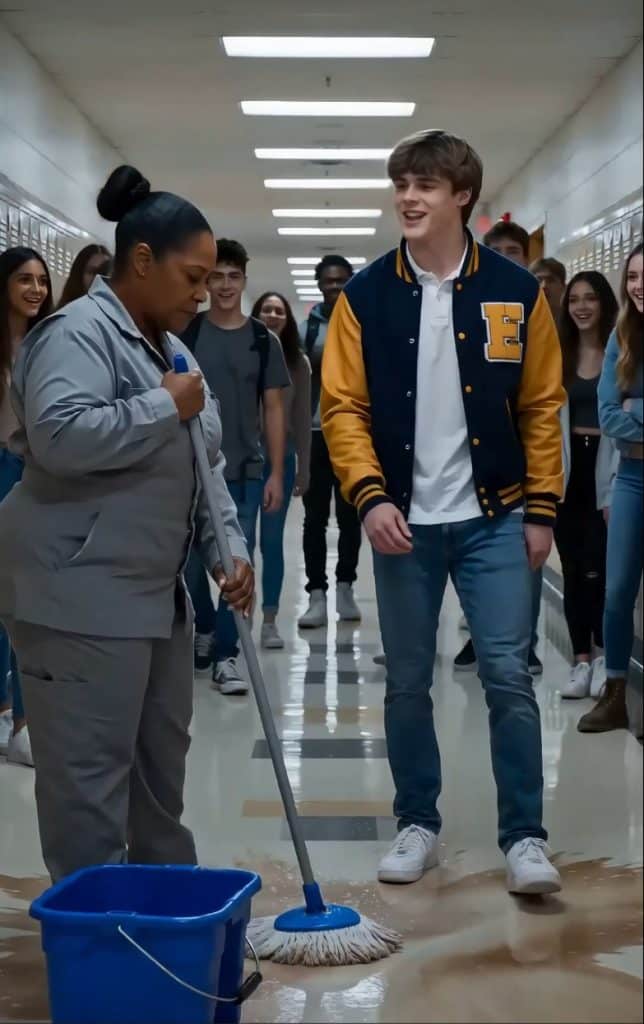
It skidded across the polished linoleum with a hollow plastic clatter, spinning once before slamming against the lockers. Dirty water fanned out in a wide, ugly splash, soaking the section of floor Marissa Cole had just finished mopping.
For one second, the students laughed.
Not all of them. Not loudly at first. But enough.
Enough for the sound to crawl under her skin.
Marissa stood still beside the wet patch, one hand wrapped around the wooden mop handle, her gray utility uniform neat despite the work she had been doing since sunrise. Her hair was pulled into a tight bun, not a strand loose. Her shoes were planted carefully beside the water, her posture straight, her face unreadable.
In front of her, Tyler Whitmore grinned like he had just scored the winning touchdown.
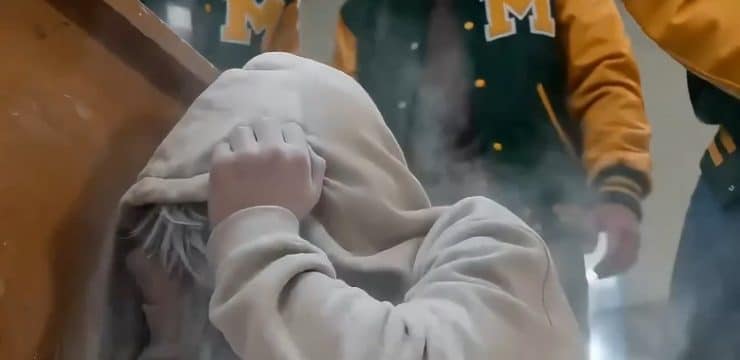
He was tall, broad-shouldered, and wrapped in a navy-and-yellow letterman jacket that seemed to make him believe the hallway belonged to him. Behind him stood five or six students, some with phones half-raised, some leaning against lockers, waiting to see how far he would go.
Tyler looked down at the spreading water, then back at Marissa.
“Clean it again,” he said. “That’s all you’re good for.”
The laughter sharpened.
A girl in a pink hoodie covered her mouth, but not before Marissa saw her smile. A boy with a backpack hanging from one shoulder whispered something to his friend, and both of them snorted.
Marissa did not move.
She had been ignored by these students for three months. Walked past like furniture. Asked for directions without being looked in the eye. Treated as though the mop in her hands had erased every other thing she had ever been.
That was fine.
A person could survive being underestimated.
She had survived worse.
Tyler stepped closer, his sneakers squeaking against the damp floor. He lowered his voice just enough to make it feel personal, but not enough to keep the others from hearing.
“What’s wrong?” he asked. “You mad?”
Marissa’s eyes lifted to his.
Calm.
Steady.
A warning he was too proud to understand.
“Floor’s wet,” she said quietly. “Step back before you slip.”
That made them laugh harder.
Tyler turned slightly toward his audience, spreading his hands like a performer receiving applause.
“You hear that?” he said. “She thinks she’s in charge.”
Then he did something small.
Something almost gentle.
Something crueler than the bucket.
He reached out and patted the top of her head.
The hallway changed.
The laughter thinned in the air. A locker door clicked shut somewhere down the corridor. The overhead lights hummed brighter than they should have, reflecting in the spilled water at Tyler’s feet.
Marissa’s jaw tightened.
Just once.
Tyler’s hand was still near her hair when she caught his wrist.
It happened so quickly that no one understood it until his smile vanished.
Marissa stepped to the side, off the wet patch, her movement compact and precise. Tyler’s shoulder dipped as she redirected his arm downward. His sneakers slid, his balance broke, and the hallway filled with a sudden collective gasp.
“What the—”
He never finished.
Marissa guided his arm across his own body, used his momentum against him, and swept his foot from behind with the smooth efficiency of someone who had not learned that move from a self-defense video.
Tyler hit the floor hard enough to knock the arrogance out of his face.
The students jumped back.
Phones lowered.
The same water he had kicked across the floor now soaked the front of his letterman jacket.
Marissa knelt beside him, placed the mop handle firmly across his upper shoulders to keep him from springing up, and looked down at him with the kind of calm that made the silence feel heavier than shouting.
His cheek hovered inches above the wet linoleum.
His breath came fast.
Marissa leaned just close enough for everyone to hear.
“Respect,” she said, “is not beneath your shoes.”
No one laughed now.
But what Tyler did not know was that Marissa Cole had once walked these same halls with a badge on her belt and a name everyone feared to cross.
Act II
Three months earlier, no one at Franklin West High School knew what to do with Marissa Cole.
They knew what her job title was. Custodial staff. Night-shift support, sometimes mornings, sometimes emergencies, always wherever the building needed cleaning most.
They knew she arrived before most teachers and left after the basketball team finished practice.
They knew she wore gray uniforms, carried keys on a retractable clip, and kept the hallway floors so clean the trophy cases reflected in them.
But they did not know her.
That made it easy to invent her.
To the freshmen, she was just “the janitor.”
To some teachers, she was “maintenance.”
To the office staff, she was “Marissa, could you handle the spill near Room 214?”
Only one person in the entire school seemed to understand there was more to her than the mop.
Principal Evelyn Hart.
And Principal Hart had hired her on a rainy Tuesday afternoon behind a closed office door with the blinds half-drawn.
Marissa had sat across from her in silence, hands folded in her lap, while Hart studied the file between them.
“You understand what I’m asking?” the principal had said.
Marissa nodded.
“I need someone inside the building who sees what people do when they think no one important is watching.”
Marissa had looked toward the hallway, where students passed in bright clusters, laughing under fluorescent lights.
“No one notices custodians,” she said.
“That’s exactly why I called you.”
Ten years before she ever pushed a mop through Franklin West, Marissa had been Officer Cole.
Then Detective Cole.
Then, for a short and brutal stretch of her life, the woman parents called when their children were in trouble and too scared to speak.
She had worked school safety cases, juvenile assault reports, intimidation complaints that adults liked to dismiss until someone got hurt. She had testified in court. She had broken up fights before they became headlines. She had sat beside crying teenagers in hospital waiting rooms and promised them the truth would matter.
And then her younger brother, Marcus, died.
Not in a dramatic police case.
Not in a way that made the news.
He died slowly from the kind of despair that grows when cruelty becomes routine and adults call it “kids being kids.” He had been fifteen, gentle, musical, and too embarrassed to tell their mother how bad things had become at his school.
After Marcus, Marissa stayed on the force for two more years.
But something in her had turned brittle.
She could still do the job. She could still read a room faster than most people could read a headline. She could still put a grown man on the ground without raising her voice.
But she could no longer ignore the sound of teenagers laughing when someone else was hurting.
So when Evelyn Hart called with a strange offer, Marissa listened.
Franklin West had a problem.
A quiet one.
Parents were calling. Students were transferring. Teachers were missing things they claimed had happened “between classes.” A scholarship student had been shoved into a locker room wall. A freshman had his lunch money taken every day for two weeks. A girl on the robotics team stopped coming to school after anonymous photos were posted in group chats.
At the center of every whisper was one name.
Tyler Whitmore.
Captain of the junior varsity football team. Son of school board member Charles Whitmore. Nephew of a local judge. Donor family. Legacy family. Untouchable family.
Every complaint dissolved before it reached consequences.
Witnesses changed their stories.
Videos disappeared.
Teachers suddenly remembered they had been facing the other direction.
So Principal Hart brought in someone Tyler would never bother hiding from.
A woman with a mop.
Marissa agreed on one condition.
“I’m not here to bait a child,” she said.
Hart’s face tightened.
“No. You’re here to protect them.”
For weeks, Marissa watched.
She watched Tyler shoulder smaller students into lockers and laugh like it was affection. She watched him take a sophomore’s sketchbook and toss it into a trash can, then clap the boy on the back hard enough to make him stumble. She watched him speak sweetly to teachers and cruelly to anyone without power.
But what disturbed her most was not Tyler.
It was the audience.
The students who laughed because silence felt unsafe.
The ones who looked away because looking meant becoming next.
The ones who learned, day after day, that dignity depended on status.
Marissa documented everything.
Dates. Times. Hallway locations. Names of witnesses. Camera blind spots. Patterns.
She was patient.
Disciplined.
Invisible.
Until the morning Tyler kicked her bucket.
Until he called her worthless without using the word.
Until he put his hand on her head in front of the whole hallway.
And crossed a line she had promised herself no one would cross again.
Act III
Tyler Whitmore did not hit the floor as a villain in his own mind.
He hit it as a boy who had never truly been stopped.
That was why the shock on his face was so complete.
For years, the world had bent around him. Teachers softened their warnings. Coaches excused his temper. His father made phone calls. His mother smiled at fundraisers. His friends laughed at whatever needed laughing at.
He had mistaken privilege for strength.
Now his cheek was near the wet floor, his right arm controlled, his jacket soaked, and the woman he had tried to humiliate was breathing evenly above him.
“Get off me,” he gasped.
Marissa did not press harder.
She did not need to.
“You need to stop struggling,” she said. “You’re going to hurt yourself.”
The words were calm enough to make him angrier.
“You can’t touch me,” he snapped. “Do you know who my father is?”
A ripple moved through the students.
There it was.
The sentence everyone expected.
The password that had opened every locked door in Tyler’s life.
Marissa’s eyes did not change.
“I know exactly who your father is.”
The hallway doors at the far end opened.
Principal Hart came through first, walking fast in low heels, her expression controlled but pale. Behind her were two teachers, the school resource officer, and Mr. Gaines, the assistant principal, who had spent months insisting Tyler was “a handful, but not malicious.”
No one spoke until they reached the semicircle of students.
Principal Hart looked at Marissa.
Marissa gave one small nod.
Only then did she remove the mop handle and step back.
Tyler scrambled onto his knees, humiliated rage burning across his face. He pointed at her with a shaking hand.
“She attacked me!”
Several students flinched.
For one terrifying second, the old machine began to move.
The one that protected boys like him.
The one that swallowed truth.
The one that taught everyone watching to doubt what they had seen with their own eyes.
Then a quiet voice broke through.
“No, she didn’t.”
Everyone turned.
The girl in the pink hoodie stood near the lockers, her phone clutched against her chest. Her name was Lena Price. Sophomore. Honor student. Robotics club. One of the students Marissa had seen Tyler torment two weeks earlier.
Lena’s face was pale, but she lifted her phone.
“I recorded it,” she said.
Tyler’s expression shifted.
Not fear yet.
Calculation.
“You better delete that,” he said.
Principal Hart’s head snapped toward him.
“Tyler.”
But Lena was not done.
Her voice trembled, then strengthened.
“He kicked her bucket on purpose. He said that awful thing. Then he touched her hair. She told him the floor was wet before any of that.”
A boy beside her swallowed hard.
“I saw it too,” he said.
Then another.
“And me.”
The words came slowly at first, like stones dropped into deep water.
Then faster.
“He’s been doing stuff like this all year.”
“He shoved Malik last week.”
“He took Evan’s inhaler during gym.”
“He said no one would believe us.”
Tyler stared at them as if betrayal had a sound and it was coming from every direction.
Mr. Gaines looked sick.
The school resource officer stepped closer to Tyler and told him to stand by the lockers. Tyler obeyed, but his eyes remained locked on Marissa.
“You set me up,” he said.
Marissa picked up the fallen bucket and set it upright.
“No,” she said. “You showed up.”
Principal Hart turned to the students.
“Anyone who has video, messages, or information about incidents involving Tyler Whitmore, you will bring them to my office today. No one will be punished for telling the truth.”
The hallway stayed silent.
Then Lena walked forward and handed over her phone.
That was the first crack in the wall.
By lunch, it had collapsed.
Videos appeared from phones that had been hidden for months. Screenshots surfaced. Audio recordings. Anonymous messages. Photos of damaged backpacks, torn assignments, bruised pride, and fear disguised as jokes.
One video showed Tyler cornering a freshman near the gym.
Another showed him dumping a tray into a scholarship student’s lap.
A third showed him telling a younger boy, “My dad runs this district. Try me.”
But the file Marissa handed Principal Hart at 2:17 that afternoon was worse than anything the students brought.
Because Marissa had not only been watching Tyler.
She had been watching the adults who protected him.
Act IV
By the end of the school day, Franklin West was no longer gossiping about the janitor.
It was gossiping about why the janitor had an evidence file.
The rumor moved faster than the buses.
Some students said she was former military. Others said she was an undercover cop. Someone claimed she had once protected a senator’s daughter, which was not true, but Marissa almost smiled when she heard it.
She was not interested in rumors.
She was interested in patterns.
And the pattern was ugly.
Over the past school year, eight formal complaints had been filed against Tyler Whitmore. Only two appeared in the district’s official discipline system. The rest had been “resolved informally,” which meant they had been buried in meetings where frightened parents sat across from administrators who used soft words to avoid hard consequences.
Marissa’s file showed missing reports.
Edited camera logs.
Emails from Charles Whitmore to the superintendent.
A memo from Mr. Gaines advising staff to avoid “unnecessary escalation involving high-profile families.”
One teacher had tried to report Tyler three times.
After the third attempt, she was removed from supervising the hallway outside the locker rooms.
Principal Hart had suspected corruption.
Marissa had proved it.
The emergency school board meeting happened three nights later in the auditorium.
It was supposed to be closed.
It did not stay that way.
By six-thirty, parents filled the seats. Students lined the walls. Teachers stood in clusters near the back, whispering with the nervous energy of people who had waited too long to say what they knew.
Charles Whitmore arrived in a black suit and fury.
He looked exactly like the kind of man who believed consequences were for other families. Tall, silver-haired, expensive watch, voice smooth enough to turn accusations into misunderstandings.
Tyler sat beside him with a bandage on one wrist and humiliation still dark in his eyes.
Marissa sat three rows back, in plain clothes for the first time anyone at the school had seen. Dark blazer. White blouse. Hair pulled back. No mop. No bucket.
Several students stared.
Lena Price stared longest.
“You were never just a cleaner,” she whispered when Marissa passed her row.
Marissa paused.
“I was always a cleaner,” she said. “People just forget how much dirt can hide in a building.”
At the front, Charles Whitmore demanded action.
“My son was assaulted by an employee,” he said, his voice carrying through the auditorium. “A grown woman put hands on a minor in a school hallway. If this district does not terminate her immediately, I promise you there will be legal consequences.”
A few people shifted uncomfortably.
Then Principal Hart stood.
“Mr. Whitmore,” she said, “your son was restrained after physically provoking a staff member, creating a dangerous condition, and ignoring a verbal warning.”
“He is a child.”
“He is sixteen,” Hart replied. “Old enough to understand that touching a woman without consent is not a joke.”
The room murmured.
Charles’s jaw tightened.
“This is absurd.”
“No,” Hart said. “What’s absurd is what this district allowed because your last name made people afraid.”
That was when the superintendent tried to interrupt.
Principal Hart did not let him.
She opened a folder.
“For months, Franklin West has been the subject of an internal safety review conducted with the assistance of Ms. Marissa Cole, a former detective specializing in juvenile protection and school intimidation cases.”
The auditorium went still.
Tyler slowly turned his head toward Marissa.
For the first time, he looked at her as a person.
Not kindly.
Not remorsefully.
But clearly.
He finally saw that the woman he had mocked had known exactly what he was long before he kicked the bucket.
Principal Hart continued.
“Ms. Cole’s findings, along with student testimony and digital evidence submitted this week, show repeated harassment, intimidation, and physical misconduct by Tyler Whitmore. They also show a pattern of administrative interference that prevented proper discipline.”
Charles rose halfway from his seat.
“This is defamation.”
Marissa stood.
She did not raise her voice.
“Then deny the emails.”
The words landed clean.
Charles turned toward her.
Marissa walked to the front with a folder in one hand. Every step seemed to strip away the hallway image they had placed on her. Not because cleaning work was small, but because they had tried to use it to make her small.
She set the folder on the table.
“In March,” she said, “you wrote to Assistant Principal Gaines requesting that a complaint from Malik Thompson’s mother be ‘handled quietly’ because your son had a recruitment showcase coming up.”
A mother in the second row stood so fast her chair squealed.
“That was my son,” she said.
Marissa turned a page.
“In April, a video file from Camera 2B went missing after Tyler was accused of trapping a freshman in the west stairwell. The deletion request came from Mr. Gaines’s login twelve minutes after you emailed him.”
Mr. Gaines looked down.
The room changed shape around him.
Parents leaned forward. Teachers stopped whispering. Students stared at one another with the stunned realization that their fear had not been imaginary. It had been managed.
Charles Whitmore no longer looked smooth.
He looked exposed.
“This woman is manipulating you,” he said. “She is a janitor.”
Marissa looked at him for a long moment.
Then she smiled sadly.
“That is the first true thing you’ve said tonight.”
The auditorium went silent.
“I clean floors,” she said. “I empty trash. I wipe away things people spill and pretend not to see. But before that, I spent twelve years cleaning up after adults who let children hurt other children because it was easier than standing up to powerful parents.”
Her voice did not shake.
“My brother was one of those children.”
No one moved.
Marissa’s eyes swept the room, past Tyler, past Charles, past the superintendent who had suddenly forgotten how to speak.
“So don’t call me just a janitor like it insults me,” she said. “This job taught me the same thing my old one did. What people leave behind tells the truth.”
Act V
The fallout did not happen in a single dramatic sweep.
It came like a bell ringing again and again.
Assistant Principal Gaines resigned before the month ended. The superintendent was placed under investigation. Charles Whitmore stepped down from the school board after the emails became public, though he called it a personal decision and said nothing about the families he had helped silence.
Tyler was removed from Franklin West pending a disciplinary hearing.
For a while, students talked about him constantly.
Then less.
Then almost never.
That was how power disappeared when people stopped feeding it.
But Marissa stayed.
That surprised everyone.
Some thought she would return to law enforcement. Others thought she would become a school safety consultant with a polished office and her name on a door.
Instead, at 6:40 on a Monday morning, she rolled her cleaning cart into the same hallway where Tyler had kicked the bucket.
Only now, students looked up when she passed.
Some nodded.
Some said good morning.
A freshman held a door open for her and turned red when she smiled.
Lena Price stopped her near the lockers two weeks after the board meeting.
“I wanted to say thank you,” Lena said.
Marissa rested one hand on the handle of her cart.
“For the hallway?”
“For making everyone tell the truth.”
Marissa studied the girl’s face. There was still fear there, but it no longer stood alone. Something stronger had begun growing beside it.
“You did that,” Marissa said. “You were the first one who spoke.”
Lena looked down.
“I almost didn’t.”
“Most people almost don’t.”
The girl nodded slowly, like she understood that sentence would follow her for a long time.
Then she reached into her backpack and pulled out a folded piece of paper.
“We made something.”
She handed it to Marissa and hurried away before Marissa could respond.
It was a drawing.
Not fancy. Not perfect. But careful.
It showed the main hallway of Franklin West, the tan lockers, the bright windows at the far end, and Marissa standing in the center with a mop in one hand. Around her were students, not laughing, not filming, but watching.
At the bottom, in blue ink, someone had written:
Respect starts where cruelty stops.
Marissa folded the paper once and tucked it into her uniform pocket.
She did not cry until she reached the supply closet.
The room smelled like lemon cleaner and cardboard. Shelves lined the walls. Extra mop heads hung from hooks. A single bulb buzzed overhead.
She pulled the drawing out again and looked at it for a long time.
Then she thought of Marcus.
Her little brother at fifteen, sitting on the back porch with his trumpet across his knees, pretending not to care what people said about him. His soft smile. His nervous hands. The way he used to say, “Rissa, you always act like you can fight the whole world.”
She had not been able to save him.
That truth had lived inside her for years like a locked room.
But maybe saving people was not always one grand rescue.
Maybe sometimes it was a girl raising her phone with trembling hands.
A hallway refusing to laugh.
A principal risking her career.
A cleaner standing still until the moment stillness was no longer enough.
Months later, Franklin West changed in ways that looked small from the outside.
More cameras were installed in blind spots. Complaints went to a review panel instead of disappearing into one administrator’s desk. Students could report bullying anonymously, but the reports had to be tracked. Teachers received training that did not soften cruelty into “conflict.”
And every freshman orientation ended with an assembly led by Marissa Cole.
She hated public speaking.
She did it anyway.
She would stand on the auditorium stage in her gray uniform, hands relaxed at her sides, and look at the rows of restless students who thought high school was a kingdom built from popularity.
Then she would tell them the truth.
Not all of it.
Not Marcus’s whole story.
Some grief belonged to the people who carried it.
But she told them enough.
She told them that laughter can become a weapon when it teaches the cruel that they have an audience.
She told them silence can feel safe and still cost someone else everything.
She told them respect was not something owed only to teachers, athletes, wealthy parents, or people with titles.
Respect belonged to the person cleaning the floor.
The student eating alone.
The kid who wore the wrong shoes.
The girl who spoke with an accent.
The boy who flinched when a group got too loud behind him.
The people everyone thought they could step over.
At the end of the first assembly, a student raised his hand and asked the question everyone had been whispering.
“Did you really take Tyler Whitmore down with a mop?”
The auditorium held its breath.
Marissa looked at him.
Then at the teachers trying not to smile.
Then at Lena Price, sitting three rows from the front, already grinning.
Marissa said, “No.”
A disappointed murmur moved through the freshmen.
She waited.
“I took him down with balance,” she said. “The mop was just there to remind him to stay down.”
The room erupted.
Not in cruel laughter.
In release.
In recognition.
In the strange joy of watching fear lose its old shape.
Later that afternoon, Marissa returned to the hallway with her bucket and mop. Sunlight poured through the far windows, turning the linoleum silver. Lockers clicked open and shut. Sneakers squeaked. Students called to one another over the ordinary noise of an ordinary school day.
Near the spot where Tyler had fallen, someone had spilled orange juice.
A small crowd had gathered around it, stepping carefully around the mess instead of through it.
A freshman saw Marissa approaching and pointed at the floor.
“Careful,” he said. “It’s wet.”
Marissa looked at the spilled juice.
Then at the boy.
Then at the students who had made space without being asked.
For a moment, she could almost hear Marcus laughing.
Not because everything was fixed.
It never was that simple.
But because something had shifted in that hallway. Something quiet. Something alive.
Marissa dipped the mop into the bucket, wrung it out, and began to clean.
No one laughed.
No one stepped over her work.
And when the bell rang, hundreds of students moved around her with a little more care than they had before.
That was enough for the morning.
Sometimes dignity returned like thunder.
Sometimes it returned as silence.
And sometimes, in a bright school hallway, it returned as a clean path no one dared to dirty again.