Act I
The first kick sent the little dog skidding across the gravel.
She yelped once, then curled herself into the dirt beside the dumpster, tan-and-white body trembling, ears flat, eyes locked on the men standing over her.
One of them laughed.
The other tapped a wooden stick against the gravel like he was warning her not to move.
Behind them, the Quick Stop sign buzzed under the hot afternoon sun. Cars rolled past on the highway. Gas pumps clicked. Somewhere inside the store, a bell rang as a customer walked in to buy coffee or cigarettes, unaware that something cruel was happening just beyond the building.
The man in the gray T-shirt stepped closer.
“Get up,” he muttered, lifting his boot again.
That was when the little girl came running.
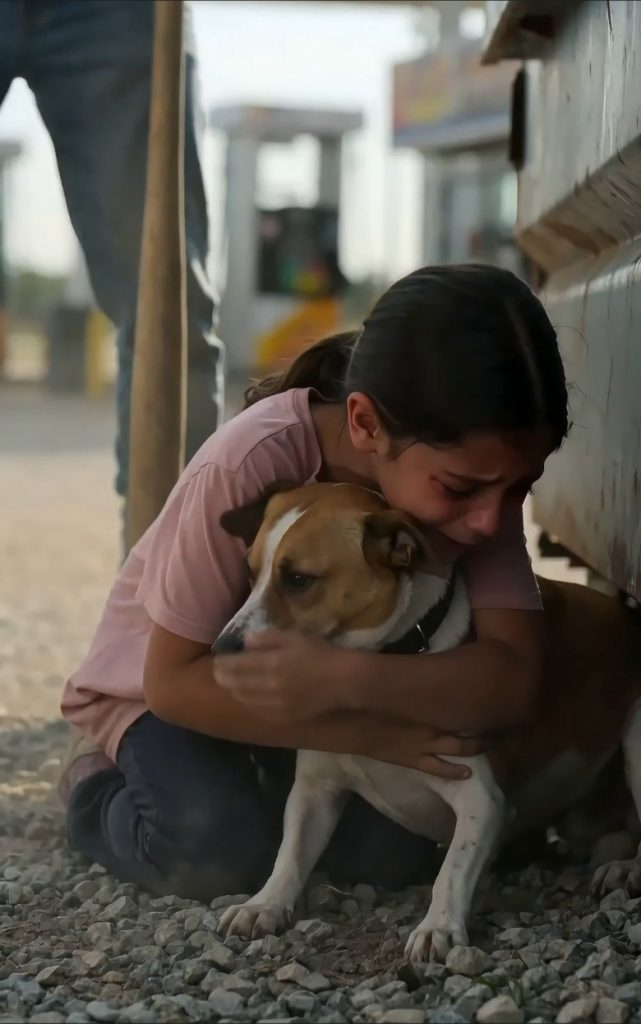
She was small, no older than eight, with dark hair pulled into a messy ponytail and an oversized pink T-shirt flapping around her knees. She sprinted across the gravel so fast she nearly fell, then dropped between the men and the dog.
“No!” she screamed.
Her knees hit the ground hard, but she didn’t stop. She wrapped both arms around the dog’s neck and shoulders, shielding the animal with her own body.
The dog pressed into her chest, shaking.
“Stop hurting her!” the girl sobbed. “Please, she’s not just one life.”
The men froze.
Not out of remorse.
Out of annoyance.
The one with the stick sneered. “Move, kid.”
The girl shook her head, tears running in two clean lines down her red cheeks.
The gray-shirted man tightened his grip on the stick. “I said move.”
A slow bootstep crunched behind them.
Everyone turned.
A biker walked in from the gas pumps.
He was middle-aged, broad through the shoulders, wearing a black leather vest over a black T-shirt, faded jeans, and boots dusty from the road. Patches covered the vest. One read BORG. Another, smaller and worn at the edges, read F.A.
He did not rush.
He did not shout.
He stopped a few steps away, eyes moving from the crying girl to the trembling dog to the sticks in the men’s hands.
“Fellas,” he said calmly, “that’s enough.”
The man in gray pointed the stick at him.
“Mind your own business, biker.”
The biker looked at the little girl again.
Then at the dog’s swollen belly, half-hidden beneath the girl’s arms.
His face changed.
Not with surprise.
With recognition.
And the men in the gravel lot had no idea they had just cornered the wrong dog.
Act II
The little girl’s name was Ava Brooks, and she had learned to love quietly.
She loved quietly because loud things got taken.
Her mother’s songs had been loud once. Her laughter too. Before the hospital, before the unpaid bills, before the landlord changed the locks on the small house with the yellow porch.
After that, Ava and her grandmother moved into a rented room behind the Quick Stop, where Grandma June worked the morning register and slept in a folding cot near the stockroom because rent was cheaper when dignity was already gone.
Ava didn’t complain.
She had her backpack. Her library books. A cracked tablet that only worked when it was plugged in. And behind the dumpster, she had found Honey.
Honey was a small tan-and-white dog with frightened eyes and a tail that wagged like it wanted permission. She first appeared near the gas station in late spring, thin and wary, circling the dumpster after closing time.
Ava started leaving pieces of biscuit under a broken crate.
By the third week, Honey let her sit nearby.
By the fifth, Honey followed her to the back door.
Grandma June said they couldn’t keep a dog.
Then Honey rested her chin on Ava’s shoe and sighed.
Grandma June closed her eyes.
“One night,” she said.
That was three months ago.
Honey slept under Ava’s cot now. She barked when strangers came too close to the stockroom. She pressed against Grandma June’s legs when the older woman’s hands ached too badly to hold the coffee pot.
Then, one morning, Ava noticed Honey’s belly had changed.
Grandma June took one look and whispered, “Oh, Lord.”
Puppies.
To Ava, that word was a miracle.
To the gas station owner, Mr. Danner, it was a problem.
He owned the Quick Stop, the gravel lot, the dumpster, the room behind the stockroom, and, as he liked to remind people, the right to decide what stayed on his property.
“No strays,” he told Grandma June. “Especially not a pregnant one. Customers don’t like filth.”
“She’s not filth,” Ava said.
Mr. Danner looked down at her like she was a stain on the floor.
“She’s not yours either.”
That morning, he told Grandma June he had called animal control.
But Ava had heard the truth from behind the soda crates.
He hadn’t called animal control.
He had called his nephews.
“Handle it before inspection,” he told them. “I don’t want that mutt around when the buyers come through.”
Buyers.
That was another word Ava had learned to fear.
The Quick Stop was being sold to a chain. New signs. New pumps. New management. No rented back room. No Grandma June at the register. No Ava doing homework beside the mop bucket.
No Honey.
Ava had been inside stocking napkins when she heard the first yelp.
She ran.
She did not think about the men being bigger. She did not think about the stick. She did not think about how badly gravel would hurt when she hit it.
She only thought of Honey’s belly.
Not just one life.
That was what she meant.
Not just a dog.
Not just a stray.
Not just something inconvenient beside a dumpster.
Honey was carrying a future.
And Ava, who had already watched too much disappear, was not going to let anyone take that too.
Act III
The biker’s name was Cole Maddox.
Most people on the highway knew him as Maddox, because bikers rarely needed first names twice.
He rode with a small club called the Fallen Angels, though the patch on his vest had been misunderstood for years by people who didn’t know what they actually did.
They weren’t outlaws.
They were rescuers.
Old soldiers. Mechanics. Retired deputies. Truckers. Men and women who had seen too much cruelty and decided to become the kind of people who showed up when softer voices were ignored.
They escorted kids to court. Delivered food to shelters. Pulled animals from roadside ditches. Stood outside homes when abusers threatened to return.
And once, five years earlier, they had rescued a dog from a storm drain outside a truck stop.
A tan-and-white little dog with terrified eyes.
Cole’s wife, Maria, had named her Honey.
Honey became the club’s mascot, though Maria hated that word.
“She’s family,” Maria said.
When Maria got sick, Honey never left her side. After Maria died, Honey stopped eating for two days. Cole slept on the floor with her until she finally rested her head on his chest and stayed.
Then, six months later, Honey vanished.
A gate left open during a thunderstorm. A frantic search. Flyers across four counties. Calls to shelters. Posts online. Nothing.
Cole blamed himself in the quiet way grieving men do, turning guilt into a private room and locking himself inside.
For nearly a year, he had looked at every tan-and-white dog he passed.
Then, on a bright, ordinary afternoon, he stopped at the Quick Stop for gas.
And heard a child scream.
Now he stood in the gravel lot, staring at the dog pressed against the little girl’s pink shirt.
Honey was thinner. Dusty. Frightened.
But it was her.
The white blaze between the eyes. The small notch in one ear. The heart-shaped tan patch on her left shoulder.
Cole’s breath left him.
“Honey?”
The dog’s head lifted.
Her trembling did not stop, but her eyes changed.
Recognition moved through her body before courage did.
Her tail thumped once against the gravel.
Ava looked up at the biker, stunned through her tears. “You know her?”
Cole swallowed hard.
“Yeah,” he said. “I know her.”
The gray-shirted man scoffed. “Great. Take the mutt and get out.”
Cole did not look at him.
He crouched slowly, keeping his hands visible, and held one palm toward Honey.
She whined.
Ava tightened her arms, afraid he would take her too.
Cole saw that.
“I’m not taking her from you,” he said gently.
Ava’s chin trembled. “They were hurting her.”
“I saw enough.”
The man with the stick stepped forward. “You didn’t see anything.”
Cole stood.
The warmth vanished from his face.
“No,” he said. “I saw two grown men attacking a pregnant dog while a child had to do what you were too cowardly to do.”
The second man raised his stick slightly.
Cole’s eyes flicked to it.
“Think carefully,” he said.
The man froze.
Behind Cole, three motorcycles rolled off the highway and into the lot.
Then two more.
Then another.
The Fallen Angels had been riding behind him, spread out along the road.
Now they arrived one by one, engines rumbling low, forming a line between the gas pumps and the gravel lot.
The gray-shirted man’s confidence drained visibly.
Ava looked from the bikers to Honey, then back to Cole.
“Is she really yours?” she whispered.
Cole looked down at the dog, and grief softened him again.
“She was,” he said. “But it looks like she found you when she needed someone.”
Ava buried her face against Honey’s neck.
“I love her.”
Cole nodded.
“I can tell.”
And that was the moment the owner of the Quick Stop stepped out of the back door.
Act IV
Mr. Danner came out angry because he expected everyone to be afraid of him.
He was a square man with a red face, a white polo shirt, and keys clipped to his belt. He stopped when he saw the motorcycles.
Then he saw Cole.
Then the girl in the gravel.
Then his nephews holding sticks.
His expression shifted quickly, trying to rearrange the scene into something that did not make him look responsible.
“What’s going on?” he demanded.
Ava flinched at his voice.
Cole noticed.
So did every biker in the lot.
The gray-shirted nephew pointed at Honey. “We were just clearing out the stray like you said.”
Danner’s face went pale.
The words hung in the air.
Cole turned slowly toward him.
“Like he said?”
Danner forced a laugh. “That’s not what he means.”
A woman’s voice cut in from behind the pumps.
“It’s exactly what he means.”
Grandma June stood there in her Quick Stop vest, one hand gripping the side of the ice machine for support. She had come out when she saw the bikes, moving slower than fear wanted her to but faster than her aching joints allowed.
“Ava,” she called.
“I’m okay,” Ava sobbed. “Honey’s hurt.”
June’s face twisted.
She started toward them, but Cole lifted a hand gently.
“We need a vet,” he said.
One of the bikers behind him was already on the phone.
Danner stepped forward. “No one’s calling anybody. This is private property.”
Cole looked around at the gas pumps, the highway, the customers now gathering near their cars.
“Public enough.”
Danner lowered his voice. “You don’t want trouble with me.”
Cole’s smile was cold.
“Man, trouble is why I stopped.”
The first police cruiser arrived six minutes later.
Animal control followed.
Then a local news van, because one of the customers had started recording the moment Ava threw herself over Honey, and the clip had already begun moving through the town faster than anyone could stop it.
Danner tried to talk over everyone.
He said the dog was dangerous.
Honey whimpered and pressed her face under Ava’s arm.
He said Ava was dramatic.
The video showed otherwise.
He said his nephews acted on their own.
The gray-shirted nephew immediately said, “You told us to do it.”
The second one nodded too fast.
Cowards often turn honest when consequences arrive.
A vet tech checked Honey right there on the gravel with careful hands. Ava refused to let go until Cole knelt beside her.
“Sweetheart,” he said, “they need to help her.”
Ava shook her head. “What if they take her?”
Cole glanced at June, then at the vet tech, then at Honey.
“No one is throwing her away again,” he said.
That word hit him harder than he expected.
Again.
Honey lifted her head and licked his wrist.
Cole closed his eyes for half a second.
Police took statements. The sticks were bagged. Danner’s nephews were cited and later charged. Danner himself was escorted inside to turn over security footage from the back lot, which showed far more than he wanted anyone to see.
It showed him pointing toward Honey.
It showed him handing one nephew cash.
It showed Ava running into frame.
It showed a child doing what every adult should have done first.
When the vet team lifted Honey onto a stretcher, Ava walked beside her, still crying.
Cole walked on the other side.
Grandma June followed them to the ambulance van, wiping her face with a napkin from her uniform pocket.
“She saved that dog,” June whispered.
Cole looked at Ava.
“No,” he said. “They saved each other.”
Act V
Honey had five puppies before dawn.
The vet clinic was small, bright, and smelled like disinfectant, coffee, and wet leather because half the Fallen Angels had refused to leave the parking lot. They stood outside under the security light, helmets tucked under their arms, quiet as church.
Inside, Ava slept in a waiting room chair with her head on Grandma June’s lap.
Cole sat across from them, elbows on his knees, staring at his hands.
At 4:17 in the morning, the vet came out smiling.
“She’s tired,” she said. “But she did it.”
Ava woke instantly.
“All of them?”
“All five.”
Ava burst into tears again, but these were different.
Relief tears.
The kind that wash fear out instead of adding to it.
When they let her see Honey, the little dog lifted her head from the blanket nest. Five tiny puppies squirmed against her belly, blind and soft and alive.
Ava pressed both hands to her mouth.
Cole stood in the doorway.
For one second, the room disappeared and he saw Maria sitting on their old kitchen floor, holding Honey’s face between both hands.
She was always meant to find somebody who needed her, Maria had once said.
Cole had thought Honey needed saving.
Maybe she had.
But so did the little girl kneeling beside her now.
The story spread quickly.
The video of Ava shielding Honey made the local news by evening. People were outraged in the way people often are when cruelty becomes visible enough to make ignoring it impossible.
Donations poured into the vet clinic. Food. Blankets. Puppy pads. Money for Honey’s care.
Mr. Danner lost the sale of the Quick Stop within forty-eight hours. The buying company released a statement about “values,” which Cole found hilarious, but useful. More importantly, state inspectors came after former employees spoke up about Danner letting Grandma June and Ava sleep in the stockroom while deducting rent from her paycheck.
By the end of the week, Danner no longer owned the Quick Stop.
By the end of the month, Grandma June had a different job at a grocery store where the manager did not shout at her for sitting during slow hours.
The Fallen Angels helped move their things into a small duplex behind a church.
A real room for June.
A real room for Ava.
A small fenced yard.
And, after long conversations, papers, tears, and one very serious promise from Ava that she would scoop every mess forever, Honey came home with them.
Cole kept visitation rights.
Ava insisted on that phrase because she heard the vet say it as a joke and liked how official it sounded.
Every Saturday, Cole arrived on his motorcycle with a bag of dog food strapped to the back and a box of donuts for Grandma June. He never came empty-handed, though June told him he did not have to bring anything.
He always said the same thing.
“I know.”
Then he brought it anyway.
The puppies grew fast.
Ava named them Biscuit, Button, Rocket, Daisy, and Maria.
Cole had to step outside when she told him the last name.
Ava followed after a minute, small hands folded nervously in front of her.
“Was that bad?”
Cole shook his head.
His eyes were wet.
“No,” he said. “That was beautiful.”
“She was your wife?”
“Yeah.”
“Did she love Honey?”
Cole looked through the window at the tan-and-white dog curled around her puppies while Grandma June pretended not to spoil them.
“She loved everybody who needed a second chance.”
Ava thought about that.
“Then she would’ve liked us.”
Cole smiled.
“She would’ve loved you.”
Months later, the gravel lot behind the Quick Stop looked different.
The dumpster had been moved. The security camera fixed. A sign near the gas pumps read: REPORT ANIMAL ABUSE. DO NOT LOOK AWAY.
The new owner put it there after Cole suggested it with the kind of politeness that did not feel optional.
Ava visited once with Honey on a leash.
The dog stopped near the place where it happened.
For a moment, her body lowered.
Ava noticed immediately.
“It’s okay,” she whispered, kneeling beside her. “You’re not there anymore.”
Honey leaned into her.
Cole stood a few feet away, watching the child comfort the dog she had once shielded with her body.
He thought about how bravery rarely looked the way people imagined. It wasn’t always loud. It wasn’t always strong. Sometimes it was a sobbing little girl in an oversized pink T-shirt, kneeling on sharp gravel because something helpless needed her more than fear could stop her.
Ava looked up at him.
“Do you think I was stupid that day?”
Cole frowned. “No.”
“Grandma says I could’ve gotten hurt.”
“You could have.”
Ava looked down.
“But Honey was getting hurt.”
Cole crouched so they were eye level.
“Being brave doesn’t mean running into danger because you don’t understand it,” he said. “It means knowing something is wrong and refusing to become the kind of person who watches.”
Ava nodded slowly.
Then Honey tugged the leash toward the car, done with old memories.
Ava smiled.
“Come on, girl,” she said. “Let’s go home.”
Honey trotted beside her, tail high now, no longer the trembling dog curled beneath a dumpster.
Behind them, the highway hummed. Sunlight flashed across the gas station windows. Gravel crunched under small sneakers, biker boots, and four careful paws.
The place still looked ordinary.
That was the frightening part.
Cruelty often happens in ordinary places. Behind gas stations. Beside dumpsters. Under bright skies while people walk past with drinks in their hands and excuses in their mouths.
But so does mercy.
Sometimes it arrives on a motorcycle.
Sometimes it arrives in the shaking arms of a child.
And sometimes, when the world calls one small life worthless, a little girl holds on tighter and reminds everyone watching that love knows how to count better than cruelty ever will.