Act I
The only thing standing between the axe and the child was a white dog.
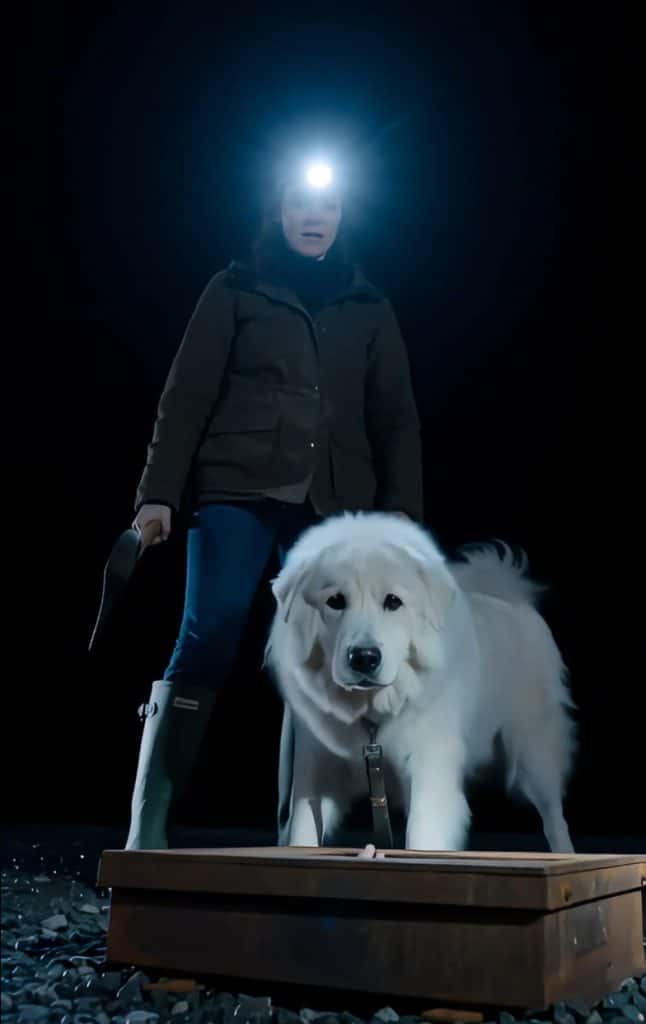
He was huge, soaked with night mist, his thick fur glowing under the woman’s headlamp like a ghost in the dark. Gravel shifted under his paws as he lowered his body in front of the rusty metal box, teeth bared, collar pulled tight by the leash tied to the handle.
Inside the box, something moved.
A small pale hand slipped through a narrow opening.
Tiny fingers trembled in the cold.
The woman with the axe took another step forward.
Her green rubber boots crushed the gravel slowly. Deliberately. The bright lamp strapped to her forehead hid her eyes and turned her face into a hard shadow.
“Move,” she said.
The dog growled.
From somewhere off in the darkness, another woman screamed, “Don’t move closer!”
But the woman with the axe did not stop.
She adjusted both hands around the wooden handle and lifted the blade slightly from her side. The metal caught the beam of her headlamp, flashing white for one terrible second.
The dog’s leash jerked against the metal box.
He could not retreat even if he wanted to.
But he did not want to.
He barked once, deep and furious, lunging as far as the tether allowed. The box scraped over the gravel behind him with a hollow metallic shriek.
From inside, the child made a tiny sound.
The dog turned instantly, lowering his head to the crack.
His growl softened into a whine. His wet nose touched the child’s fingers. The hand curled weakly against his muzzle.
Then the woman raised the axe higher.
“Last chance,” she whispered.
The dog looked up.
His whole body went rigid.
He knew what was coming.
And still, he stayed.
Act II
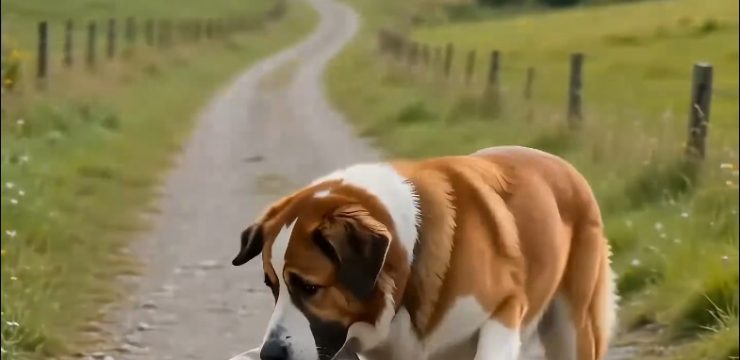
The dog’s name was Bear, though he had been small when Emma Reed named him.
Small for a Great Pyrenees, at least. A round white puppy with clumsy paws, sleepy eyes, and no understanding that he would one day grow into a creature strong enough to pull a grown man off balance.
Emma had been seven when her father brought him home.
“He’s not a toy,” her father warned.
Emma nodded solemnly. “He’s a brother.”
Her father laughed then.
That was before the accident. Before the funeral. Before people began speaking in lowered voices about custody and property and whether Emma’s mother could manage the old farm alone.
Bear became more than a dog after that.
He slept outside Emma’s door. Walked with her to the bus stop. Stood between her and strangers without being taught. When she cried into his fur, he stayed as still as a mountain.
Emma’s mother, Claire, used to say Bear had been born with an old soul.
“He knows who needs guarding,” she said.
For years, the farm survived on stubbornness.
Claire worked the orchard, sold eggs, rented out pasture, and kept the place together with wire, prayer, and exhaustion. Emma grew up quick, the way children do when grief and chores both wake before sunrise.
Then Claire’s older sister came back.
Marla Vance arrived with a suitcase, a sharp haircut, and concern that felt too rehearsed. She said she only wanted to help. She cooked, cleaned, drove Claire to appointments, and told everyone in town that her sister was too proud to admit she was drowning.
At first, Claire was grateful.
Then things began disappearing.
Bank statements. Insurance documents. The deed to the lower pasture. Letters from the county. Medication bottles that ran out too fast.
When Claire questioned her, Marla cried.
When Emma questioned her, Marla smiled.
“You’re a child,” she said. “You don’t understand adult problems.”
But Bear understood something.
He stopped letting Marla near Emma’s room.
He growled when she entered the barn.
He once stood in front of Claire’s desk and refused to move until Emma looked inside the drawer and found a forged signature form half-hidden beneath tax receipts.
That was when Claire called a lawyer.
That was also when Marla stopped pretending.
The night everything changed, Emma was not supposed to be outside.
A storm had rolled in after sunset, and Claire had gone to meet the lawyer in town with a folder of proof. Emma stayed home with Bear, watching cartoons with the lights low.
Then she heard the back door open.
Marla stood in the kitchen wearing a dark jacket, green rubber boots, and a headlamp.
Behind her was a man Emma didn’t recognize.
“Where’s the folder?” Marla asked.
Emma ran.
Bear went with her.
Across the yard. Past the barn. Toward the old gravel lot behind the machine shed, where her father had once stored tools and rusted equipment he always swore he would fix.
Emma knew the hiding places there.
She knew the old industrial box with the broken latch.
She climbed inside because she was small enough.
Bear stayed outside because he was not.
Marla found them ten minutes later.
By then, Bear’s leash had caught around the box handle. Emma had looped it there herself, thinking she could keep him close.
She did not know she had tied her guardian to the place where she was trapped.
And Marla had brought an axe.
Act III
Claire Reed reached the gravel lot too late and exactly in time.
She came running through the dark with one shoe missing, phone still connected to emergency dispatch, lungs burning from the sprint across wet grass and mud. The lawyer’s office had been closed when she arrived in town. The call had been a trick. A delay.
By the time she realized that, Emma was not answering her phone.
Claire drove home so fast she barely remembered the road.
Now she stood at the edge of the headlamp glow, soaked and shaking, watching her sister raise an axe over the dog who had once slept at the foot of her daughter’s bed.
“Marla,” Claire said, voice breaking. “Put it down.”
Marla did not turn.
“Stay back.”
“My daughter is in there.”
“I know where she is.”
The words were calm.
That was what made them monstrous.
Bear barked again, a raw warning that echoed off the metal walls of the shed. His front paws slid in the gravel as he pulled against the leash. The box scraped another inch.
Emma’s hand vanished back into the darkness.
Claire could hear her crying now.
Not loudly.
Emma had always tried to be brave.
That almost destroyed Claire.
“Emma,” she called, forcing her voice to stay steady, “baby, I’m here.”
A small sob came from inside the box.
Marla’s headlamp snapped toward Claire, blinding her.
“She ruined everything,” Marla said.
“She’s a child.”
“She saw too much.”
Claire took one slow step forward.
Bear’s growl deepened, but not at her.
At Marla.
The axe lowered slightly as Marla shifted her stance.
“You think I wanted this?” she said. “You think I wanted to spend years cleaning up after you while you sat on land you couldn’t even afford?”
Claire’s face tightened.
“So that’s what this is.”
Marla laughed once. “Don’t act surprised. That farm was dying. I found a buyer. I found a way out.”
“You forged my name.”
“I saved us.”
“You stole from us.”
Marla’s jaw clenched.
The headlamp beam shook.
For the first time, Claire saw fear under the anger.
Not fear of guilt.
Fear of consequences.
The dispatcher’s voice crackled from Claire’s phone on the gravel.
“Ma’am, officers are approaching the property. Keep distance if there is a weapon present.”
Marla heard it.
Her whole body stiffened.
Police lights flickered faintly through the trees beyond the orchard road.
Red.
Blue.
Far, but coming.
Marla looked at the box.
Then at Bear.
Then at the axe.
Claire understood before she moved.
Marla wasn’t trying to open the box.
She was trying to destroy the only witness who had kept Emma alive long enough for help to come.
Act IV
Claire screamed.
Bear lunged.
Marla swung the axe downward, not with the clean force of someone in control, but with the panic of someone watching her lies collapse.
The blade struck the metal edge of the box instead of the dog.
The impact rang through the gravel lot like a bell.
Bear recoiled but did not run. The leash held him close. He barked and drove his body forward again, forcing Marla to step back.
Claire threw herself toward the box.
“Emma!”
The child’s hand appeared again.
Claire grabbed it.
Small. Cold. Real.
“I’ve got you,” she sobbed. “I’ve got you.”
Marla raised the axe a second time.
A shout cut through the dark.
“Drop it!”
A deputy burst into the headlamp glow, weapon drawn but steady, another officer right behind him with a flashlight fixed on Marla’s hands.
“Drop the axe now!”
Marla froze.
For one long second, everyone stood trapped inside the same circle of light.
Claire on her knees at the box.
Emma’s hand clutched in hers.
Bear between them and Marla, chest heaving, fur streaked with mud and rain.
The axe trembled above Marla’s shoulder.
Then Bear barked once more.
Marla flinched.
The axe fell from her hands and hit the gravel with a heavy thud.
The officers moved fast.
One pulled Marla back. The other kicked the axe away and knelt beside Claire.
“Can she breathe?”
“Yes,” Claire cried. “She’s stuck. The latch is jammed.”
The deputy called for rescue tools.
Bear whined and shoved his nose through the opening beside Emma’s hand. Inside the box, the girl’s fingers curled weakly into his fur.
“Bear,” Emma whispered.
The dog went still.
His entire body softened around that one word.
Claire pressed her forehead to the rusted metal.
“Talk to me, baby.”
“It’s dark,” Emma cried.
“I know.”
“I tried to keep Bear with me.”
“You did,” Claire said, tears running down her face. “You kept him close.”
The fire department arrived minutes later, though to Claire it felt like hours. Men in heavy coats and helmets moved under portable lights, cutting through the rusted latch with a shriek of metal that made Bear bark until Emma whispered his name again.
The door opened.
Emma tumbled into her mother’s arms wrapped in dust, fear, and freezing air.
Claire held her so tightly the child gasped.
“I’m sorry,” Claire said over and over. “I’m sorry. I’m sorry.”
Emma shook her head against her mother’s shoulder.
“Bear didn’t leave.”
“No,” Claire whispered, looking at the white dog standing beside them, still blocking Marla even though officers had her restrained. “He didn’t.”
A firefighter crouched and unclipped Bear’s leash from the box handle.
The moment he was free, Bear pressed his huge head against Emma’s chest.
She wrapped both arms around his neck.
And for the first time that night, the dog stopped shaking.
Act V
Marla Vance confessed in pieces.
Not out of remorse.
Out of exhaustion.
The forged documents were found in her truck, hidden beneath a tarp. The missing bank statements were in a locked case behind her seat. The buyer’s contract for the lower pasture had already been signed by someone pretending to be Claire.
The man Emma saw in the kitchen was arrested two counties away before sunrise.
He had been paid to scare Claire into signing everything over after Marla claimed the farm was already lost. When Emma saw him taking the folder from Claire’s desk, panic turned the scheme into something worse.
Marla tried to say she never meant to hurt Emma.
Claire did not answer when officers told her.
Some lies are too ugly to deserve a response.
Emma spent the night at the hospital for observation. She was cold, scraped, and terrified, but safe. Bear was treated by a veterinarian in the parking lot because he refused to leave the back of the ambulance until Emma herself told him to go.
Even then, he watched the hospital doors until she came out the next morning.
News spread fast through the county.
People brought casseroles. Flowers. Dog treats. Fence repair offers. Apologies for not noticing how much control Marla had taken over Claire’s life.
Claire accepted the help she needed.
She did not accept every apology.
Trust, once rusted through, does not open just because someone knocks.
The farm stayed hers.
The lawyer filed emergency protections before Marla’s associates could move another paper. The bank froze the suspicious transfers. The county sheriff’s office opened a wider investigation into forged property sales targeting grieving families and elderly landowners.
What began in the gravel lot did not end there.
It pulled up roots.
Names.
Signatures.
Quiet thefts dressed as family help.
But Emma cared mostly about the box.
For weeks, she refused to go near the machine shed. She slept with the hallway light on and Bear stretched across her bedroom doorway like a white wall of fur and breath.
Claire slept in the room with her at first.
Then on the floor.
Then in the hallway.
Healing moved slowly, the way dawn moves across winter fields.
A little light.
Then more.
One morning, Emma woke before school and found Bear sitting beside the kitchen door, staring toward the gravel lot.
She stood beside him.
“I don’t want it there,” she said.
Claire, pouring coffee with tired hands, turned.
“The box?”
Emma nodded.
Claire called the scrap yard that afternoon.
When the truck came, Emma insisted on watching from the porch. Bear sat beside her, calm but alert, as two men loaded the rusted metal box and hauled it away.
It scraped the gravel one last time.
Emma flinched.
Bear leaned his whole body against her.
She did not cry.
That night, Claire lit a fire in the living room, and Emma took the old leash that had tethered Bear to the box. She held it for a long time.
“I tied him there,” she whispered.
Claire sat beside her.
“You were trying to keep him safe.”
“But he couldn’t run.”
“No,” Claire said softly. “He chose not to.”
Emma looked at Bear sleeping near the hearth.
The dog opened one eye, as if he knew he was being discussed.
Emma smiled faintly.
“What should we do with it?”
Claire thought for a moment.
Then she brought out her father’s old hammer and a small brass hook.
Together, they hung the leash by the front door.
Not as a memory of the box.
As a memory of what Bear had done there.
Underneath, Claire placed a little wooden sign Emma painted herself.
BEAR’S PLACE.
Months passed.
The orchard bloomed white in spring. The lower pasture stayed untouched. Claire hired two neighbors to help with repairs and finally learned to ask for help before desperation made choices for her.
Emma returned to school. Slowly. With Bear walking her to the bus stop every morning and waiting there every afternoon like a guardian carved from snow.
Children asked if he was famous.
Emma shrugged.
“He’s Bear.”
That was enough.
On the first warm night of summer, Claire and Emma walked out to the gravel lot after dinner. The shed had been cleaned. The broken tools removed. New lights installed along the wall. Where the box once sat, Claire had placed a raised garden bed.
Emma planted sunflowers there.
Bear sniffed the soil, sneezed, and lay down beside it like he had been assigned permanent watch.
Emma knelt and pressed a seed into the dirt.
“Do you think flowers can grow here?” she asked.
Claire looked at the place where fear had once stood in a circle of headlamp light.
Then at her daughter.
Then at the dog who had refused to move even when the axe rose above him.
“Yes,” she said. “I think they can.”
By late August, the sunflowers were taller than Emma.
Their yellow faces turned toward the morning light, bright and stubborn, growing from the same gravel where Marla had tried to bury the truth.
People who visited the farm always noticed them.
Some asked why they were planted there.
Emma usually answered simply.
“Because Bear guarded that spot.”
And if they asked what he guarded, she would look toward the house, where Claire worked at the kitchen table and Bear slept beneath the window with one ear always listening.
Then Emma would say, “Me.”
No more.
No less.
Because the whole story was too large for strangers.
The darkness. The axe. The rusted box. The hand reaching out.
The dog who knew that love is not always soft.
Sometimes love growls.
Sometimes love plants its paws in gravel.
Sometimes love looks up at a raised blade, hears the word “move,” and refuses.
Not because it is fearless.
Because something smaller is behind it.
And that is all the reason courage needs.