Act I
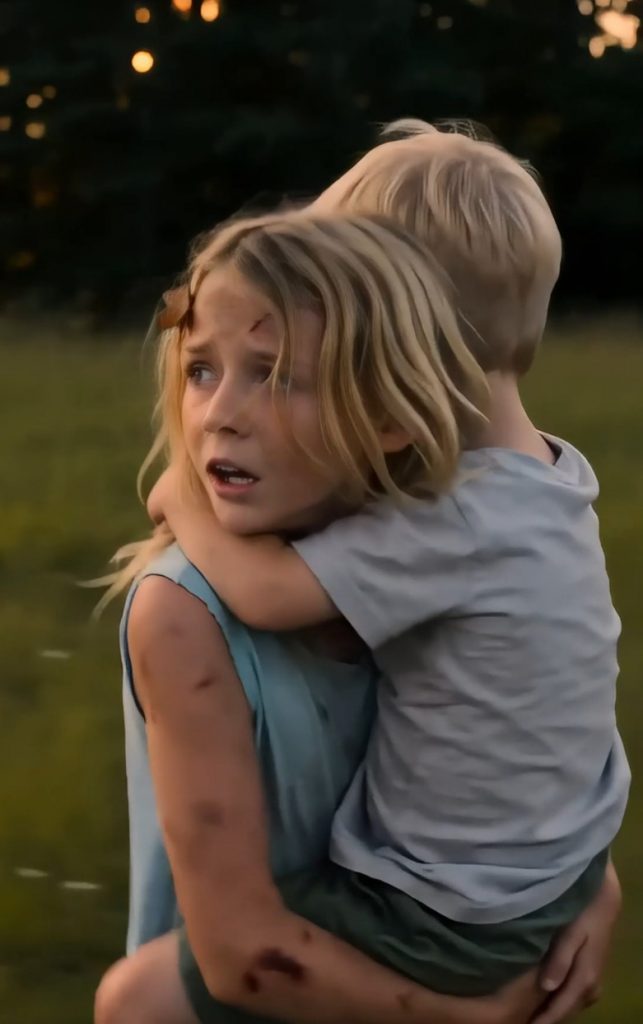
The sun was sinking behind the trees when the little girl came out of the forest carrying the boy.
At first, Elsie Ward thought she was seeing a shadow.
The field behind her cottage often played tricks at sunset. The tall grass moved in waves. Deer crossed near the treeline. Sometimes the low orange light made tree branches look like arms reaching out of the dark.
But this was no deer.
This was a child.
Barefoot.
Stumbling.
Carrying another child against her chest.
Elsie stood frozen behind the kitchen window, one hand still around her teacup.
The girl could not have been older than nine. Her blonde hair was tangled, with a dry oak leaf caught near her cheek. Dirt streaked her arms and legs. Her light blue shirt was torn at one shoulder, and her small face was twisted with exhaustion.
The toddler in her arms barely moved.
Elsie dropped the cup.
It shattered in the sink.
By the time she reached the front door, the girl was already on the porch, knocking with the last strength in her body.
Not a proper knock.
A desperate little fist striking wood again and again.
Elsie pulled the door open.
The girl stood there swaying, eyes wide and wet, the toddler’s head resting heavily against her shoulder.
For one terrible second, neither of them spoke.
Then Elsie gasped, “Where did you come from?”
The girl looked back over the field.
Beyond the golden grass, the treeline had gone nearly black.
Something moved there.
Maybe wind.
Maybe not.
The girl turned back to Elsie, lips trembling.
“Help us,” she breathed. “They’re coming after us.”
Elsie did not ask who.
She stepped aside and pulled them in.
The girl crossed the threshold and collapsed to her knees, still trying to keep the toddler from hitting the floor. Elsie caught him first, then gathered both children into the warm hallway while her old heart hammered against her ribs.
“Lock the door,” the girl whispered.
Elsie locked it.
“Please,” the child said. “The back one too.”
Elsie moved faster than she had in twenty years.
She locked the kitchen door. Pulled the curtains. Turned off the front porch light. Then she came back to find the girl kneeling beside the toddler, brushing his hair from his forehead with shaking fingers.
“Ben,” the girl whispered. “Wake up. We made it.”
The toddler gave a weak little sound.
Elsie knelt beside them. “What’s your name, sweetheart?”
The girl’s eyes lifted.
For the first time, Elsie saw their color.
Pale blue.
Painfully familiar.
“My name is Hannah,” she said. “Hannah Mercer.”
Elsie stopped breathing.
Mercer.
The name struck her like a door flying open in a room she had kept locked for years.
Outside, somewhere beyond the field, a branch snapped.
Hannah flinched.
Elsie looked toward the dark window.
Because now she knew one thing for certain.
Those children had not found her house by accident.
Act II
Twenty-two years earlier, Elsie had worked for the Mercer family.
Not as a servant, though some people in town said the word anyway.
She had been a housekeeper, a cook, a nurse when fevers came, a driver when school buses broke down, and sometimes the only person in that big stone house who knew when a child was crying behind a locked bedroom door.
The Mercers owned half the land beyond the north ridge.
Timber. Orchards. Old rental cottages. A private lake no one outside the family had ever been allowed to swim in.
But money had never made that house warm.
Only one person had.
Clara Mercer.
She was seventeen when Elsie first met her. Wild blonde hair. Blue eyes. A laugh too big for the rules around her. Clara was the kind of girl who fed barn cats from china saucers and hid injured birds in her bathroom until they healed.
Years later, Clara ran away from the estate with a mechanic named Daniel Reed.
Her father disowned her.
Her brother Julian called her selfish.
Elsie sent money secretly for months.
Then Clara wrote one letter back.
I am safe. I have love. That is more than I ever had in that house.
After that, years passed.
Elsie left the Mercer estate when her knees got bad and bought the small wooden cottage at the edge of the old field. She stayed away from the family. She heard rumors, of course. Everyone did.
Clara came back after her husband died.
Clara had a daughter.
Clara’s father changed his will.
Clara died suddenly before the papers were finalized.
Then Julian Mercer took over everything.
Elsie had not seen the child.
Not once.
But now Hannah Mercer was sitting on her hallway floor with Clara’s eyes, holding a toddler as if the world had already tried to take him.
Elsie moved gently. “Is Ben your brother?”
Hannah nodded.
“How old is he?”
“Two.”
“Are you hurt?”
Hannah shook her head too quickly.
Elsie did not push. She brought towels, water, a blanket warmed by the old radiator. She checked the toddler’s breathing and pressed two fingers carefully to his wrist.
Weak.
But steady.
“What happened?” Elsie asked.
Hannah looked toward the curtained window.
“They said Mom lied,” she whispered. “They said this wasn’t our home anymore.”
Elsie went still.
“Who said that?”
“Uncle Julian.”
The name brought cold into the room.
Hannah swallowed. “After Mom got sick, he moved us to the lodge in the woods. He said it was temporary. He said the big house needed repairs.”
Elsie already hated the rest before she heard it.
“At first, there was a nanny. Then she stopped coming. Then the phone disappeared. Uncle Julian said Ben and I were going to a better family because Mom was gone and nobody wanted us.”
Elsie’s jaw tightened.
Hannah’s hand trembled on Ben’s back.
“But Mom told me something before she died. She said if anything ever felt wrong, run toward the sunset across the west field. She said there was a woman in a wooden house who would know her name.”
Elsie closed her eyes.
Clara.
Even after all those years, Clara had remembered.
Hannah’s voice dropped.
“Tonight I heard them talking. Uncle Julian and a man in a black coat. They said the papers could not be signed until we were gone.”
Elsie opened her eyes.
“What papers?”
Hannah reached into the waistband of her shorts with shaking fingers and pulled out a folded envelope, damp at the edges and smudged with dirt.
“I took this from his desk.”
Elsie unfolded it.
At the top was the Mercer family crest.
Beneath it were legal pages, signatures, and a stamped petition to declare Hannah and Ben missing dependents presumed abandoned by their deceased mother.
Elsie read just enough to understand.
If the children vanished, Julian inherited everything.
If they were alive, he did not.
Outside, a car engine growled faintly beyond the trees.
Hannah grabbed Elsie’s arm.
“They found us.”
Act III
Elsie did not panic.
Old women are often mistaken for fragile things.
People see gray hair, slow steps, thin hands, and assume fear has made a home there.
But Elsie Ward had survived a violent husband, buried two sons, nursed dying strangers, and once walked through a blizzard to bring medicine to a child no doctor could reach. Panic was for people who had time to waste.
She picked up the phone.
No signal.
The storm three nights earlier had taken the landline down again.
Her cell phone showed one bar, then none.
“Of course,” she muttered.
Hannah stared at her. “What do we do?”
Elsie looked at the children, the letter, the darkening windows.
Then she moved.
She carried Ben into the pantry off the kitchen, where shelves of canned peaches, flour, and old jars lined the walls. At the back was a low door hidden behind a hanging quilt.
“My husband built this during the war,” Elsie said. “I used to laugh at him for it.”
She opened it to reveal a small crawlspace with blankets, a flashlight, and an old battery radio.
Hannah’s eyes widened.
“You’re hiding us?”
“I’m keeping you safe.”
Hannah shook her head. “No. I can help.”
“You already did.”
“But—”
Elsie touched her cheek softly. “Your mother trusted me. Now you trust me.”
That almost broke the girl.
She crawled inside with Ben, still holding his hand. Elsie gave her water and the flashlight.
“Do not come out unless I call you by your full name,” Elsie said. “Hannah Clara Mercer. Understand?”
Hannah nodded.
Elsie closed the hidden door.
Then she went to the kitchen, wiped the children’s muddy prints from the floor as best she could, and placed the legal papers beneath the loose board under her sink.
Headlights swept across the curtains.
A car stopped outside.
Two doors closed.
Elsie picked up the kettle from the stove and poured hot water into a cup as if she had been expecting company.
The knock came hard.
Three sharp strikes.
Elsie opened the door with the chain still latched.
Julian Mercer stood on her porch.
He was tall, polished, and dressed for a courtroom rather than a field. His dark coat looked expensive. His face looked calm in the way cruel men look calm when they believe the world has always made room for them.
Beside him stood a younger man Elsie did not know, broad-shouldered, with mud on his boots and a flashlight in one hand.
“Mrs. Ward,” Julian said. “How good to see you.”
“No, it isn’t.”
His smile tightened.
“We’re looking for my niece and nephew. They wandered off from the lodge. We’re very concerned.”
Elsie sipped her tea.
“Concern looks different on decent people.”
The younger man shifted.
Julian’s eyes sharpened. “Have you seen them?”
“No.”
The lie left her mouth cleanly.
Julian looked past her shoulder into the warm hallway. “May we come in?”
“No.”
“I must insist.”
“And I must remind you this is my house.”
The polite mask fell a little.
“Elsie,” he said softly, “those children are frightened. Hannah has always been unstable.”
Elsie stared at him.
There it was.
The first brick in the wall he meant to build around a child’s truth.
“She ran into the woods with her brother,” Julian continued. “If anything happens to them, I will have to tell the authorities that you interfered.”
Elsie leaned closer to the narrow gap in the door.
“If anything happens to those children,” she said, “I will tell the authorities where to dig.”
Julian’s face went still.
Behind Elsie, from deep inside the house, Ben coughed.
Just once.
Small.
Weak.
Human.
Julian heard it.
His eyes moved past her.
And then he smiled.
Act IV
Julian kicked the door once.
The chain held.
Barely.
Elsie stumbled backward, but she did not fall. She grabbed the heavy iron fireplace poker leaning near the entry table and planted herself between the doorway and the hall.
“Leave,” she said.
Julian’s voice turned cold. “Open the door.”
“No.”
The second kick split the frame.
Hannah made no sound from the pantry.
Elsie silently thanked Clara for raising a brave child.
The younger man on the porch lowered his voice. “Mr. Mercer, this is getting out of hand.”
Julian rounded on him. “Do you want to be paid or not?”
That was enough.
Elsie remembered his face.
Remembered the sentence.
Remembered everything.
The third impact broke the chain.
The door swung inward.
Julian stepped inside and stopped when he saw the poker in Elsie’s hands.
“You would hit me?”
“I would aim lower than your pride.”
The younger man did not enter. He stayed on the porch, suddenly pale.
Julian moved one step farther.
From the road came another sound.
Not wind.
Not branches.
A siren.
Distant but coming closer.
Julian froze.
Elsie smiled.
“You didn’t think an old woman living alone would have no friends, did you?”
The truth was simple.
Elsie’s phone had no signal.
But the battery radio in the crawlspace did.
And Hannah, clever little Hannah, had found the emergency channel while Elsie spoke at the door.
The siren grew louder.
Red-and-blue light flickered faintly through the trees.
Julian backed toward the door. “This is a misunderstanding.”
Elsie lifted the poker higher. “Most crimes are, once cowards hear sirens.”
A sheriff’s vehicle tore into the yard, followed by another truck. Doors opened. Boots hit gravel.
Sheriff Nora Bell stepped onto the porch with her hand near her holster.
“Julian Mercer,” she called. “Step outside.”
Julian raised both hands, already rearranging his face into innocence.
“Sheriff, thank God. My niece and nephew are missing, and this woman—”
“Hannah called us on the emergency band,” Sheriff Bell said.
Julian stopped speaking.
The younger man beside him looked at the ground.
Elsie heard the pantry door creak.
“Hannah Clara Mercer,” she called, voice shaking now that help had come. “You can come out.”
For a moment, nothing happened.
Then the quilt moved.
Hannah emerged first, carrying Ben again, her face pale but fierce. The toddler’s eyes were half-open now, one tiny hand curled in her shirt.
The sheriff’s expression changed when she saw them.
Julian tried one last time.
“Hannah, sweetheart, tell them you were confused.”
Hannah looked at him.
The whole room seemed to hold its breath.
Then she said, “I heard you say we had to disappear before the judge asked questions.”
Julian’s jaw tightened.
Sheriff Bell turned to the younger man. “Is that true?”
He swallowed.
Julian hissed his name.
But fear works both ways once power starts to crack.
The man lifted his eyes.
“He paid me to drive them across the state,” he said. “Told me they were being placed with relatives. Then I heard him say no one would look for kids everyone thought their mother abandoned.”
Hannah flinched at the word abandoned.
Elsie moved to her side.
Sheriff Bell stepped forward.
“Julian Mercer, you are coming with me.”
Julian looked at Hannah then, not with sorrow, not with apology, but with pure resentment.
“You have no idea what you’ve done.”
Hannah held Ben tighter.
Elsie answered for her.
“She survived.”
Act V
By midnight, the little wooden house was full.
Deputies moved in and out. A paramedic checked Ben and wrapped him in a thermal blanket. Sheriff Bell sat at Elsie’s kitchen table with the recovered documents spread before her, her face growing darker with every page.
Hannah refused to let go of Ben until the paramedic promised he would not take him away.
“He stays where you can see him,” the medic said gently.
Only then did she loosen her grip.
Elsie made soup because she did not know what else to do with her shaking hands. Hannah ate three spoonfuls and fell asleep sitting upright, one hand still resting on her brother’s blanket.
The truth came out in pieces.
Clara Mercer had never abandoned her children.
She had been trying to protect them.
Before her death, she had discovered that Julian had been selling parcels of Mercer land illegally through shell companies. The west field, the old lodge, even Elsie’s cottage land had been marked for private sale.
But Clara’s father had changed his will before he died.
Everything went to Clara’s children.
Julian would receive only a small administrative stipend unless Hannah and Ben were legally removed, declared unfit heirs, or presumed missing.
So he built a story.
Clara was unstable.
Clara ran from responsibility.
Clara’s children needed placement.
Hannah was difficult.
Ben was too young to remember.
Lies, Elsie thought, were like weeds. They grew fastest where decent people were too tired to pull them up.
But Clara had planted something too.
A warning in her daughter’s memory.
Run toward the sunset.
Find the wooden house.
Say your name.
By morning, Julian Mercer was in custody, and the story had already begun moving through the county. Reporters gathered at the courthouse. Lawyers arrived at the sheriff’s office. Relatives who had ignored Clara for years suddenly claimed concern for her children.
Elsie ignored them all.
She sat beside Hannah’s hospital bed while Ben slept in a crib nearby.
The girl woke slowly, panic flashing first, then fading when she saw Elsie.
“Where is he?” Hannah whispered.
“Right there.”
Hannah turned her head and saw Ben asleep beneath a clean blanket.
Her eyes filled.
“You kept him safe,” Elsie said.
Hannah shook her head. “I almost dropped him.”
“But you didn’t.”
“I was scared.”
“Of course you were.”
“Mom said I had to be brave.”
Elsie leaned closer.
“No, sweetheart. Brave does not mean you were not scared. Brave means you kept loving him while you were scared.”
Hannah cried then.
Quietly at first, then with her whole exhausted body.
Elsie held her until the nurse came in and pretended not to see.
Weeks passed.
The court moved slowly, but not blindly. Clara’s documents were found in a safe Julian had tried to empty. The trust was restored. Sheriff Bell’s report made it clear the children had been deliberately isolated and endangered.
Elsie was asked if she would serve as temporary guardian.
She said yes before the lawyer finished the sentence.
Her cottage changed after that.
The pantry door stayed open. The porch light burned every night. Ben’s toy trucks appeared beneath the kitchen table. Hannah’s drawings covered the refrigerator, most of them showing a field, a house, and a huge orange sun.
The first time Hannah drew the treeline, she made it black.
Months later, she drew it green.
That was how Elsie knew healing had begun.
In spring, they returned to the field.
Not at sunset.
In morning light.
The grass was bright and wet with dew. Birds called from the trees. The path Hannah had taken that night had vanished beneath new growth, but she seemed to know exactly where her feet had fallen.
Ben toddled beside her, holding Elsie’s hand.
At the edge of the field, Hannah stopped and looked back toward the cottage.
“It looked farther that night,” she said.
“It was farther that night,” Elsie replied.
Hannah thought about that.
Then she smiled faintly.
On the porch, Sheriff Bell waited with papers confirming what Elsie already felt in her bones.
The children were staying.
Not hidden.
Not as fugitives.
As family.
That evening, when the sun lowered behind the trees again, Hannah stood at the doorway holding Ben on her hip. The same golden light crossed the grass. The same forest darkened in the distance.
But this time, no one was chasing them.
Elsie came to stand beside her.
Hannah whispered, “Mom knew you’d help.”
Elsie swallowed the ache in her throat.
“Your mother knew I loved her.”
Hannah leaned against her side.
“Do you think she saw us make it?”
Elsie looked across the field, toward the sunset burning softly through the branches.
“I think love has a way of knowing when it has done its job.”
The child nodded as if that made perfect sense.
Behind them, the cottage glowed warm.
Soup simmered on the stove. A small pair of shoes dried near the door. Ben babbled sleepily against Hannah’s shoulder.
The field no longer looked endless.
The forest no longer looked like a mouth waiting to swallow them.
And the little girl who had once crossed it barefoot with her brother in her arms finally understood something her mother had left behind like a map.
Safety was not always where you began.
Sometimes it was the door you reached when every step hurt, every shadow followed, and you kept going anyway.