Act I
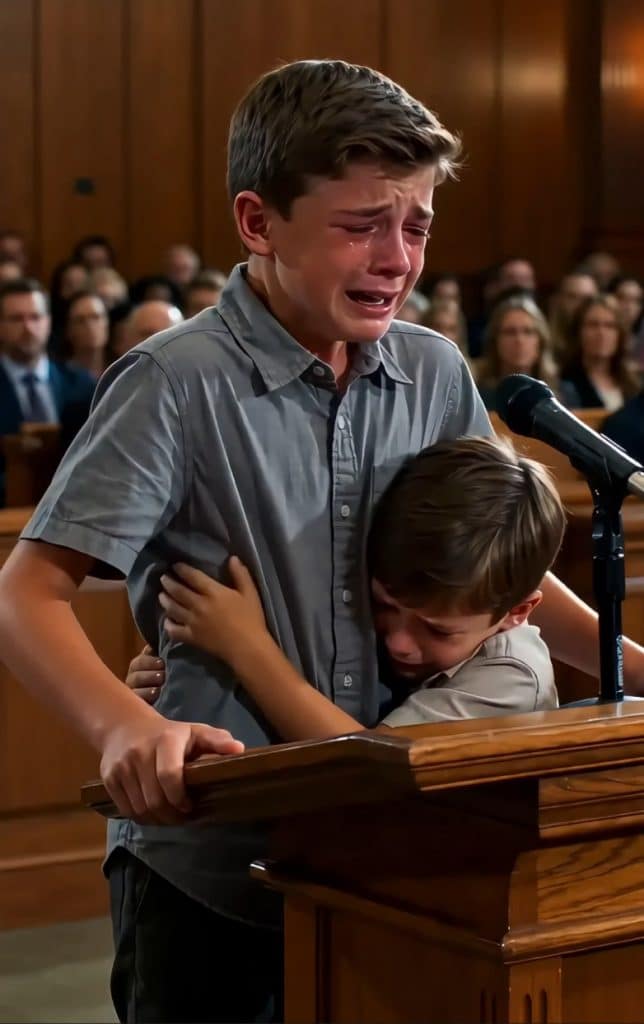
The courtroom was so quiet that everyone could hear the younger boy crying into his brother’s shirt.
His small hands were locked around Noah’s waist, fingers twisted in the gray fabric like it was the only thing keeping him from falling out of the world.
Noah Parker stood behind the witness stand with tears running down his face.
He was sixteen, but grief had made him look both younger and older at the same time. His cheeks were red. His eyes were swollen. One hand gripped the wooden ledge in front of him, while the other rested on his little brother’s shoulder.
“Eli,” he whispered, barely moving his lips. “I’ve got you.”
Eli only cried harder.
Across the courtroom, Judge Marcus Holloway sat behind the high wooden bench, looking down at the two boys with the kind of sadness he could not allow himself to show too fully.
Family court had trained him to keep his face steady.
But nothing had trained him for this.
Noah swallowed, trying to force air past the sobs caught in his chest.
The lawyer beside the witness stand lowered his eyes. The gallery sat frozen. A woman in the back row covered her mouth, tears already shining on her cheeks.
Judge Holloway leaned forward slightly.
“Noah,” he said gently, “you don’t have to continue if you need a moment.”
Noah shook his head.
He had already been given too many moments.
Too many nights on plastic shelter mattresses. Too many social worker meetings. Too many adults speaking over him while Eli clung to his sleeve under conference tables.
If he stopped now, someone else would decide.
And someone else might decide wrong.
He looked at the judge.
His voice broke before the first word was finished.
“I don’t have parents,” he said.
The courtroom seemed to tighten around him.
Eli’s small arms squeezed his waist.
Noah shut his eyes for half a second, then opened them again.
“But I can still take care of him.”
The words came out trembling, desperate, and full of a courage no child should ever have needed.
“I know I’m not eighteen. I know I don’t have a house. I know I don’t have money like they want me to have. But I know what cereal he eats. I know he sleeps with the hallway light on. I know he gets scared when people slam doors. I know how to calm him down when he can’t breathe because he thinks I’m leaving too.”
His voice cracked.
“I’m all he has.”
Eli buried his face deeper into him.
Noah looked down and touched the back of his brother’s head, gentle even while his own body shook.
“Please,” he whispered to the judge. “Don’t send him somewhere I can’t follow.”
No one moved.
Then, from the back of the gallery, the woman who had been crying stood up so suddenly the wooden bench creaked beneath her.
And in her hand was a sealed envelope with their mother’s name written across the front.
Act II
Before the courtroom, before the emergency hearings and case files and whispered arguments in courthouse hallways, Noah and Eli had lived in apartment 3B above a laundromat on Mercer Street.
It was not much.
The heater rattled. The kitchen window stuck. The bedroom floor slanted slightly toward the closet. On rainy nights, the neon sign from the laundromat flickered blue through the blinds and made the walls glow like an aquarium.
But it was home.
Their mother, Lena Parker, worked double shifts at a senior care center and still found a way to make pancakes on Sundays. She had tired eyes, quick hands, and a laugh that came out soft at first, then grew if the boys kept trying.
Noah used to think she was unbreakable.
Then he grew old enough to notice the unpaid bills folded under the toaster.
He noticed her counting coins at the kitchen table.
He noticed her turning away when the school asked for field trip money.
He noticed how often she said, “We’re fine,” when no one in the room had asked.
Their father had been gone for years.
Not dead. Not missing. Just gone in the way some people leave slowly before their bodies finally follow. He sent birthday cards twice, then stopped. Eli did not remember him. Noah wished he did not.
So Noah learned to help.
He packed Eli’s lunches. He signed reading logs. He learned which buses were late and which grocery store sold bruised fruit cheap on Fridays. He became the emergency contact before any paperwork made it official.
Lena hated that.
Not because she was ungrateful.
Because every act of Noah’s responsibility reminded her he was still a child.
“Your job is school,” she would say.
“My job is him,” Noah would answer.
She would look at him then with a sadness he did not understand until much later.
Three months before the hearing, Lena got sick.
At first, she called it exhaustion. Then a stubborn cough. Then stress. She kept working because missing shifts meant missing rent, and missing rent meant a notice on the door.
By the time Noah convinced her to go to the clinic, she was too weak to argue.
The hospital kept her overnight.
Then longer.
Eli slept in a chair beside her bed, his small hand wrapped around her wrist. Noah sat on the floor because there were only two chairs and he wanted Eli to have the other one.
Lena looked at her sons and knew something they did not.
She asked for paper.
Noah thought she was writing a grocery list.
She was not.
She wrote three letters.
One to Noah.
One to Eli.
One to a woman named Claire Tan, who had once been Noah’s fifth-grade teacher and later became the kind of neighbor who left food outside their door without making anyone thank her.
Noah did not know about the letters.
He only knew his mother squeezed his hand and said, “Keep him close, but don’t carry everything alone.”
He promised because she needed him to.
Two weeks later, Lena Parker was gone.
After the funeral, the system arrived.
Forms.
Assessments.
Temporary placement.
Emergency contacts.
Noah answered every question as if the right answer might keep Eli in the same room.
But the law had its own language.
Minor.
No legal guardian.
Insufficient housing.
Sibling placement not guaranteed.
A social worker named Ms. DeWitt tried to be kind. That somehow made the words hurt more.
“We want what is safest for both of you.”
Noah looked at Eli asleep against his side in the waiting room.
“Then don’t split us up.”
No one promised.
That was how they ended up in court.
That was why Noah stood at the witness stand, begging a judge to understand that sometimes the safest place in the world was not the cleanest house or the nicest file.
Sometimes it was the older brother whose shirt a frightened child refused to let go of.
Act III
The woman in the gallery stepped into the aisle.
Her name was Claire Tan.
Noah recognized her immediately, though he had not seen her properly since the funeral. She wore a dark coat, her long black hair pulled back, her face pale with nerves and tears.
The bailiff moved toward her. “Ma’am, please sit down.”
Claire held up the envelope.
“I’m sorry,” she said, voice shaking. “Your Honor, I have something the court needs to see.”
Judge Holloway’s brow tightened.
“This is not the time for interruptions.”
“I know,” Claire said. “But it’s from their mother.”
Noah went still.
Eli lifted his face from Noah’s shirt just enough to look back.
The lawyer turned sharply. Ms. DeWitt’s pen stopped moving. The entire gallery seemed to inhale at once.
Judge Holloway looked at the envelope.
Then at the boys.
“Approach.”
Claire walked forward as if every step weighed more than the last. She handed the envelope to the clerk, who passed it to the judge.
The paper was worn at the edges.
On the front, in Lena Parker’s familiar handwriting, were the words:
For the court, if my boys are ever at risk of being separated.
Noah’s knees nearly buckled.
The judge opened it carefully.
Inside was a letter, signed and dated from Lena’s hospital room. Attached to it were two notarized forms, a copy of Claire Tan’s foster certification, and a temporary guardianship request Lena had started before her final admission.
Judge Holloway read silently at first.
Then he removed his glasses.
The courtroom waited.
Finally, he said, “Ms. Tan, why was this not submitted earlier?”
Claire’s face crumpled with guilt.
“I didn’t know it existed until this morning.”
Noah stared at her.
Claire turned toward him. “Your mom hid it in the book she gave me before she died. The old poetry book. I couldn’t open it after the funeral. I just… I couldn’t.”
Her voice broke.
“This morning, I found the envelope inside.”
Noah remembered the book.
Blue cover. Gold letters. His mother kept it beside her bed and underlined lines when she could not sleep.
Claire faced the judge again.
“Lena asked me a year ago if I would take the boys if anything ever happened to her. I said yes. I got certified because she was scared the boys’ father might come back only if there was money involved, or that the state might split them.”
The lawyer beside Noah leaned forward.
“You are willing to take both children?”
Claire looked at Noah first.
Not past him.
Not over him.
At him.
“Yes,” she said. “But not as a replacement for Noah. Lena was clear about that. Eli needs his brother. Noah needs to be allowed to be a kid. I can give them a home where both things are true.”
Noah could not speak.
Eli whispered, “Noah?”
Noah’s hand tightened on his shoulder.
Judge Holloway returned to the letter.
This time, he read aloud.
“My sons have already lost more than children should. If I am gone, please do not make Noah prove love by becoming a parent before he has finished growing. Please do not make Eli lose the brother who has been his safe place. If Claire Tan is willing, I ask that both boys be placed with her, together, with Noah’s bond to Eli honored rather than used against him.”
The judge’s voice faltered on the last line.
Noah lowered his head.
For the first time since his mother died, he heard her protecting him.
Not from grief.
From being swallowed by duty.
Act IV
The courtroom changed after the letter.
Not loudly.
Not dramatically.
But everyone felt it.
The case was no longer only about whether Noah could take care of Eli. It was about whether the adults in the room could finally do what Lena had asked before her voice was lost.
Ms. DeWitt stood when the judge called on her.
Her face was solemn.
“Your Honor, our department was not aware of Ms. Tan’s certification or the mother’s written request. Given this new information, we would need to verify the documents, but Ms. Tan is known to the school district and has no disqualifying record. If she remains willing, a joint placement may be possible.”
Possible.
Noah hated that word.
It was not yes.
But it was no longer no.
The lawyer representing the boys, Mr. Alden, cleared his throat.
“Your Honor, I would also like the record to reflect the younger child’s attachment response today. Eli Parker has not left his brother’s side since entering the courtroom. Separation would not be a neutral administrative decision. It would be another loss.”
Eli did not understand every word, but he understood enough to hold Noah tighter.
Judge Holloway looked down at him.
“Eli,” he said gently, “can you look at me for a moment?”
Eli shook his head immediately.
Noah bent slightly. “It’s okay. He’s not mad.”
Eli peeked out with red eyes.
The judge’s face softened.
“Do you want to stay with Noah?”
Eli nodded so hard his hair fell over his forehead.
“And would you feel safe with Ms. Tan?”
Eli looked at Claire.
She gave a small wave through tears.
Eli whispered, “She makes rice soup when people are sick.”
A ripple of emotion moved through the gallery.
Claire covered her mouth.
Noah almost smiled.
Almost.
Judge Holloway sat back.
For a long moment, he said nothing. He looked at the documents, then at the boys, then at the woman who had stood up with the letter of a mother who had planned for love even while dying.
Finally, he spoke.
“This court is not blind to the law,” he said. “But neither is it blind to harm.”
Noah stopped breathing.
The judge continued.
“Noah Parker, you are not old enough to be your brother’s legal guardian today.”
The words hit anyway.
Noah’s face crumpled.
“But,” the judge said, firmer now, “that does not mean the court will punish you for loving him. It does not mean your brother will be removed from you. And it does not mean you must carry an adult burden alone to prove your devotion.”
Noah looked up slowly.
Judge Holloway turned to the clerk.
“Pending verification of the documents, I am ordering emergency joint placement of both boys with Claire Tan. Sibling separation is denied. A review hearing will be scheduled within thirty days.”
For one stunned second, Noah did not move.
Then Eli understood before he did.
“We stay?” Eli whispered.
Noah nodded once.
Then again.
“We stay.”
Eli burst into tears and clung to him, but this time the sound was different.
Still broken.
Still painful.
But no longer hopeless.
Noah bent over his little brother and held him with both arms, shaking so hard the microphone picked up his breath.
In the gallery, people cried openly now.
Even Mr. Alden wiped his eyes.
Judge Holloway looked down at his papers to give the boys the dignity of not being watched too closely in the moment their world stopped falling.
But Claire watched.
She stood alone in the aisle, holding the edge of the bench to steady herself.
Because she understood something Noah did not yet.
The court had kept the boys together.
Now the real work of becoming a home was about to begin.
Act V
Claire’s apartment smelled like ginger, laundry soap, and rain.
That was the first thing Eli noticed.
The second thing was the blue blanket folded on the couch.
The third was the small lamp left on in the hallway.
“For you,” Claire said softly. “Noah told me you don’t like the dark.”
Eli looked at Noah, surprised.
Noah shrugged like it was nothing.
It was not nothing.
Claire had two bedrooms. She gave the larger one to the boys, though Noah tried to argue.
“You need an office,” he said.
“I need you two to sleep,” she answered.
That ended it.
The first night, Eli cried until almost midnight. Noah lay beside him on the floor because Eli would not sleep unless he could see him. Claire sat outside the door with a mug of tea, listening to the low murmur of Noah’s voice telling his brother the same story three times.
At school, Noah struggled to stay awake.
At home, he tried to cook, clean, track Eli’s homework, and apologize whenever Claire did anything for them.
On the fifth day, she found him hand-washing Eli’s socks in the bathroom sink at six in the morning.
“Noah,” she said gently, “we have a washing machine.”
“I didn’t want to bother you.”
Her face softened, then saddened.
“You are allowed to bother me.”
He stared at the water.
“I don’t know how.”
That was when Claire sat on the edge of the bathtub and cried.
Not loudly. Not in a way that made him comfort her.
Just enough that he knew she understood.
Healing did not look like a courtroom victory.
It looked like Eli waking from nightmares and learning he could call for two people instead of one.
It looked like Noah flinching when an adult said, “I’ll handle it,” because he did not yet believe adults meant it.
It looked like Claire burning pancakes on a Saturday morning and Eli laughing for the first time in weeks.
It looked like Noah leaving his backpack by the door one afternoon and going back for it in a panic because he thought forgetting something meant everything might fall apart.
Claire handed it to him and said, “Small mistakes don’t make people leave.”
He did not answer.
But he heard her.
Thirty days later, they returned to court.
This time, Eli wore a sweater Claire had bought him. Noah wore the same gray shirt, freshly washed and ironed. Claire sat beside them, nervous but steady.
Judge Holloway reviewed the reports.
School attendance stable.
Medical appointments completed.
Therapy scheduled.
Home visit approved.
Sibling bond strong.
He looked over his glasses at Noah.
“How are you doing?”
Noah opened his mouth to say fine.
Claire gave him a look.
He swallowed.
“I’m tired,” he admitted.
The judge nodded. “That is a more believable answer.”
A tiny smile moved through the room.
Noah looked down at his hands.
“But Eli is sleeping better. And Ms. Tan puts extra dumplings in his soup because he pretends he doesn’t like them but he does.”
Eli whispered, “Traitor.”
Noah nudged him gently.
The judge’s mouth twitched.
“And you, Eli?”
Eli leaned against Noah’s side, but he answered.
“I like my bed. And the hallway light.”
Claire’s eyes shone.
Judge Holloway closed the file.
“The court finds continued placement with Ms. Tan to be in the best interests of both children. Permanent guardianship proceedings may begin.”
Noah let out a breath he seemed to have been holding for a month.
Eli reached for his hand under the table.
This time, Noah let him take it.
A year later, the witness stand felt like something from another life.
Not forgotten.
Never that.
But farther away.
Noah had grown taller. Eli had lost a front tooth. Claire’s apartment had become crowded with library books, mismatched shoes, school art, and grocery lists stuck to the refrigerator.
On the anniversary of their mother’s death, Claire took them to the park with paper lanterns.
They wrote messages on them.
Eli wrote: I miss you. I ate soup. Noah is still here.
Noah stared at his blank paper for a long time.
Then he wrote: You were right. I needed help. I’m sorry I thought that meant I failed.
Claire pretended not to read it.
The lanterns rose slowly into the evening sky, warm and trembling.
Eli leaned against Noah, but not with panic this time.
With trust.
Noah watched the lights drift upward until they became small stars.
For months, he had believed love meant holding on so tightly that no one could take Eli from him.
Now he was learning something harder.
Love could also mean letting someone else carry the groceries.
Signing the permission slip.
Sitting outside the bedroom after nightmares.
Making rice soup.
Leaving the hallway light on.
Claire stood beside him, hands in her coat pockets.
“Your mom would be proud of you,” she said.
Noah’s throat tightened.
“For keeping him?”
“For letting yourself be kept too.”
He looked away, blinking fast.
Eli tugged his sleeve. “Can we go home?”
Home.
The word still surprised Noah sometimes.
He looked at Claire.
Then at Eli.
Then at the last lantern disappearing into the dark.
“Yeah,” he said softly. “Let’s go home.”