Act I
Daniel Pierce had already put the can back twice.
It sat on the shelf under the white buzz of the fluorescent lights, blue label facing out, as if it were watching him. Carol Kry milk. The only kind Milo could keep down. The only kind the clinic had circled on the paper before sending Daniel home with a baby carrier, a stack of forms, and no real help.
His hand hovered over it.
Then he looked left.
Nothing but cereal boxes, canned soup, cheap pasta sauce, and a narrow aisle so quiet he could hear the refrigerators humming in the back.
He looked right.
No cashier. No customers. No one to see a grown man with a scruffy beard and tired eyes standing in a grocery store aisle, about to do the one thing he had promised his mother he would never do.
His fingers closed around the can.
“I’m sorry,” he whispered. “I have no choice.”
The words barely left his mouth before shame swallowed them.
He slipped the can into his olive-green backpack.
The metal shifted inside with a dull little sound that made his heart slam against his ribs. Daniel froze, one hand still on the zipper. For a second, he imagined turning around, putting everything back, walking home empty-handed, and listening to his baby brother cry through another night.
He could not do it.
He reached for another can.
Then another.
Then one more.
Four cans. A loaf of bread. Nothing else.
He had passed the cookies. Passed the soda. Passed the cigarettes behind the counter, the frozen meals, the batteries, the things people stole because they wanted them.
This was not want.
This was the end of every other option.
Daniel stepped out of the aisle with his shoulders hunched, his backpack heavier than it should have been. The white checkout counter waited near the front door. Outside, through the glass panes, the street looked wet and gray, traffic sliding by as if the rest of the world had not stopped.
Then a voice cracked through the store.
“Hey!”
Daniel turned so fast his hand snapped to the strap of his backpack.
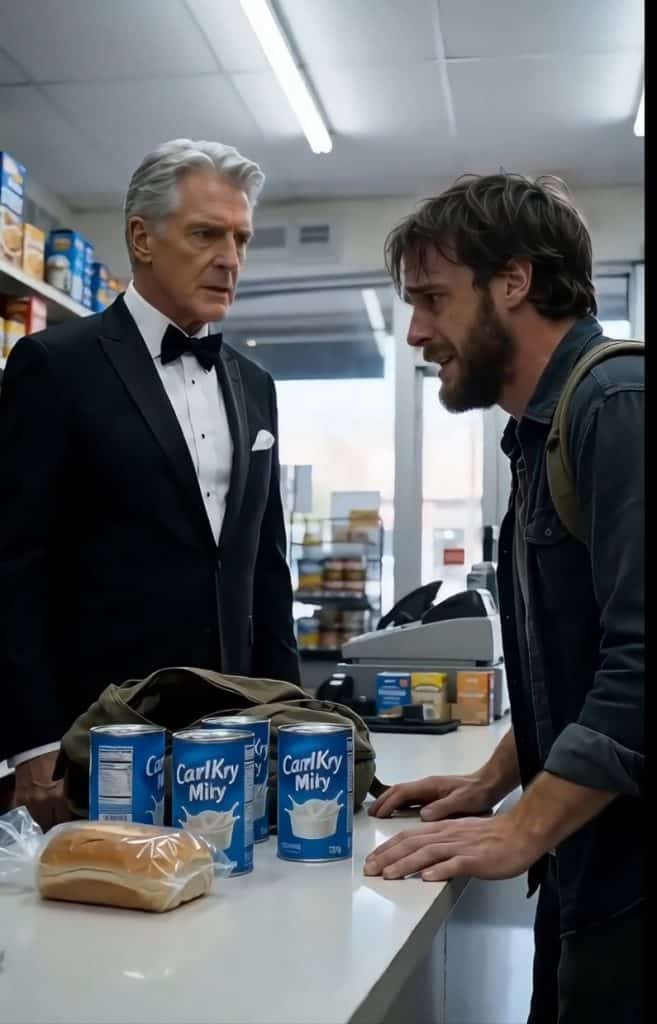
Near the entrance stood an older man in a black tuxedo.
He looked completely out of place among the gum racks and discount paper towels. Silver hair. Sharp eyes. Crisp white shirt. Black bowtie. White pocket square. He stood like a judge who had stepped down from a bench and into a corner store.
His stare dropped to Daniel’s backpack.
Daniel’s stomach sank.
The older man walked forward slowly, every polished shoe tap echoing against the glossy floor.
“Empty it on the counter,” he said. “Now.”
Daniel’s mouth went dry. “Please, sir…”
The man’s expression did not move.
“Don’t call the police,” Daniel said, his voice breaking before he could stop it.
The older man stepped closer.
“I said empty it.”
Daniel lowered his eyes, unzipped the backpack, and placed the stolen things on the white counter one by one.
The first can hit with a dull thud.
Then the second.
Then the third.
Then the fourth.
The loaf of bread landed beside them with a soft plastic crinkle.
The older man looked down.
Four blue cans. One cheap loaf. No alcohol. No cash. No luxury. Nothing hidden under the desperation.
Daniel kept both hands flat on the counter, as if that might prove he was done lying.
“It’s for my baby brother,” he whispered. “He hasn’t eaten.”
For the first time, the man in the tuxedo said nothing.
And then he saw what Daniel had stolen.
Act II
Arthur Bellamy had not come to his store that night to show mercy.
He had come straight from a charity gala downtown, where wealthy people in black suits and glittering dresses had applauded him for feeding the neighborhood. There had been candles on every table. A photographer near the stage. A gold plaque with his name on it.
Arthur Bellamy, Community Leadership Award.
He had stood in a ballroom less than thirty minutes earlier and spoken into a microphone about hunger, dignity, and the responsibility of those who had enough.
Then his phone buzzed.
His night clerk had texted him from Bellamy’s Market.
Another theft. Same aisle. Check cameras.
Arthur had left the gala before dessert.
He was tired of being taken for a fool. Tired of watching people slip things into jackets and backpacks, then pretending poverty made every wrong choice sacred. He had built this market with thirty years of work, after his father’s hardware store failed and left the family with nothing but debt and pride.
He knew hardship.
He also knew excuses.
So when he walked into the store and saw Daniel in the aisle, looking around before sliding a can into his bag, Arthur felt the old anger rise in him.
Not tonight, he thought.
Not in my store.
But now the stolen items sat on the counter, small and awful under the lights.
Daniel was still breathing too fast. His beard was untrimmed. His denim shirt hung loose at the shoulders. He looked like he had not slept in days. Not drunk. Not bold. Not careless.
Ashamed.
That bothered Arthur more than he wanted it to.
“What’s your name?” Arthur asked.
Daniel swallowed. “Daniel.”
“Daniel what?”
“Pierce.”
The name hit Arthur like a hand closing around his throat.
Pierce.
For a moment, the store changed around him. The white counter blurred. The hum of the refrigerators faded. Arthur saw a woman in a blue apron standing behind that same counter fifteen years earlier, laughing while she counted change into a child’s palm.
Evelyn Pierce.
She had worked at Bellamy’s Market for nearly a decade. Nights. Weekends. Holidays. She had known every regular customer by name and every child by what candy they tried to sneak near the register.
Arthur remembered her oldest boy too.
A skinny kid with wary eyes who used to sit on milk crates after school, doing homework behind the counter while his mother restocked gum and lottery tickets.
Daniel.
Arthur looked at the man in front of him again.
The boy was gone, but not completely. He was still there beneath the beard, beneath the exhaustion, beneath the shame of being caught with baby milk in his bag.
“Evelyn’s son?” Arthur asked.
Daniel’s face changed.
He looked startled, then guarded. “You knew my mother?”
“I employed your mother.”
Daniel gave a bitter laugh, small and tired. “Then you knew a better version of us.”
Arthur looked back at the cans.
“Where is she?”
The bitterness vanished.
Daniel lowered his head.
“She died three weeks ago.”
The words fell between them.
Arthur went still.
He had not heard. But of course he had not heard. He had stopped coming to the store every day after the second location opened. Then the third. Then the foundation. Then the board meetings. He had become a man whose name was on the door but whose hands rarely touched the shelves.
“I’m sorry,” Arthur said.
Daniel nodded once, but his eyes stayed down.
“She had Milo late,” Daniel said. “My little brother. He’s six months old. She was sick longer than she let on. By the time I realized how bad it was, she was already hiding bills under the mattress.”
Arthur said nothing.
Daniel rubbed both hands over his face, as if he could push back the humiliation.
“I lost my job taking her to appointments. Benefits got delayed because his birth certificate has a mistake on it. The church pantry had diapers but no milk. The clinic gave me two sample cans. They ran out yesterday.”
He glanced at the stolen cans.
“I tried,” he said. “I swear to God, I tried everything before this.”
Arthur had heard desperate stories before. Some true. Some polished from use. But Daniel’s voice had no performance in it. He sounded like each word cost him more than the cans.
“Do you have proof?” Arthur asked.
It was not a kind question.
Daniel flinched anyway.
Then he reached into the front pocket of his backpack and pulled out a folded stack of papers.
Hospital discharge forms. A delayed benefits notice. A past-due rent warning. A small clinic sheet with Milo’s name printed at the top and Carol Kry milk circled in blue ink.
And beneath it all, an envelope.
It was creased, stained, and sealed with tape that had been opened once and pressed shut again.
Arthur saw the handwriting before Daniel could hide it.
Evelyn Pierce had written his name on the front.
Mr. Bellamy.
His chest tightened.
Daniel followed his stare. “I found that in her drawer after the funeral. I wasn’t going to bring it.”
“Why not?”
Daniel’s jaw worked.
“Because she told me never to beg from people who made you feel small.”
Arthur had no answer for that.
Daniel slid the envelope across the counter.
Arthur stared at it.
Then the older man noticed the name on the paper tucked inside.
Act III
Arthur opened the envelope slowly.
Inside was a letter written in Evelyn’s careful, rounded handwriting. The ink faded in places, as if she had paused more than once while writing it.
Mr. Bellamy,
I know you are busy now. I see your name on the new stores and on the foundation posters. I am proud of what you built, even if I do not think you remember people like us much anymore.
Arthur stopped reading.
The fluorescent lights buzzed overhead.
Daniel stood across from him, arms wrapped around himself, watching with the dull fear of a man waiting for punishment.
Arthur forced himself to continue.
I am writing because I have a baby now, and I am sick. I have tried not to ask. You know me. I worked for every dollar I ever took from your store. But I was told the emergency shelf was closed unless Mr. Bellamy approves it himself.
Arthur’s brows drew together.
The emergency shelf.
Years ago, after a winter when three families on the block had gone hungry, Arthur had created a quiet store credit system. No posters. No speeches. No shame. If someone needed milk, bread, rice, diapers, or medicine, the clerk could write it under “community account” and Arthur covered it at the end of the month.
It was not charity for cameras.
It was the kind of help his mother once needed and never received.
But as the business grew, his managers complained.
Too many people were abusing it, they said.
Too many losses.
Too many stories.
Arthur had signed a policy change he barely read.
No credit without owner approval.
No exceptions.
He remembered signing it in the back of a car on the way to a fundraiser.
The letter continued.
Mr. Carson said you signed the new rule yourself. I do not blame you. Maybe there are things I do not understand. But if anything happens to me, Daniel will try to carry everything alone. He is proud. He will starve quietly before he asks.
Arthur’s hand tightened on the page.
Please do not let Milo go hungry because my son is too ashamed to ask.
There was another paper inside.
A copy of a rejected community account request.
Customer name: Evelyn Pierce.
Requested items: infant milk, bread, diapers.
Decision: denied.
Under the denial was a signature.
Arthur Bellamy.
For a few seconds, Arthur could not breathe properly.
It was his signature. There was no denying it. It had been stamped digitally, probably approved through a stack of store forms his office sent every Friday.
He had not seen Evelyn’s name.
But his name had still closed the door.
Daniel looked at the paper, then at Arthur’s face.
“You didn’t know,” Daniel said quietly.
It would have been easy to accept that mercy.
Arthur could have said no. He could have blamed Carson. He could have blamed the system, the paperwork, the growth of the company, the impossible number of decisions that landed on a man’s desk after success turned him into a stranger to his own store.
But the cans sat between them.
Four small witnesses.
“I should have known,” Arthur said.
Daniel’s eyes reddened. “My mother waited two hours here once. She said she saw you come in through that door. She tried to talk to you, but your driver said you were late.”
Arthur remembered that night.
Rain. Cameras. A banquet speech. Someone holding an umbrella over his head while he rushed from the curb to the store office for a photo with the mayor.
He remembered a woman near the register.
He did not remember looking at her face.
Daniel’s voice shook now, anger finally breaking through the shame.
“She went home and told me it was fine. She said everybody gets busy. She said good men still miss things.”
Arthur closed his eyes.
That was worse than accusation.
Forgiveness from someone he had failed.
“I didn’t come here to steal from you,” Daniel said. “I came because this was the last place she believed might still help us.”
Arthur looked down at the letter again.
The tuxedo suddenly felt obscene.
Half an hour ago, strangers had applauded him for fighting hunger while a woman who trusted him had died leaving behind a baby with no milk, and her oldest son had been reduced to whispering apologies in an aisle.
Arthur folded the letter with care.
Daniel reached for the cans, as if to return them.
“I’ll put them back,” he said. “Just don’t call the police. Please.”
Arthur’s voice came out rough.
“I am not calling the police.”
Daniel froze.
Arthur looked at the denial form one more time.
Because one signature at the bottom belonged to him.
Act IV
For a moment, Daniel did not believe him.
Men in tuxedos did not forgive men with stolen cans. Store owners did not soften after catching someone red-handed. People with power did not usually admit when their name had hurt someone poor enough to be ignored.
Arthur reached into his jacket.
Daniel stiffened.
But the older man did not pull out a phone to call the police.
He pulled out his wallet.
He walked behind the counter, opened the register, and rang up every item Daniel had taken. The scanner beeped too loudly in the quiet store.
One can.
Second can.
Third.
Fourth.
Loaf of bread.
Then Arthur paused, turned, and walked down the aisle himself.
Daniel watched him in confusion.
Arthur came back with diapers. Oatmeal. Eggs. Bananas. Soup. Baby wipes. A pack of clean bottles. Another two cans of Carol Kry milk.
He placed them all on the counter.
Daniel shook his head. “No, I can’t—”
“You can,” Arthur said.
“I can’t pay.”
“I know.”
Arthur scanned every item anyway.
Then he took a hundred-dollar bill from his wallet, put it in the register, and closed the drawer.
“These are paid for,” he said.
Daniel stared at the groceries like they might vanish.
His mouth trembled, but he fought hard not to cry. That fight made him look younger. Not thirty-two. Not a father-brother-provider-whatever the world had forced him to become.
Just a son who had buried his mother and gone home to a hungry baby.
Arthur picked up Evelyn’s letter.
“Where is Milo now?”
“With Mrs. Kline upstairs. Neighbor. She’s watching him.” Daniel wiped his face with the back of his hand. “I told her I was going to find something.”
Arthur’s face tightened at the word find.
Not buy.
Find.
“How far?”
“Two blocks.”
Arthur nodded. “Then we’re going.”
Daniel looked alarmed. “No. Please. You don’t have to come. I’ll leave. I won’t come back.”
“That is not what I meant.”
Arthur lifted the bags himself.
Daniel stared at him as if this was another kind of trap.
Arthur looked down at his tuxedo, then at the bags of groceries in his hands. The absurdity of it cut through him. He had dressed tonight to receive praise for goodness. Now goodness required no stage, no speech, no plaque.
Just carrying milk through the rain.
The two men stepped outside.
The street was cold, and Daniel walked fast, glancing back every few steps as if expecting Arthur to change his mind. They passed a shuttered laundromat, a bus stop, a brick building with peeling paint. At the corner, Daniel slowed in front of a narrow apartment entrance.
The stairwell smelled like old wood and boiled cabbage.
On the third floor, a door opened before Daniel knocked.
Mrs. Kline, a thin woman in slippers and a faded cardigan, looked first at Daniel, then at Arthur, then at the grocery bags.
“Oh, thank God,” she whispered.
Inside, the apartment was small and dim.
A baby whimpered from a folded blanket in a laundry basket lined with towels. He was tiny, round-cheeked, red from crying, one fist pressed against his mouth.
Daniel dropped to his knees beside him.
“Hey, Milo,” he whispered, and every hard line in his face disappeared. “I’m here. I got it. I got it.”
Arthur stood near the doorway, holding the grocery bags like a man who had arrived late to a fire he had helped start.
Mrs. Kline prepared the bottle with practiced hands. Daniel held the baby carefully, murmuring nonsense in a broken voice until Milo latched on and the room finally quieted.
The silence that followed was not empty.
It was relief.
Arthur watched Daniel lower his head over the child.
Then he looked around the apartment.
There was a stack of unpaid bills on the table. A framed photo of Evelyn near the window. A folded store apron hung over the back of a chair, the Bellamy’s Market logo still visible on the pocket.
Arthur walked toward it and touched the fabric lightly.
“She kept it,” Daniel said.
Arthur’s voice was barely above a whisper. “She was one of the best people who ever worked for me.”
Daniel did not answer.
That was fair.
Arthur reached into his tuxedo pocket and took out the award program from the gala. His photo was on the front. Beneath it were the words Feeding the Future.
He looked at the smiling version of himself printed there.
Then he tore it in half.
Daniel looked up.
Arthur folded the torn paper and put it away.
“I want to fix this,” he said.
Daniel’s eyes hardened. “People always say that after it’s too late.”
Arthur nodded.
“Yes,” he said. “They do.”
For once, he did not defend himself.
Then he did something Daniel had not expected from a man who had just caught him stealing.
Act V
Arthur Bellamy sat at Daniel’s kitchen table until midnight.
Not as a hero.
Not as a businessman.
Not as the man in the tuxedo who owned the sign on the corner.
He sat there with Evelyn’s letter spread in front of him, making calls in a voice Daniel had not heard in the store. Not sharp. Not commanding. Controlled, yes, but different. The voice of a man pulling strings he should have pulled sooner.
First, he called the manager who had denied Evelyn’s request.
Daniel heard only one side of the conversation, but it was enough.
“No. You will not speak over me.”
Pause.
“She asked for infant milk.”
Pause.
“I do not care what the policy said. I care that you hid behind it.”
Another pause.
“Bring me every community account file from the last two years by morning.”
Then Arthur called a lawyer he knew. Then a social worker. Then a pediatric clinic. He did not promise miracles. That made Daniel trust him more.
Miracles were what people promised when they wanted applause.
Arthur promised appointments. Paperwork. Rent paid directly to the landlord for three months. A proper crib. A corrected benefits file. Final wages Evelyn was still owed, with interest, though Daniel did not understand how that was possible until Arthur admitted the store had never closed out her sick leave properly.
By then, Daniel was too tired to be angry.
He just sat with Milo asleep against his chest, one hand spread protectively over the baby’s back.
Near one in the morning, Arthur stood to leave.
The tuxedo was wrinkled now. One sleeve had formula on it. His polished shoes had rainwater stains. He looked less perfect than he had in the store.
He looked more human.
At the door, Daniel stopped him.
“I did steal,” he said.
Arthur turned.
Daniel’s face was pale with exhaustion, but his eyes were clear.
“I don’t want you pretending I didn’t.”
Arthur nodded slowly.
“No,” he said. “You made a wrong choice under a weight no one should have left on your shoulders.”
Daniel swallowed.
“My mom would’ve hated it.”
“Yes,” Arthur said. “I think she would have.”
That hurt.
But it was honest.
Arthur reached into his pocket and pulled out the receipt from Bellamy’s Market. He placed it on the table.
“Then we will make sure you never have to make that choice again.”
The next morning, Daniel returned to the store.
Not through the aisles like a thief.
Through the front door with Milo in a carrier against his chest.
The same lights buzzed overhead. The same shelves stood packed tight with cans and cereal boxes. The same white counter shone under the harsh brightness.
But something had changed.
Near the register was a new sign, handwritten in black marker.
If your child is hungry, come to the counter. No shame. No questions in front of others.
Ask for the community shelf.
Daniel stood in front of it for a long time.
Arthur came out from the back, no tuxedo now, just a dark sweater and rolled-up sleeves. In his hands was an old blue apron.
Evelyn’s apron.
Freshly washed.
“I thought you might want this,” he said.
Daniel stared at it.
For a second, he was a kid again, sitting on milk crates while his mother rang up customers and told him to finish his homework before helping with the bread shelf.
He took the apron carefully.
His throat tightened.
“Thank you.”
Arthur nodded toward the back office. “There is also a part-time job here if you want it. Stockroom first. Flexible around Milo’s appointments. Real pay. No charity disguised as work.”
Daniel looked at him sharply.
Arthur did not smile.
“I owe your mother better than a speech,” he said.
Daniel looked down at Milo, who was awake now, blinking at the bright store lights with calm, full-bellied curiosity.
The baby made a small sound.
Not crying.
Just alive and present and safe for the moment.
Daniel pressed his lips to the top of his brother’s head.
“I’ll work,” he said. “But I’m paying back what I took.”
Arthur glanced at the receipt still folded in Daniel’s hand.
“Fair,” he said. “One dollar a week.”
Daniel almost laughed.
It came out broken, but it was real.
Months later, people in the neighborhood would talk about the night Arthur Bellamy came back from a gala in a tuxedo and caught a man stealing baby milk.
Some told it like a scandal.
Some told it like a miracle.
Daniel never told it either way.
To him, it was the night shame met mercy across a white checkout counter. The night four cans hit the surface one by one and forced a powerful man to see what his policies had done to people whose names he should have remembered.
Arthur kept Evelyn’s letter framed in his office.
Not where customers could see it.
Where he could.
Above his desk, beneath the line that had changed him more than any award ever had.
Please do not let Milo go hungry because my son is too ashamed to ask.
The original sign stayed by the register.
If your child is hungry, come to the counter.
And every time Daniel stocked the blue cans of Carol Kry milk, he placed them carefully on the shelf, label facing out, remembering the night he had whispered an apology to a grocery aisle because he thought he had no choice left.
He had been wrong.
There had been a choice.
It just should not have taken a stolen can, a dead woman’s letter, and a man in a tuxedo finally looking down long enough to see it.