Act I
The milk jug shook in Noah Bennett’s hands before anyone noticed him.
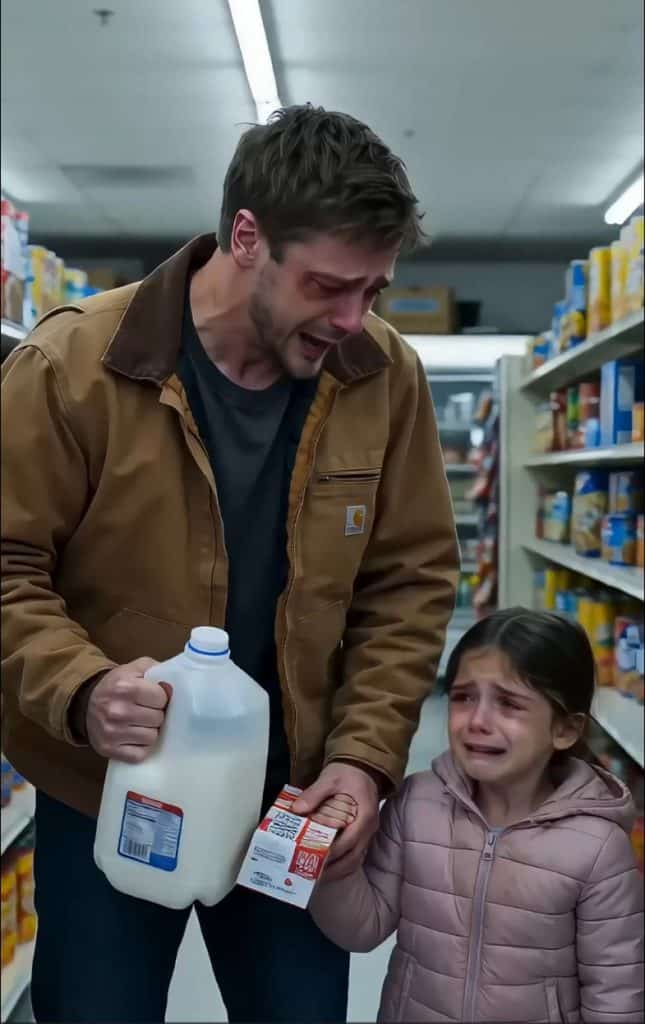
He stood in the middle of aisle three under the cruel white glare of fluorescent lights, holding a plastic gallon of milk and a small carton against his chest like they were something fragile. Around him, the shelves were full. Bread. cereal. canned soup. pasta sauce. bright boxes with smiling families on them.
His daughter stared up at him from beside the shopping cart.
Sophie was six years old, maybe forty pounds in her pink puffer jacket, with dark hair sticking to her damp cheeks. She had stopped crying in the car, but not because she felt better. She had stopped because she had seen her father crying too.
That was worse.
Noah looked down at her and tried to smile.
It failed.
“I’m sorry, baby,” he whispered, his voice cracking. “I had no choice.”
Sophie’s small hand tightened around his fingers.
She did not understand everything. She understood the empty fridge. She understood her stomach hurting. She understood that Daddy had stood at the checkout counter ten minutes earlier while the card reader beeped and the cashier shook his head.
Declined.
Noah had tried another card.
Declined.
He had counted coins from his jacket pocket. One dollar. Forty-three cents. A button. A gas station receipt. Nothing close to enough.
So he walked away from the register, down aisle three, and made the worst decision of his life.
He slipped the milk under his jacket.
He tucked the carton beneath his arm.
Then he turned toward the door.
He made it five steps.
A hand clamped onto his sleeve near the checkout counter.
“What the hell are you doing?”
The shout ripped through the grocery store.
Noah spun around, and the milk jug bumped against his ribs with a hollow plastic creak. The owner, Viktor Sokolov, stood inches from him in a brown leather jacket, his jaw tight, a radio clipped to his collar. He grabbed Noah’s arm and twisted him toward the front of the store.
Customers turned.
A teenage cashier froze behind the counter.
Sophie gasped.
“Everybody look!” Viktor shouted, dragging Noah into the open. “This guy’s stealing from my store.”
Noah’s face burned so hot it felt like fever.
“Please,” he said. “Please, man, don’t—”
Viktor jabbed a finger toward his chest.
“Empty your pockets. Now. You look broke as hell.”
The words landed harder than the grip on his arm.
Noah lowered his head.
He had been broke before. Quietly broke. Privately broke. The kind of broke where you pretended you had already eaten, where bills lived unopened in drawers, where you smiled for your child in the rearview mirror so she would not see panic on your face.
But this was different.
This was public.
This was everyone watching him become the worst thing they could imagine.
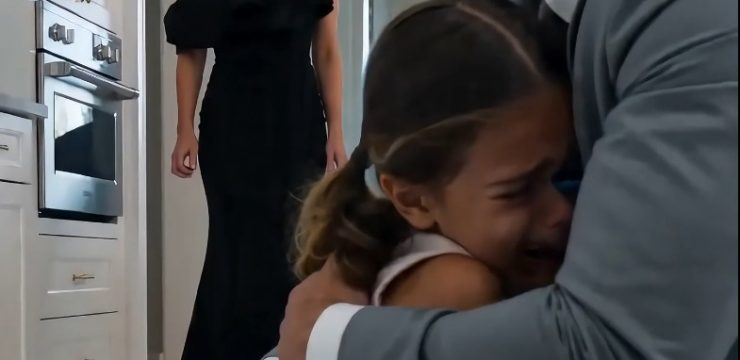
Beside him, Sophie began to sob.
“Daddy,” she cried, her small shoulders shaking. “I’m sorry. I said I was hungry.”
Noah turned toward her, and whatever was left of him broke.
“No, baby,” he whispered. “No, no, this isn’t your fault.”
But she kept crying.
A manager in a gray button-up shirt stepped forward from behind the counter. His name tag read Aleksandr. His expression did not change as he looked from the stolen milk to the crying child.
“Good,” he said flatly. “Cops are coming.”
The store door opened.
A police officer walked in with a dark blue uniform, a badge, and gold stars at his collar. Older. Broad-shouldered. Rugged-faced. Calm in a way that made the whole store go still.
He looked at the owner. Then at Noah. Then at Sophie.
“Who hit the panic button?” the officer asked.
Viktor raised his hand like a man presenting evidence.
“Me,” he said. “I caught this thief.”
The officer’s eyes moved to the milk and the carton pressed against Noah’s chest.
“Stealing what?”
Before Noah could answer, Sophie looked up through tears.
“Please,” she whispered. “I’m sorry. I was hungry.”
The officer did not move.
And in that silence, everyone felt something shift.
Act II
Officer Frank Callahan had answered hundreds of theft calls in thirty-two years.
He knew the rhythms before he reached the door. The angry store owner. The embarrassed suspect. The customers pretending not to stare while staring anyway. The manager already thinking about paperwork. The quiet calculation of whether this was a warning, a ticket, or a ride in the back of a cruiser.
But he had also learned something else.
The loudest person in the room was not always the most honest.
So when Sophie Bennett whispered that she was hungry, Frank did not reach for his cuffs.
He crouched down.
That alone changed the room.
Viktor’s mouth tightened. Aleksandr frowned. Noah stared at the officer like he was afraid kindness might be another kind of trap.
Frank lowered his voice.
“What’s your name, sweetheart?”
Sophie sniffled. “Sophie.”
“How old are you, Sophie?”
“Six.”
Frank nodded as if that mattered more than the accusation hanging over her father’s head.
“And when did you eat last?”
Noah closed his eyes.
Sophie looked at him first, as children do when truth feels dangerous.
“It’s okay,” Frank said gently. “You’re not in trouble.”
Her lips trembled.
“At school yesterday.”
A murmur moved through the store.
Noah bent at the waist as if someone had struck him.
“That’s not—” His voice failed. He swallowed hard. “I was going to get paid today. I was. The job said the check would clear this morning.”
Viktor scoffed. “Here we go.”
Frank stood.
The softness did not leave his face, but his eyes hardened when he turned to the owner.
“Let him speak.”
Viktor spread his arms. “Officer, he stole. You saw the items. Milk. Eggs. Whatever story he has, he stole from me.”
Noah’s fingers tightened around the milk jug.
“I know what I did,” he said quietly. “I’m not saying I didn’t.”
That made Frank look at him more carefully.
Noah was in his early thirties, but exhaustion had aged him. Short brown hair. stubble. red eyes. A brown work jacket with old dust ground into the seams. He looked less like a man trying to get away with something and more like a man who had run out of places to stand.
“What’s your name?” Frank asked.
“Noah Bennett.”
Frank paused.
The name touched something old in his memory, but he could not place it yet.
“Address?”
Noah gave it.
Frank knew the building. Old brick apartments above a closed dry cleaner. Bad heat in winter. Elevators that stopped working whenever the landlord decided repairs were optional.
“Where’s Sophie’s mother?”
The question hurt before it finished.
Noah looked down.
“Hospital,” he said. “Six weeks now.”
Sophie wiped her cheek with her sleeve. “Mommy’s sleeping a lot.”
Noah’s face twisted.
Frank understood then that the child had been given the gentle version of something awful.
“My wife, Rachel,” Noah said, forcing the words out, “had complications after surgery. She’s awake some days. Some days she isn’t. I lost my steady work taking care of Sophie and going back and forth to the hospital. I picked up day labor, but the check got delayed.”
Aleksandr exhaled impatiently.
“People always have a story.”
Frank turned to him.
“Did I ask you?”
Aleksandr shut his mouth.
Noah continued, quieter now.
“I came in with a benefits card. It didn’t work. I tried my debit. Nothing. I asked if I could leave my driver’s license and pay tomorrow.”
Viktor barked a laugh. “This is not a charity.”
“No,” Noah said. “It’s not.”
There was no anger in it.
Only shame.
“That’s when I should have left,” Noah said. “But she said her stomach hurt.”
Sophie began crying again.
Noah dropped to one knee beside her, still holding the milk awkwardly against his chest.
“Baby, listen to me. You did nothing wrong.”
“I said I was hungry,” she sobbed.
“I know. You’re allowed to be hungry.”
That sentence did something to the room.
A woman near the bread shelf looked away and wiped her eyes. The teenage cashier stared down at the floor. Even Viktor’s face shifted for half a second before pride dragged it back into anger.
Frank noticed everything.
Then he noticed the carton tucked under Noah’s arm.
It was not eggs.
It was a small carton of chocolate milk from the kids’ cooler.
Noah caught his glance and looked ashamed all over again.
“She asked for it,” he whispered. “I was going to put it back. I swear.”
Sophie buried her face in her father’s jacket.
Viktor slapped the counter with his palm.
“Enough. Arrest him.”
Frank looked at the milk.
Then at the child.
Then at the father.
“I’m not done asking questions,” he said.
Because the officer had just remembered where he had heard the name Bennett before.
Act III
Three months earlier, Frank Callahan had stood in the rain outside a collapsed parking structure downtown.
A delivery driver had been trapped under broken concrete after part of the old ramp gave way. Emergency crews could hear him calling, but they could not reach him fast enough. The equipment was delayed. The rain was getting heavier. The broken slab kept shifting.
Then a worker in a brown jacket had crawled into a narrow gap before anyone could stop him.
Frank had watched from behind the tape as the man disappeared into the wreckage with nothing but a flashlight and a rope around his waist.
Twenty minutes later, he came out bleeding from one eyebrow, dragging the driver by the shoulders.
The news called him a hero for one night.
Then the city forgot him.
Frank had not.
He looked now at Noah’s jacket.
There, near the cuff, was a torn patch from Bennett Mechanical.
Frank’s voice changed.
“You pulled a man out of the Fifth Street garage collapse.”
Noah froze.
Viktor frowned. “What does that have to do with anything?”
Frank ignored him.
Noah swallowed. “That was months ago.”
“You were injured.”
“Just a cut.”
“You refused the ambulance.”
“I had to pick up Sophie.”
Frank remembered the report now. The worker had missed two weeks after the rescue. No insurance. No paid leave. His employer classified him as temporary, then quietly stopped scheduling him.
The city gave him a certificate.
The hospital gave him a bill.
Frank felt a slow anger rise in him, but he kept it under control.
“Why didn’t you ask for help?” he said.
Noah gave a tired, humorless smile.
“From who?”
It was not a challenge.
It was a real question.
Frank had no quick answer.
Viktor stepped forward again. “Officer, I respect whatever story this man has, but I run a business. If people steal, I call police. Simple.”
“No,” Frank said. “It’s not simple.”
Viktor’s face flushed.
Frank turned to the counter.
“Put the items down.”
Noah obeyed immediately.
The milk jug landed first. Then the little carton. His hands hovered near them for a second, as if it hurt him to let them go.
Frank looked at Aleksandr.
“Did he try to pay?”
The manager shifted.
“He said card declined.”
“Did he ask for credit?”
Aleksandr shrugged. “We don’t do that.”
The cashier behind the counter, a nervous boy with acne along his jaw, raised his hand slightly.
Everyone looked at him.
Viktor snapped, “Leo.”
The boy flinched but kept going.
“He did ask,” Leo said. “He said he could leave his ID. He said he’d come back tomorrow. Mr. Aleksandr told him to stop holding up the line.”
Aleksandr’s jaw tightened.
Frank looked at Viktor.
“Did you hear that part before you hit the panic button?”
Viktor crossed his arms. “I saw theft. That is enough.”
Sophie sniffled into Noah’s jacket.
Frank stared at the milk and the carton. Then he reached into his own pocket and took out his wallet.
Viktor blinked. “What are you doing?”
Frank placed a twenty-dollar bill on the counter.
“Buying the milk.”
Noah shook his head immediately. “No, officer. Please don’t.”
Frank did not look away from Viktor.
“Ring it up.”
Viktor’s face went dark. “That’s not the point.”
“You’re right,” Frank said. “The point is you wanted an arrest more than you wanted payment.”
The store was silent now.
Viktor leaned closer, lowering his voice but not enough.
“You officers always think you can come into my store and tell me how to run it.”
Frank’s expression stayed calm.
“No. I came into your store because you pressed a panic button for a hungry six-year-old and her father holding milk.”
Viktor laughed once, sharp and bitter.
“So now I’m the villain?”
Nobody answered.
That was answer enough.
Then Sophie looked up at Frank with red eyes and said something that made the officer stop cold.
“Are you going to take Daddy away like they took Mommy?”
Noah’s face collapsed.
And Frank finally understood that this was not just about a stolen gallon of milk.
Act IV
Noah pulled Sophie closer.
“No one took Mommy, Soph,” he whispered. “She’s in the hospital. Remember? Doctors are helping.”
“But she didn’t come home,” Sophie said.
The words were small.
Too small for the pain inside them.
Frank crouched again, but this time he did not speak right away. He let the child breathe. He had learned that frightened kids did not need more adult noise. They needed a face that did not look angry.
“I’m not taking your daddy away tonight,” he said.
Noah looked up sharply.
Viktor exploded.
“You don’t get to decide that!”
Frank stood slowly.
Actually, he did get to decide a great deal in that moment. He knew the law. He knew discretion. He knew the difference between someone stealing televisions from loading docks and a father making a panicked, wrong choice over milk.
He also knew that humiliation could become its own cruelty.
“Mr. Sokolov,” Frank said, “you can file a report. I’ll take it. But I am not putting this man in handcuffs in front of his child over food that is now being paid for.”
Viktor pointed at Noah. “Then you are rewarding him.”
“No,” Frank said. “I’m refusing to make a hungry child pay for adult failure.”
The line landed hard.
Aleksandr looked away.
Frank turned to the cashier. “Ring up the milk. The carton too.”
Leo moved quickly, almost gratefully. The scanner beeped. The register opened. Frank paid with the twenty and told Leo to keep the change for a sandwich from the deli counter.
Then he looked back at Noah.
“You still have to make this right.”
Noah nodded quickly, tears gathering again. “I will. I’ll work it off. Clean the store. Anything.”
Viktor scoffed. “I don’t want him in my store.”
A woman from the bread aisle stepped forward.
She was older, with gray hair tucked under a knit hat. She held a basket with soup cans and bananas.
“I’ll pay for groceries for the girl,” she said.
Another customer cleared his throat.
“I’ve got bread.”
Someone else said, “I can get cereal.”
The store shifted.
Not all at once. Not like a movie where shame becomes applause. It was clumsy. Awkward. Human. People looked at each other, embarrassed by their own delay, then began picking up items from nearby shelves.
Bread.
Peanut butter.
Applesauce.
Rice.
A box of oatmeal.
Sophie watched, confused, her little hand still gripping Noah’s jacket.
Noah kept shaking his head.
“No, please. You don’t have to do this.”
The older woman put bananas on the counter.
“Honey,” she said gently, “we know.”
That was why they did it.
Frank watched the pile grow and felt his jaw tighten. Not because kindness bothered him, but because it had taken a child’s public shame to awaken it.
Viktor looked furious, trapped between his pride and the crowd’s sudden conscience.
“You people are ridiculous,” he muttered.
Frank heard him.
So did everyone else.
Then Leo, the cashier, spoke again.
His voice was quiet.
“Mr. Sokolov, there’s a donation bin in the back.”
Viktor turned sharply. “What?”
“For the holiday food drive,” Leo said. “It’s full. It’s been full for two weeks. You said we couldn’t put it out yet because the local news crew wasn’t scheduled until Friday.”
The silence snapped into something colder.
Aleksandr glared at Leo.
Viktor’s mouth opened, then closed.
Frank looked at the owner. “Is that true?”
Viktor’s face hardened. “Those donations are for an organized event.”
“They’re food,” Frank said.
“For families who qualify.”
Frank’s voice dropped.
“There is a hungry child standing in front of you.”
Noah closed his eyes.
Sophie looked from face to face, too young to understand policies but old enough to feel when adults were using them as walls.
Frank stepped closer to Viktor.
“You pressed a panic button before asking one question,” he said. “But you held donated food in the back because cameras weren’t here yet?”
Viktor’s confidence finally cracked.
Only a little.
But enough.
The officer turned toward Aleksandr.
“Bring the bin out.”
Aleksandr did not move.
Frank’s eyes sharpened.
“Now.”
For the first time since the officer entered the store, the manager obeyed.
And when he came back with the donation bin, the truth on the counter became impossible to ignore.
Act V
The bin was full.
Canned vegetables. pasta. baby cereal. soup. shelf-stable milk. peanut butter. crackers. all stacked beneath a handwritten sign that said Community Food Drive.
Sophie stared at it.
Noah stared too, but for a different reason.
He recognized the sign.
“I came in last week,” he said slowly. “I asked about that.”
Frank looked at him.
Noah’s voice was rough.
“There was a sign in the window. Said families could ask inside. I asked him.”
He pointed at Aleksandr.
The manager stiffened.
Noah continued. “He told me it was only for registered families. I asked how to register. He said the list was closed.”
Frank turned to Aleksandr.
“Was it?”
Aleksandr’s face tightened.
Viktor snapped, “Don’t answer.”
Too late.
Everyone already knew.
Leo set the receipt on the counter, his hands shaking.
“There was no list,” the cashier said. “They were waiting for the photo event.”
The older woman near the counter muttered something under her breath. Another customer walked out, shaking his head. Not in fear. In disgust.
Viktor looked around the store he owned and realized control was slipping from him.
Frank picked up the gallon of milk and handed it to Noah.
“This is paid for.”
Then he handed Sophie the little carton.
“And this is yours.”
Sophie looked at her father before taking it.
Noah nodded, tears on his cheeks.
“Say thank you,” he whispered.
“Thank you,” Sophie said to Frank.
The officer’s face softened.
“You’re welcome.”
Then Frank turned to Noah.
“I’m still writing a report.”
Noah nodded. “I understand.”
“But not the one he wants,” Frank said.
Viktor stiffened.
Frank continued, calm and precise. “I’ll document the attempted theft, the payment, the circumstances, and the store’s handling of the panic alarm. I’ll also document the food donation issue and send it to the community liaison office.”
Viktor’s mouth tightened. “You have no right.”
“I have a badge and a pen,” Frank said. “Tonight, that’s enough.”
For the first time, a few people almost smiled.
Almost.
Noah did not. He was too tired, too ashamed, too relieved. He knelt in front of Sophie and zipped her pink jacket up to her chin.
“We’re going home,” he said softly.
She held the carton with both hands.
“Is Daddy in trouble?”
Noah looked at Frank, then back at his daughter.
“Daddy made a mistake,” he said. “And Daddy is going to fix it.”
Frank respected him for that.
Not denial. Not excuses. Not the kind of pride that rots into blame.
Just truth, said gently enough for a child to survive it.
The older woman placed two full grocery bags beside Noah.
“They’re paid for,” she said before he could protest.
Noah’s lips parted, but no words came.
Frank helped carry one bag to the door. Sophie walked between the two men, sipping her chocolate milk through a straw Leo had given her. Outside, the evening air was cold and damp, and the grocery store lights spilled across the sidewalk behind them.
Noah stopped before stepping off the curb.
“Officer,” he said.
Frank turned.
“I wasn’t trying to be a thief.”
“I know.”
“I became one anyway.”
Frank held his gaze.
“For about five minutes,” he said. “Don’t let it become who you are.”
Noah nodded, and that sentence seemed to steady him more than comfort would have.
Frank gave him the number of a family services coordinator he trusted. Then the number of a hospital social worker who knew how to push delayed paperwork through systems that moved too slowly for hungry children. He told Noah to call in the morning and say Officer Callahan sent him.
Noah folded the paper like it was worth more than money.
Two weeks later, Frank returned to the grocery store.
Not for a theft call.
For coffee.
The donation bin was no longer in the back. It sat near the entrance with a clear sign, and no camera crew in sight. Leo was running the register. Aleksandr was gone. Viktor stayed in his office and did not come out while Frank was there.
On the counter was a small handwritten note.
Community shelf available. Ask cashier privately.
Frank looked at it for a long moment.
It was not enough to fix everything.
But it was something.
As he turned to leave, the door opened and Noah Bennett walked in.
He looked different.
Still tired. Still carrying more than one man should. But clean-shaven now, with Sophie beside him in the same pink puffer jacket. She carried a folded drawing in both hands.
When she saw Frank, her face lit up.
“Officer!”
Frank crouched as she ran over.
She handed him the drawing.
It showed a man in a blue uniform, a little girl in a pink coat, a grocery store, and a giant milk jug almost as tall as the people. Across the top, in uneven letters, Sophie had written:
Thank you for not taking my daddy.
Frank stared at the paper longer than he meant to.
Noah cleared his throat.
“Rachel woke up,” he said.
Frank looked up.
Noah’s eyes shone, but this time not with shame.
“She’s talking. Doctors say it’ll be slow, but she’s talking. First thing she asked was whether Sophie was eating.”
Sophie nodded proudly. “I had oatmeal.”
Frank smiled.
“That’s good news.”
Noah reached into his jacket and placed a small envelope on the counter.
Viktor’s office door cracked open.
Noah saw him.
Everyone did.
The store went quiet again, but not like before.
Noah held the owner’s gaze.
“I came to pay back the milk,” he said.
Viktor looked away first.
Leo took the envelope gently. “I’ll mark it paid.”
“It already was,” Frank said.
Noah shook his head.
“Not by me.”
There was dignity in that.
The kind public humiliation tries to steal.
The kind a man can still reclaim, one hard step at a time.
Sophie tugged her father’s sleeve.
“Can we get Mommy soup?”
Noah looked down at her and smiled, really smiled.
“Yeah, baby,” he said. “We can get Mommy soup.”
They walked down the aisle together, past the milk, past the cereal, past the shelves that had once looked full to everyone except a hungry child.
Frank stood by the counter holding Sophie’s drawing.
He thought about panic buttons. About policies. About how quickly a crowd could become a courtroom when a poor man made a mistake in public. He thought about the owner shouting thief before asking why, and a little girl apologizing for hunger as if hunger were a crime.
Then he folded the drawing carefully and placed it inside his jacket pocket.
Because some calls did not end when the report was filed.
Some stayed with you.
And every time Frank passed that grocery store after that night, he remembered the sound of Sophie’s trembling voice under the fluorescent lights.
Please… I’m sorry… I was hungry.
The store owner had wanted everyone to look at a thief.
Instead, everyone saw a father.