Act I
The man was not breathing right.
That was the first thing Lily Harper noticed.
He lay on his back across the brick path, one arm bent awkwardly beside him, his dark olive jacket dusted with dry leaves. Around him, the autumn park looked too beautiful for an emergency. Red maples burned against the pale sky. Gold leaves drifted over the black metal fence. Somewhere nearby, a bird kept singing as if nothing had happened.
Lily dropped to her knees beside him.
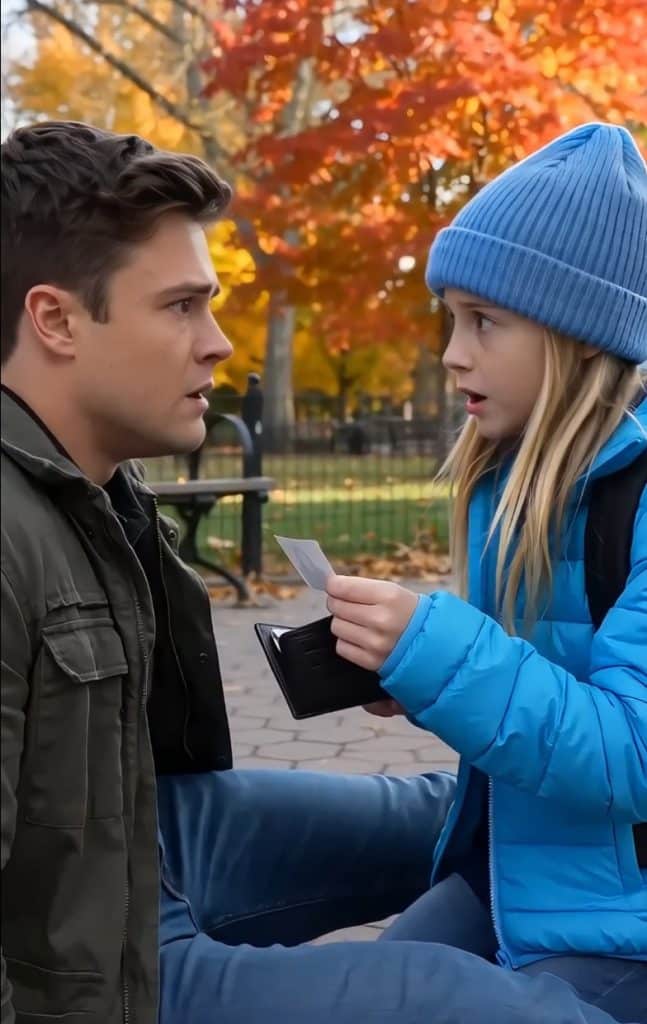
She was ten years old, small inside her bright blue puffer jacket, with a knit beanie pulled low over her blonde hair. Her backpack slid off one shoulder as she leaned close, trying to remember everything her mother had taught her.
Check if they respond.
Check for breathing.
Call for help.
“Hey,” she said, voice shaking. “Can you hear me?”
The man did not answer.
His face was pale. His lips were dry. He looked young, maybe in his thirties, but exhausted in a way that made him seem older. A faint groan escaped him as Lily pressed two fingers carefully to the side of his neck.
There.
A pulse.
Fast and weak, but there.
Lily sucked in a breath.
“Sir, open your eyes,” she said louder. “Please. Open your eyes.”
His eyelids fluttered.
A dry leaf scraped across the walkway in the wind.
Lily turned her head, searching for an adult, but the nearest bench was empty. The park was between busy hours, too late for morning joggers and too early for people walking home from work.
So she stayed.
She leaned her ear near his chest, just like her mother had shown her when they watched a safety video one rainy Sunday. His breathing came ragged and uneven.
“You’re okay,” Lily whispered, though she did not know if he was. “I’m here.”
The man’s eyes opened halfway.
They were brown, unfocused, and frightened.
He tried to sit up.
“No, wait,” Lily said quickly, putting one hand near his shoulder without forcing him down. “You fell. You need help.”
He blinked at her like he was trying to pull the world back into shape.
Then something slipped from his jacket pocket.
A black leather wallet landed open among the leaves.
Lily noticed it only because a small photograph slid halfway out of the photo sleeve.
She picked it up carefully.
“I’ll find your ID,” she said. “I need to know who to call.”
The man made a weak sound, but she was already looking inside.
Credit cards. A driver’s license. A folded receipt. And the photograph.
Lily pulled it free.
It was old, slightly faded, softened at the corners from years of being carried. In it, the man looked much younger. Barely older than a teenager. His arm was wrapped around a girl with long blonde hair, a wide nervous smile, and a silver heart necklace.
Lily’s fingers went cold.
She knew that necklace.
She knew that smile.
She saw it every morning in the kitchen when her mother rushed to pack lunch and pretend she was not tired.
Lily looked from the photo to the man on the path.
Her hand trembled.
“Where did you get a picture of my mom?”
The man stared at the photograph.
His face changed before he spoke.
Not confusion.
Recognition.
And Lily suddenly understood that this stranger had not collapsed into her life by accident.
Act II
Lily’s mother never talked much about before.
That was what Lily called it in her head.
Before meant the years before Lily was born. Before their apartment over the pharmacy. Before the late shifts at the clinic. Before boxed macaroni dinners and the little calendar on the fridge with every bill written in careful blue ink.
Before was a locked room.
Sometimes Lily found pieces of it anyway.
An old silver necklace in a velvet pouch. A photograph cut neatly in half. A college acceptance letter from a university her mother had never attended. A shoebox of cards with no return addresses, tied with string and hidden behind winter blankets.
Whenever Lily asked, her mother smiled too fast.
“Old stuff,” she would say.
But old stuff had weight.
Lily could feel it.
Her mother, Anna Harper, was loving but guarded. She sang while washing dishes. She remembered every school project deadline. She could calm frightened patients at the clinic with one hand on their shoulder and a voice that made panic feel smaller.
But some nights, when she thought Lily was asleep, Anna sat at the kitchen table staring at nothing.
On those nights, Lily would hear the faint click of the silver heart necklace opening and closing in her mother’s hand.
Once, when Lily was seven, she asked about her father.
Anna froze.
Not dramatically. Not angrily.
Just still.
Then she said, “He was someone I loved when I was very young.”
“Where is he?”
Anna’s eyes had filled, but she did not cry.
“I don’t know, sweetheart.”
Lily had learned not to push.
Children learn the shape of silence quickly.
The official version was simple: Lily’s father had left before she was born. Anna had been hurt. Anna had been young. Anna had built a life anyway.
But Lily always sensed there was more.
There were no angry speeches in their apartment. No torn-up pictures in the trash. No warnings about men who disappear. Just a sadness so old it had become part of the furniture.
And now that sadness had a face.
The man on the park path touched the air near the photo but did not take it from her.
“What’s your name?” he asked weakly.
Lily hesitated.
“My mom says not to tell strangers.”
A faint, broken smile moved across his face.
“She taught you right.”
His breathing hitched.
Lily looked around again, panic returning. “I’m calling 911.”
She grabbed her phone from her backpack and made the call with shaking hands. She told the operator the park name, the path near the black fence, the man’s condition, and that he had passed out.
The operator told her to stay with him.
So she did.
The man leaned back against the path, eyes closing for a moment.
Lily held the photo tight.
“You know my mom,” she said.
He opened his eyes again.
“Yes.”
“How?”
His face folded with pain, but not from the fall.
“I knew her before everything went wrong.”
The words chilled Lily more than the wind.
“What went wrong?”
He looked at her then, really looked at her, as if searching her face for proof of something he was afraid to believe.
Before he could answer, sirens began to rise beyond the trees.
The man turned his head toward the sound, then back to Lily.
“My name is Caleb Reed,” he whispered.
Lily felt the photo shake in her fingers.
Reed.
That was the name on one of the hidden envelopes in her mother’s shoebox.
And the ambulance arrived before he could say anything else.
Act III
Anna Harper reached the hospital fifteen minutes after the ambulance.
She arrived still wearing her clinic scrubs, hair coming loose from its clip, face drained of color. Lily had called her from the waiting room and said the words no mother expects to hear from a child.
I found a man in the park.
He had your picture.
His name is Caleb Reed.
Anna had gone silent on the phone for so long that Lily thought the call had dropped.
Then she heard her mother breathe.
“Where are you?”
Now Anna pushed through the emergency department doors with fear written across every part of her.
Lily ran to her.
Anna dropped to her knees and grabbed her daughter by the shoulders.
“Are you hurt?”
“No.”
“Did he hurt you?”
“No, Mom. He fainted. I helped him.”
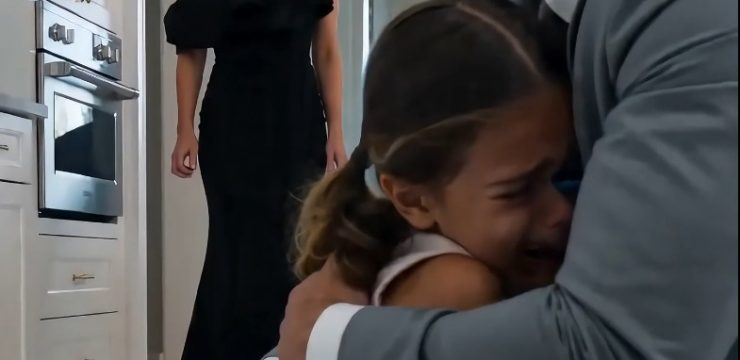
Anna pulled her into a hug so tight Lily could feel her mother’s heart racing.
Then Anna saw the photo in Lily’s hand.
The air between them changed.
“Where did you get that?” Anna whispered.
“His wallet.”
Anna took the photograph like it might burn her.
For a moment, she was no longer Lily’s mother standing under hospital lights. She was the girl in the picture, young and bright and standing beside a boy she had once trusted with her whole future.
Lily watched her mother’s face.
“Mom,” she asked quietly, “who is he?”
Anna closed her eyes.
Before she could answer, a doctor stepped into the waiting area.
“Family for Caleb Reed?”
Anna opened her eyes.
The doctor looked from her to Lily.
“Are you relatives?”
Anna did not speak.
Lily looked up at her.
The silence answered more than a yes could have.
The doctor explained that Caleb had suffered a severe blood sugar crash combined with exhaustion and dehydration. He was stable now, awake, and asking for Anna.
Anna’s hand tightened around the photo.
“I can’t,” she said.
But her feet moved anyway.
Lily followed her down the hallway.
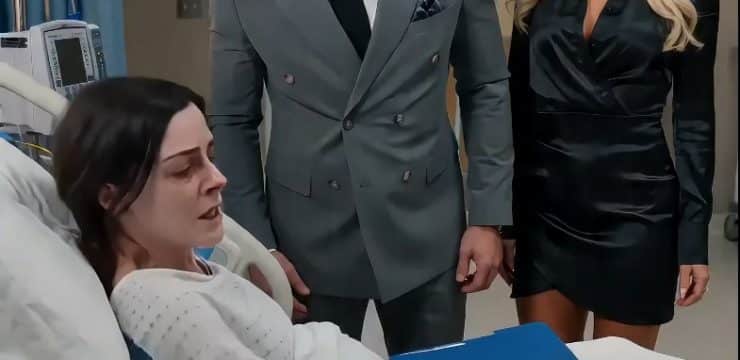
Caleb lay in a hospital bed with an IV line in his arm and monitors beside him. He looked smaller there, less mysterious, more human. When Anna entered, his eyes filled instantly.
“Annie,” he said.
Lily had never heard anyone call her mother that.
Anna stopped just inside the door.
“Don’t call me that.”
Caleb nodded, hurt flashing across his face.
“Okay.”
Years of silence stood between them.
The doctor excused himself. Lily stayed near the door, unsure whether she was allowed to hear whatever came next but unable to move.
Anna held up the photo.
“Why do you still have this?”
Caleb’s voice was rough.
“Because it was the only thing I had left.”
Anna laughed once, but it was full of pain.
“You left me with a baby.”
Lily’s stomach dropped.
Caleb stared at her.
Then at Anna.
His face went white.
“A baby?”
Anna looked confused, then angry.
“Don’t.”
“I didn’t know.”
The words were quiet.
Too quiet to be a performance.
Anna stepped closer.
“What do you mean you didn’t know?”
Caleb swallowed.
“I came back.”
Anna froze.
Lily felt her whole world tilt.
Caleb’s eyes stayed on Anna now, desperate and wet.
“I came back from that job in Oregon. Your mother told me you were gone. She said you chose the nursing program in Chicago and didn’t want me following you. She gave me back the ring.”
Anna shook her head slowly.
“No.”
“She said you didn’t want letters. That you needed a clean start.”
“My mother told me you left town with another girl.”
Caleb’s face crumpled.
“No.”
The room went still.
Even the monitor seemed too loud.
Anna sat down hard in the chair beside the bed.
Lily looked between them, her throat tight.
“What ring?” she whispered.
Neither adult answered at first.
Then Caleb looked at her.
His voice broke.
“The ring I was going to give your mother.”
Anna covered her mouth.
And for the first time in Lily’s life, she saw her mother realize that the story she had survived might not have been true.
Act IV
The truth came out in fragments.
It always does when it has been buried too long.
Caleb and Anna had been nineteen when the photo was taken. They had grown up in the same town, worked summers at the same grocery store, and planned a life with the reckless certainty of people too young to know how fiercely the world guards its disappointments.
Caleb left for a six-week construction job in Oregon because the money was good and he wanted savings before asking Anna to marry him. He wrote every week.
Anna never received the letters.
Anna called his aunt’s house twice.
He never got the messages.
By the time Caleb returned, Anna’s mother, Margaret, had already decided what kind of future her daughter deserved.
Not marriage to a broke boy with work boots and big promises.
Not motherhood at nineteen.
Not staying in a small town where people whispered.
So she split the story in two and handed each half to the person most likely to break under it.
She told Caleb that Anna had chosen school and wanted him gone.
She told Anna that Caleb had left without looking back.
Then, when Anna discovered she was pregnant, Margaret pressed harder.
“You will ruin your life chasing a man who abandoned you,” she told her. “You will raise this child without begging him to care.”
Anna believed her because the alternative was unbearable.
Caleb believed her because he had no reason to think a mother would lie about her own daughter’s pain.
Years passed.
Anna moved away before Lily was born. Caleb drifted from job to job, carrying one photograph and a grief he never understood how to name. Margaret died when Lily was four, taking the full truth with her.
Or so everyone thought.
Caleb had found the first crack three months earlier.
A storage unit notice arrived at his old address, forwarded through relatives. Inside were boxes from Margaret’s house that had never been claimed. Most were ordinary things: dishes, curtains, holiday decorations.
Then he found the shoebox.
Letters.
His letters.
Every envelope he had sent Anna from Oregon, unopened.
Beneath them was one photograph of Anna holding a newborn baby.
On the back, in Margaret’s handwriting, were three words:
Anna and Lily.
Caleb had driven across the state the next morning.
He had found the town. Then the clinic. Then the apartment over the pharmacy. But every time he got close, fear stopped him.
“What was I supposed to do?” he whispered from the hospital bed. “Knock on your door after ten years and say I might be the man your mother told you abandoned you?”
Anna sat very still.
Lily watched her mother’s hands.
They were clenched together so tightly her knuckles had gone pale.
“You should have,” Anna said.
Caleb nodded, tears slipping down the side of his face.
“I know.”
No excuse followed.
That made the apology heavier.
“I was scared,” he said. “And ashamed. And angry. And then today I saw her in the park.”
He looked at Lily.
“I knew before I knew. The hair. The way she knelt down and started giving orders like she was in charge of the whole emergency.”
Despite everything, Anna let out a broken laugh.
“That sounds like her.”
“I tried to stand,” Caleb said. “I wanted to ask her name. Then everything went black.”
Lily looked down at the photograph in her lap.
The young Anna in the picture looked happy in a way Lily had never seen. The young Caleb looked at her like she was the only person in the world worth seeing.
Lily did not know what she was supposed to feel.
Anger, maybe.
Hope, maybe.
Fear most of all.
“If he’s my dad,” she said softly, “why didn’t Grandma want him?”
Anna’s face twisted with fresh pain.
Caleb closed his eyes.
Anna reached for Lily, but Lily did not step forward immediately.
That was the first moment Anna truly understood.
The secret had not only hurt the past.
It was standing in front of her child now, asking for a shape.
Act V
Caleb did not ask for forgiveness that day.
That mattered.
He did not ask Anna to believe everything at once. He did not ask Lily to call him anything. He did not tell them the past could be fixed because one photograph had survived.
He only asked for a chance to tell the truth carefully.
Anna said nothing for a long time.
Then she said, “We’ll do a test.”
Caleb nodded immediately.
“Of course.”
The days that followed were strange and quiet.
Lily returned to school. Anna returned to the clinic. Caleb stayed in town while recovering, renting a small room above an auto parts shop and sending Anna one text each morning.
I’m here if you want to talk.
Most days, she did not answer.
But she did not block him.
That was something.
The DNA test came back two weeks later.
Anna opened the email at the kitchen table with Lily beside her.
Neither of them spoke at first.
Then Anna turned the screen.
Probability of paternity: 99.99%.
Lily stared at the number until it stopped looking like math and started looking like a door.
“So,” she said.
Anna wiped her eyes.
“So.”
Lily looked toward the window, where yellow leaves scraped lightly against the glass.
“Can I meet him again?”
Anna covered her mouth, then nodded.
They met in the same park.
Not on the same path. Anna could not bear that yet. They chose a bench near the black metal fence, beneath a maple tree losing red leaves one at a time.
Caleb arrived early.
Lily noticed that.
He stood when he saw them, then stopped himself from coming too close.
“I didn’t know what you liked,” he said awkwardly, holding out a small paper bag. “So I brought three options. Hot chocolate. Apple cider. Lemon tea.”
Lily looked at Anna.
Anna gave the smallest nod.
Lily chose hot chocolate.
They sat with careful space between them.
At first, they talked about nothing dangerous.
School.
Weather.
The park.
Caleb’s dog, who lived with his cousin until he found a real place.
Then Lily asked, “Did you really write letters?”
Caleb reached into his jacket.
Anna stiffened, but he only pulled out a folded envelope.
“I made copies,” he said. “The originals are yours if you want them.”
Anna took the envelope.
Inside were photographs of letters written in younger handwriting, full of hope and ordinary details. Work boots hurting his feet. A diner with terrible coffee. A line about missing Anna so badly he bought her favorite candy and kept it in his glove compartment like an idiot.
Anna cried before reaching the second page.
Lily leaned against her.
Caleb looked away to give them privacy, though his own eyes were wet.
Weeks became months.
No one called it healing because healing sounded too neat. It was messier than that. There were angry conversations. Long silences. Questions Lily asked at bedtime that Anna could not always answer. Moments when Caleb looked at Lily and grief crossed his face because he was seeing ten lost years all at once.
But he kept showing up.
School play.
Doctor appointment.
Rainy Saturday pancakes.
A science fair where Lily’s volcano did not erupt until ten minutes after judging ended.
He did not try to buy his way into fatherhood. He did not arrive with grand promises or expensive gifts. He brought time. He brought patience. He brought the quiet steadiness of someone who knew absence had done damage words could not undo.
One evening in late spring, Lily found her mother at the kitchen table with the old photograph.
The same one from Caleb’s wallet.
Anna had placed it beside a newer picture taken the week before: Anna, Lily, and Caleb standing in the park under new green leaves.
In the old photo, two teenagers stood before life was split by a lie.
In the new one, three people stood after the truth.
Not perfect.
But together.
“Do you still love him?” Lily asked.
Anna looked startled.
Then she smiled sadly.
“I don’t know what love becomes after that much time,” she said. “But I know I never stopped missing the person I thought he was. And now I’m learning who he is.”
Lily considered that.
“Do I have to call him Dad?”
Anna reached across the table and squeezed her hand.
“No. You get to decide what feels true.”
Lily nodded.
A week later, Caleb walked her home from the library. The sky was pink. The air smelled like rain and cut grass. They stopped at the same autumn path where she had found him months earlier, though the trees were green now and the leaves no longer covered the bricks.
Lily looked down.
“This is where you fell.”
Caleb gave a sheepish smile.
“Not my finest moment.”
“You scared me.”
His face softened.
“I’m sorry.”
She kicked lightly at a pebble.
“I’m glad I found you.”
Caleb stopped walking.
For a second, he looked like the sentence had taken the strength from his knees all over again.
“So am I,” he said quietly.
Lily reached into her backpack and pulled out a small folded paper.
It was a copy of the old photograph, printed fresh, not faded.
“I made one for you,” she said. “So you don’t have to keep the broken old one in your wallet.”
Caleb took it with both hands.
Then Lily added, “But don’t lose that one. Mom says old things matter.”
Caleb laughed softly, wiping his eyes.
“She’s right.”
They kept walking.
At the corner near the pharmacy, Lily slipped her hand into his.
She did not call him Dad.
Not yet.
But Caleb looked down at their joined hands like he had been handed the entire world and told to carry it gently.
Upstairs, Anna watched from the apartment window.
She pressed one hand to the silver heart necklace at her throat.
For years, she had thought the past was a closed door.
But sometimes doors open in strange ways.
A man falls in a park.
A child remembers what to do.
A wallet slips open.
A photograph survives long enough to tell the truth.
And a family that had been separated by one old lie begins, carefully and imperfectly, to find its way back through the leaves.