Act I
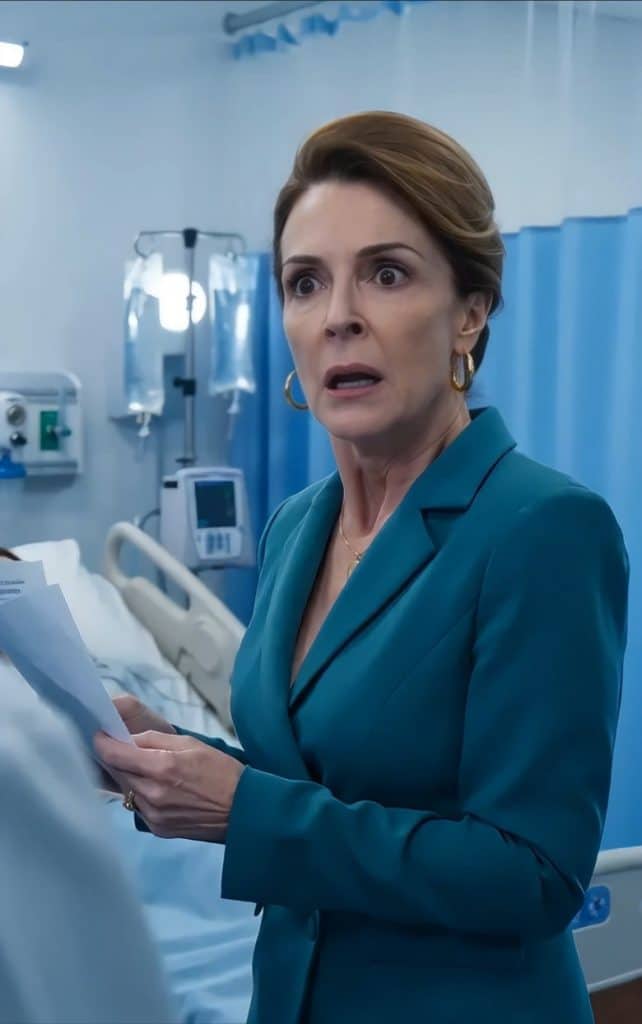
Victoria Langley entered the hospital room like a verdict.
Her teal business suit was spotless. Her gold hoop earrings flashed beneath the fluorescent lights. In one hand, she clutched a folded medical paper so tightly the edges had begun to crease.
The door struck the wall behind her.
“I told you she’s not good enough,” she snapped.
Her son, Ethan, turned from the hospital bed so fast his face went pale.
“Mom, stop.”
But Victoria had not come to listen.
She had marched straight from the consultation room, down the polished blue-toned hallway, past nurses, carts, and closed doors, carrying what she believed was proof. Her shoes had clicked hard against the floor, each step gathering more anger.
Now she stood in front of Mia’s hospital bed, breathing like she had been waiting years for this moment.
Mia Langley lay beneath a thin hospital blanket, too weak to sit up. Her patterned gown hung loose on her shoulders. An IV line ran into her arm. The bedside monitor beeped softly beside her, steady and fragile.
She looked nothing like the trap Victoria had spent years imagining.
She looked twenty-seven, exhausted, and afraid.
Ethan stepped between his mother and his wife.
“Don’t do this here,” he said.
Victoria lifted the paper.
“Here is exactly where this needs to happen.”
Mia closed her eyes.
Not because she was guilty.
Because she had no strength left for cruelty.
Victoria pointed toward the bed.
“She trapped you with sickness and lies.”
Ethan’s jaw tightened.
“Enough.”
“No, Ethan. You need to hear it. Ever since that woman entered your life, everything has been about her. Her appointments. Her pain. Her emergencies. Her debts. Her need for help.” Victoria’s voice cracked, but anger held it together. “And now this? Now she wants your entire family dragged into her medical drama?”
Mia turned her face slightly toward the window.
A tear slipped into her hairline.
Ethan saw it.
Something in him broke.
“She’s my wife,” he said. “And she’s sick.”
Victoria laughed once, bitter and sharp.
“She’s always sick when it’s convenient.”
The room went silent.
Even the monitor seemed louder after that.
Then a calm voice came from the doorway.
“That is enough, Mrs. Langley.”
Dr. Marcus Bell stepped into the room in a white coat and blue tie, his hospital ID clipped neatly to his pocket. He did not raise his voice. He did not need to.
Victoria turned toward him, still gripping the paper.
“I have every right to protect my son.”
Dr. Bell looked from her to Ethan, then to Mia.
“You are not protecting him,” he said. “You are making this harder for a patient in critical condition.”
Victoria’s face hardened.
“Critical? She’s been exaggerating for years.”
Dr. Bell’s expression did not change.
“No. She hasn’t.”
Ethan looked at him.
Something in the doctor’s voice made the floor feel unstable.
“What do you mean?”
Dr. Bell stepped farther into the room.
“Mia is not here because of stress. She is not here because of attention. She is not here because of manipulation.”
Victoria’s grip loosened on the paper.
The doctor turned to Ethan.
“She needs a transplant.”
Ethan’s voice came out breathless.
“A transplant for what?”
The answer landed with devastating calm.
“Kidney failure. Stage four.”
Victoria froze.
The color drained from her face.
The paper lowered slowly at her side.
And before anyone could speak, Dr. Bell looked directly at her and delivered the truth she was least prepared to hear.
“Your mother is the closest donor match we’ve found.”
Act II
Victoria Langley had disliked Mia before she ever met her.
That was the truth Ethan never wanted to admit aloud.
Mia came from the wrong side of town. She worked as a bakery cashier while finishing nursing prerequisites at community college. She wore thrift-store dresses, laughed too loudly when she was nervous, and sent handwritten thank-you notes after dinners where Victoria had barely spoken to her.
To Ethan, those things made her real.
To Victoria, they made her dangerous.
Victoria had built her life on control. After Ethan’s father died, she turned grief into discipline. She managed the family business, the house, the investments, the charity board, and eventually Ethan himself.
She loved her son fiercely.
But her love had sharp edges.
She saw every woman near him as a possible theft.
Mia was the worst kind of threat because Ethan did not simply want her.
He softened around her.
He listened differently. Smiled differently. Stopped asking Victoria’s opinion before making choices. He moved out of the house. He cooked dinner. He forgot to call on Sundays because he was taking Mia to a night market, or helping her study, or sitting beside her during one of her mysterious bouts of exhaustion.
At first, Victoria called it immaturity.
Then manipulation.
Then strategy.
“She knows exactly what she’s doing,” she told her sister once. “Poor girls learn early how to make men feel needed.”
Her sister had gone quiet.
Victoria remembered that silence and resented it.
When Ethan proposed, Victoria cried in the bathroom for twenty minutes before returning with a perfect smile.
When Mia hugged her, Victoria let her.
Barely.
The wedding was small, warm, and unbearable. Ethan cried during his vows. Mia’s hands shook when she promised to love him in sickness and health.
Victoria remembered thinking how convenient that line sounded coming from her.
The illness was not dramatic at first.
Fatigue. Nausea. Swelling in her ankles. Pain she tried to hide. Appointments Ethan attended with increasing fear. Lab results Mia folded into drawers. Medical bills they paid in careful increments.
Victoria saw only the effect on Ethan.
He looked tired.
He missed meetings.
He spent weekends driving Mia to specialists instead of visiting his mother.
So Victoria built a story that made her anger feel noble.
Mia was fragile on purpose.
Mia needed attention.
Mia was keeping Ethan tied to her by making herself helpless.
Then came the call from the hospital.
Mia had collapsed at home.
Ethan had found her on the bathroom floor, conscious but disoriented, one hand pressed against the tile. By the time Victoria arrived at the hospital, Ethan looked like a man whose whole world had been reduced to one bed, one monitor, and one wife breathing too shallowly beneath blue curtains.
Dr. Bell requested donor screening for immediate family and close contacts.
Ethan volunteered first.
He was not a match.
Mia’s parents were gone. Her brother had a medical condition that excluded him. Two friends tested and failed.
Then, because hospitals move strangely when desperation enters the room, Victoria was asked to test.
She almost refused.
Not because she feared the test.
Because some part of her understood that agreeing would make Mia real in a way hatred had protected her from.
But Ethan had looked at her with red eyes.
“Please, Mom.”
So Victoria gave blood.
Then she went into the consultation room.
When she came out holding the folded paper, she had not understood what she carried.
She saw words. Numbers. Compatibility markers. Mia’s name. Her own name.
And because anger reads every document as evidence for itself, Victoria twisted the truth before the doctor could explain it.
She marched into the room ready to accuse Mia of dragging her into one final performance.
Instead, she learned her body might be the only thing standing between Mia and a future.
Now the hospital room watched her discover what hatred had cost.
Act III
Ethan stared at Dr. Bell like he had misheard him.
“My mother?”
“Yes,” the doctor said. “Initial compatibility testing shows she is the strongest potential donor match. We still need further evaluation, but the preliminary result is significant.”
Victoria could not move.
The paper in her hand trembled.
“That can’t be right,” she whispered.
Dr. Bell turned toward her.
“It is right.”
“But I’m not related to her.”
“Kidney matching is not that simple. Blood type compatibility and tissue markers matter. In rare cases, a non-relative can be a better candidate than family.”
Victoria looked at Mia.
For the first time, she really looked.
Not at the background she came from. Not at the wedding dress Victoria thought was too simple. Not at the young woman she had accused of stealing her son.
At the patient.
Mia’s eyes were open now.
She had heard everything.
But she said nothing.
That silence hurt more than accusation would have.
Ethan turned to his mother slowly.
“You knew it was serious?”
Victoria swallowed.
“I knew she was sick.”
“No.” His voice shook. “You knew she was in kidney failure?”
“I thought—”
“What? That she was pretending?”
Victoria flinched.
Ethan’s face twisted with years of swallowed pain.
“She stopped coming to family dinners because you made comments about her food restrictions. She stopped asking for help because you said she enjoyed being fragile. She hid hospital bills from me because she didn’t want you saying she married me for money.”
Victoria’s lips parted.
No defense came.
Ethan pointed toward Mia, but his eyes stayed on his mother.
“She has been apologizing for being sick because of you.”
Mia whispered, “Ethan…”
He turned immediately, his anger breaking into tenderness.
“No. I’m done letting this be quiet.”
Dr. Bell took one step closer.
“Mrs. Langley, I need to be clear. No one can pressure you into donation. It is a serious medical decision, and you have every right to decline.”
Victoria looked at him, stunned by the mercy in the statement.
Decline.
The word should have felt like escape.
Instead, it felt like a mirror.
For years, she had believed Mia wanted to take something from her family.
Now she was being told Mia had never asked.
Not once.
The choice was Victoria’s.
And that made it unbearable.
She looked down at the paper again. The document was creased from her grip. The same paper she had carried like a weapon had become something else entirely.
A summons.
A reckoning.
A chance.
Mia’s voice came softly from the bed.
“You don’t have to do anything.”
Victoria looked up.
Mia’s face was pale and damp with exhaustion. Her lips were cracked. Her eyes were tired beyond age. And still, she was trying to spare Victoria from guilt.
That was when Victoria felt the first real break inside herself.
Not dramatic.
Not loud.
Just one clean fracture through the story she had used to justify cruelty.
She had called this woman manipulative.
Yet Mia had not begged.
She had not accused.
She had not even asked.
Ethan sat beside the bed and took Mia’s hand.
Victoria saw their fingers fit together.
She saw the way he leaned toward her as if the rest of the room was weather and Mia was shelter.
For the first time, Victoria understood something that should have been obvious years ago.
Mia had not taken her son.
She had given him a place to love without being controlled.
And Victoria had hated her for it.
Act IV
The next two days were full of tests.
Victoria submitted to all of them without complaint.
Bloodwork. Imaging. Consultations. Questions about medical history, medications, risks, recovery, consent. The transplant coordinator spoke gently but directly. The donor advocate reminded Victoria more than once that she could stop the process at any time.
Victoria nodded.
Each time, she thought of leaving.
Then she saw Ethan in the hallway, standing alone by the vending machines, head bowed, both hands covering his face.
She had seen her son upset before.
As a boy with scraped knees. As a teenager after his first heartbreak. As a young man at his father’s funeral, trying to look strong while shaking through the service.
But this was different.
This was helplessness.
And Victoria realized she had spent years mistaking control for protection.
Mia’s condition had worsened quietly because she had tried so hard not to be a burden. She had worked through pain. Smiled through nausea. Hidden swelling beneath loose pants. Delayed appointments when bills piled up.
She had not trapped Ethan with sickness.
She had tried to protect him from it.
On the third night, Victoria stood outside Mia’s room long after visiting hours softened into hospital silence.
Ethan was asleep in a chair beside the bed, one hand still holding Mia’s. The monitor glowed. The IV line ran clear. Mia was awake, staring toward the window.
Victoria knocked gently.
Mia turned.
For a moment, neither woman spoke.
Then Victoria entered.
No suit jacket this time. No paper in her hand. No armor.
Just a tired woman carrying the weight of what she had done.
“Mia,” she said.
Mia waited.
Victoria sat in the chair near the foot of the bed, careful not to wake Ethan.
“I have said terrible things to you.”
Mia’s eyes lowered.
“Yes.”
The honesty stung, but Victoria deserved it.
“I convinced myself I was protecting Ethan.”
Mia’s voice was quiet.
“You were protecting your place in his life.”
Victoria closed her eyes.
There it was.
The truth, spoken without cruelty.
“Yes,” she whispered. “I was.”
Ethan stirred but did not wake.
Victoria looked at him, then back at Mia.
“When his father died, I made Ethan my reason to keep going. I told myself that was love. Maybe part of it was. But somewhere along the way, I stopped seeing him as someone I raised and started treating him like someone I owned.”
Mia’s expression softened, but only slightly.
Victoria did not expect more.
“I blamed you because he chose you freely,” Victoria continued. “And I didn’t know how to survive not being chosen first anymore.”
The monitor beeped between them.
Steady.
Unforgiving.
Mia swallowed.
“I never wanted to replace you.”
“I know that now.”
“I wanted you to like me.”
Victoria’s face crumpled.
That simple sentence destroyed her more than any accusation could have.
Mia looked away quickly, embarrassed by her own vulnerability.
“I tried so hard at first. I asked Ethan what flowers you liked. What wine to bring. What stories not to mention. I bought that blue dress for your birthday dinner because he said you liked blue.”
Victoria remembered the dress.
She had told Mia it was brave to wear something that cheap with confidence.
She had watched Mia’s smile falter and felt satisfied.
Now the memory burned.
“I am so sorry,” Victoria whispered.
Mia did not say it was okay.
It was not.
Instead, she asked, “Are you doing this because you feel guilty?”
Victoria lifted her head.
The question mattered.
“No,” she said slowly. “Guilt brought me to the hallway. It won’t carry me through surgery.”
Mia watched her.
“I am doing it because you are my son’s wife. Because you are a person. Because I was wrong before I knew whether I could save you. And because if I walk away now just to preserve my pride, then there will be nothing left of me worth respecting.”
Mia’s eyes filled.
“I’m scared.”
Victoria let out a shaky breath.
“So am I.”
For the first time, the two women looked at each other without Ethan standing between them.
Not mother-in-law and daughter-in-law.
Not rival and intruder.
Just two frightened people in a blue hospital room, finally telling the truth.
Act V
The transplant was scheduled six days later.
Victoria signed the consent forms with a steady hand.
Ethan cried when she told him.
Not loudly. Not in a way that belonged to movies. He simply sat down in the consultation room, bent forward, and covered his mouth with both hands.
“Mom,” he said, voice breaking.
Victoria touched his shoulder.
“Don’t thank me yet. I still intend to complain about hospital pudding.”
He laughed through tears.
For one brief second, he looked eight years old again.
Then he stood and hugged her.
Victoria held him carefully, aware that even this embrace needed to change. She could love him without gripping so tightly he could not breathe.
The morning of surgery, Mia was wheeled past Victoria’s pre-op bay.
Their beds paused beside each other.
Ethan stood between them, wrecked by love and fear.
Victoria looked at Mia.
“I know I haven’t earned forgiveness.”
Mia’s voice was weak but clear.
“No. Not yet.”
Victoria nodded.
“Fair.”
Mia reached one hand across the small space.
Victoria stared at it.
Then took it.
“But this is a start,” Mia said.
Victoria held her hand as the nurses adjusted lines and checked charts around them.
A start.
She would take that.
The surgery was long.
Ethan spent the hours in the waiting room with Dr. Bell’s updates, bad coffee, and memories he could not sit still under. He remembered his mother teaching him to tie a tie before his father’s funeral. Mia dancing barefoot in their kitchen the night they moved into their first apartment. The two women he loved most, both behind surgical doors because the truth had arrived late but not too late.
When Dr. Bell finally came out, Ethan stood before the doctor said his name.
“They’re both stable,” Dr. Bell said.
Ethan dropped into the chair behind him and wept.
Recovery was slow.
Victoria hated being weak and made sure everyone knew it.
Mia slept often. Her color returned in small increments. Her voice gained strength. The numbers on the charts began to move in the direction everyone had been praying for.
But the emotional recovery was harder.
There were awkward silences. Apologies that arrived clumsily. Old wounds that did not vanish because an organ had been given. Ethan no longer allowed peace to be purchased with silence.
When Victoria made a cutting remark out of habit, he called it out.
When Mia tried to minimize pain, he stopped her.
When Victoria wanted to help, Mia learned to say what kind of help was welcome and what kind was control wearing a nicer coat.
Three months later, they gathered for dinner at Ethan and Mia’s apartment.
It was the first family meal since the surgery.
Victoria brought flowers.
Not expensive lilies from a designer florist.
Sunflowers from the corner market because Ethan said they made Mia smile.
Mia answered the door in a soft sweater, still thin, still recovering, but upright.
Victoria held out the bouquet.
“I thought these might be less dramatic than roses.”
Mia looked at them, then at her.
“They’re perfect.”
Dinner was simple. Soup, bread, roasted vegetables, and a cake Ethan had overbaked but insisted was rustic. For the first time in years, nobody performed.
Victoria asked Mia about her nursing classes.
Mia answered cautiously at first, then with more warmth when Victoria listened without correcting her.
After dinner, Ethan cleared plates in the kitchen.
Victoria and Mia sat alone at the table.
The old discomfort appeared again, but this time Victoria did not fill it with judgment.
Mia touched the scar beneath her sweater, absentmindedly.
Victoria noticed and looked away quickly.
Mia saw.
“It still feels strange,” she said.
Victoria nodded.
“Mine too.”
They sat quietly.
Then Mia said, “Sometimes I get angry.”
Victoria looked at her.
“At me?”
“Yes.”
Victoria absorbed it.
“I understand.”
“And sometimes I feel grateful. Then angry that I feel grateful. Then guilty for being angry.”
Victoria’s eyes lowered.
“That sounds exhausting.”
“It is.”
“I won’t ask you not to feel any of it.”
Mia studied her face, searching for the old trap.
It was not there.
So she nodded.
That was enough for one night.
A year later, Mia returned to the hospital as a nursing student.
Not as a patient.
On her first day of clinical rotation, she passed Room Four and stopped.
The room was empty. The blue curtains were pulled back. Sunlight touched the bed rails. The monitor was off.
She stood there for a long moment.
Then a voice behind her said, “You okay?”
Victoria stood in the hallway, holding two coffees.
She had insisted on driving Mia that morning, then pretended she had only come because traffic near the hospital was impossible and she already needed caffeine.
Mia smiled faintly.
“I’m okay.”
Victoria handed her a cup.
“I got the one you like.”
Mia took it.
“You remembered.”
Victoria looked through the doorway into the empty room.
“I remember a lot of things I wish I had done differently.”
Mia did not answer right away.
Then she said, “So do I.”
They stood side by side in the sterile hallway where everything had once shattered.
The place where Victoria had stormed in with a paper she misunderstood.
The place where Ethan had stood between the woman who raised him and the woman he chose.
The place where a doctor’s calm voice had revealed that judgment had no power against truth.
Victoria looked at Mia.
“You were always good enough,” she said.
Mia’s eyes filled, but she did not look away.
“I know.”
That answer surprised them both.
Then Victoria smiled.
Not sadly.
Proudly.
Mia turned toward the nurses’ station, shoulders straightening as she began the first day of the future she had nearly lost.
Victoria watched her go.
The monitor beeps, the harsh lights, the smell of antiseptic, the memory of shame—all of it remained.
But something else remained too.
A second chance.
Not clean.
Not easy.
Not owed.
Given.
Like life itself, placed carefully into hands that had finally learned how much damage they could do, and how much healing they might still choose.