Act I
The wedding had been perfect until the dog came running.
Grace Whitmore stood beneath the flower-covered arbor with one hand resting lightly over her pregnant belly, the other trembling inside her groom’s. A soft wind moved through the grass. White folding chairs stretched behind her in clean rows. Guests smiled under a cloudy sky while the officiant opened his book and began the words everyone had come to hear.
Then Buddy barked.
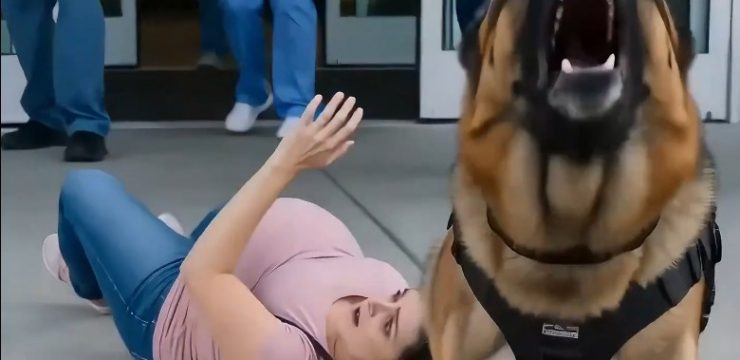
The German Shepherd tore across the grass from the side of the ceremony, black collar flashing against his thick coat. Before anyone could stop him, he lunged at Grace’s gown and caught the long lace train between his teeth.
Grace screamed.
The guests gasped.
Buddy pulled.
Hard.
Grace stumbled backward, arms flailing, one hand flying protectively to her belly as the dog dragged her away from the arbor. Lace stretched. Chairs scraped. Someone shouted for help.
Then Grace fell into an empty chair in the front row.
Buddy released the dress immediately.
He did not bite her.
Did not jump on her.
Did not come closer.
Instead, he spun back toward the wedding arbor and barked with a desperation that shook his whole body.
But Caleb Whitmore saw only his pregnant bride on the ground.
“Buddy, are you out of your mind?” he shouted.
He rushed forward, face twisted with fear and fury. The dog lowered himself, still barking toward the flowers, but Caleb was too panicked to understand.
He struck Buddy away from Grace.
Once.
Then again.
Guests cried out.
Buddy curled low in the grass, whining, but his eyes never left the arbor. Even hurt, even confused, he forced his head up and barked again.
Grace sat frozen in the chair, breathing hard, fingers locked over her stomach.
“Caleb,” she whispered.
He stood over the dog, chest heaving, still angry, still terrified.
“What is wrong with him?”
Buddy barked toward the roses.
The officiant turned slowly.
The flowers around the top beam trembled.
Then a thin crack split through the wood.
And the entire wedding fell silent.
Act II
Buddy had belonged to Grace before he belonged to anyone else.
Technically, he was Caleb’s dog now. That was what the adoption papers said. But everyone in town knew the truth. Buddy had been Grace’s shadow since the winter her father died.
Her father, Thomas Avery, had trained search-and-rescue dogs for the county fire department. He was the kind of man who trusted animals before people, not because he disliked people, but because dogs rarely lied about danger.
Buddy was his last dog.
A large German Shepherd with intelligent eyes, a black collar, and the stubborn soul of a guardian who believed every person he loved was his responsibility.
When Thomas collapsed from a sudden heart condition three years earlier, Buddy refused to leave the hospital hallway. Grace sat on the floor beside him all night, one hand buried in his fur, while doctors came and went with faces too gentle to trust.
After the funeral, Buddy stopped eating unless Grace sat beside his bowl.
Grace understood.
She had stopped living properly too.
Then Caleb came into her life.
Caleb Whitmore was not the richest man in town, but his family acted as if money had been invented for them. His mother, Elaine, owned half the land around Briarfield. His younger brother, Owen, managed the family vineyard. Caleb, unlike both of them, worked with his hands.
He restored old barns.
Built furniture.
Fixed porches for neighbors who paid him in pies and IOUs.
Grace loved that about him first.
Buddy took longer.
For weeks, the dog watched Caleb like he was a weather system. Then one evening, Caleb found him lying near Thomas’s old tool shed during a thunderstorm and sat beside him without touching him.
“You miss him too, huh?” Caleb said.
Buddy rested his head on Caleb’s boot.
After that, Grace began to believe happiness might not be betrayal.
When she became pregnant, Caleb cried before she did. He pressed both hands to his face in their tiny kitchen, then knelt in front of her and whispered, “I’m going to spend the rest of my life earning this.”
The wedding was supposed to be simple.
A field behind the old Whitmore farmhouse.
A wooden arbor Caleb built himself.
Roses chosen by Grace because her father used to plant them badly and blame the soil when they died.
Buddy was meant to walk down the aisle with the ring pouch tied gently to his collar.
But on the morning of the wedding, Elaine Whitmore insisted the dog be kept away.
“He’s too large,” she said, smiling at Grace’s belly. “Too unpredictable around all this lace and excitement.”
Grace almost argued.
Then nausea hit her, and Caleb’s cousin offered to keep Buddy near the barn until the ceremony ended.
That cousin was Owen.
Grace should have noticed Buddy growling when Owen took the leash.
She should have noticed Owen’s hand tighten on the collar.
She should have noticed the way Elaine looked not at the dog, but at the arbor.
But brides are told to ignore bad feelings on wedding days.
Smile.
Breathe.
Walk slowly.
Trust the people around you.
So Grace walked beneath the roses.
And Buddy broke free just in time.
Act III
The arbor did not collapse immediately.
That was what made the next seconds worse.
It groaned.
Low and ugly.
A sound that did not belong under wedding music or flowers.
The officiant backed away first, clutching his ceremony book. Then one of the front-row guests pointed upward.
“Something’s wrong with the beam.”
Caleb turned.
His anger drained so quickly it left him pale.
The top crosspiece of the arbor had shifted. One side sagged under the weight of roses, ribbon, and hidden string lights. A split ran down the supporting post nearest where Grace had been standing moments earlier.
Buddy barked again.
Not at Grace.
At the base of the arbor.
A groomsman moved closer.
Caleb shouted, “Don’t touch it!”
Too late, the groomsman froze.
A thin wire dangled behind the flowers, dark against the pale wood. It should have been secured along the back support. Instead, it hung loose where the split widened, exposed by the shifting frame.
The wedding planner covered her mouth.
“We turned those lights on for photos,” she whispered.
Grace’s hand tightened on the chair.
“Caleb.”
He looked at Buddy curled on the grass.
Then at Grace.
Then back at the arbor.
The truth began to move through him, slow and terrible.
Buddy had not attacked her.
Buddy had pulled her away.
A sharp snap cracked through the field.
The left post buckled.
The arbor crashed down exactly where Grace had been standing.
Flowers scattered across the grass. Chairs toppled. Guests screamed and rushed backward. The officiant fell to one knee but was pulled clear by two men in the front row.
The loose wire sparked once against damp grass before the power strip was yanked from the generator by a quick-thinking cousin.
Then there was silence.
The kind of silence that comes after a room realizes a tragedy missed its appointment by inches.
Grace stared at the wreckage.
Had Buddy not pulled her backward, the heavy beam would have fallen across her shoulders and belly.
Caleb dropped to his knees beside the dog.
“Buddy,” he said, voice breaking. “Oh God. Buddy.”
The German Shepherd whimpered but lifted his head toward Grace.
Still checking.
Still guarding.
Grace slid from the chair and reached for him, ignoring the murmurs around her.
“Don’t move too fast,” someone warned.
She did not listen.
She placed both hands gently on Buddy’s neck and lowered her forehead to his.
“You saved us,” she whispered.
Buddy’s tail moved once.
Caleb touched the dog’s side with shaking fingers.
“I’m sorry,” he choked. “I didn’t know. I didn’t know.”
Grace looked at him through tears.
Behind him, Elaine Whitmore stood near the aisle, one hand pressed against her pearls.
She was the only person not looking at the fallen arbor.
She was looking at Owen.
And Owen was gone.
Act IV
They found Owen behind the barn.
Not running.
Hiding.
That made it worse.
He stood beside the old generator trailer with mud on his shoes and a roll of electrical tape half-hidden beneath a tarp. When Caleb reached him, Owen’s face had already lost the easy charm he wore like a family crest.
“What did you do?” Caleb asked.
Owen lifted both hands.
“Nothing. The arbor was old.”
“I built it last week.”
Owen swallowed.
“It must have been the wind.”
“There was no wind strong enough to split a support beam.”
Grace arrived behind Caleb with Buddy leaning against her leg and the county deputy, Marisol Grant, walking beside her. Marisol had been a guest at the wedding, invited because she had once worked search-and-rescue with Grace’s father.
The moment Buddy barked, Marisol had known the sound.
Not aggression.
Alert.
Now she looked at Owen’s shoes.
“Step away from the tarp.”
Owen laughed weakly.
“Seriously?”
Marisol’s voice cooled.
“Now.”
Under the tarp lay a handsaw, electrical tape, and a small battery-powered cutting tool.
Caleb looked like he might be sick.
“Owen.”
His brother’s face twisted.
“You weren’t supposed to marry her.”
The words came out raw.
Grace went still.
Elaine appeared at the edge of the barn, face pale but composed.
“Owen,” she said sharply. “Stop talking.”
That command broke him.
Maybe he had carried too much. Maybe seeing the arbor fall where Grace and the baby had been standing made even his resentment turn on him. Maybe he realized Elaine had planned to let him take the blame alone.
Whatever the reason, Owen looked at his mother and laughed once.
“You said it would scare her.”
Elaine’s face hardened.
The field seemed to shrink around them.
Grace’s voice was barely audible.
“What?”
Owen looked at her.
“She said if the arbor cracked, if something happened before the vows, Caleb would take it as a sign. She said no one would get hurt.”
Caleb stared at Elaine.
His mother did not deny it fast enough.
Marisol stepped closer.
“Elaine, don’t say another word without counsel.”
But Elaine Whitmore had spent too many years being obeyed to recognize the moment obedience ended.
“She trapped him,” she snapped, pointing at Grace. “With a baby, a story, and that saintly little wounded act.”
Caleb’s voice broke.
“That is my wife.”
“She is not your wife yet.”
Grace stood straighter, one hand over her belly, the other on Buddy’s collar.
“No,” she said. “I’m the woman your dog saved.”
Elaine’s eyes flashed.
“That dog ruined everything.”
Buddy growled softly.
Marisol looked from Elaine to Owen, then to the wreckage of the arbor beyond them.
“No,” she said. “He exposed it.”
The investigation began before the guests had even left the field.
Photos were taken. Tools were bagged. The support beam showed fresh cuts hidden beneath floral wrap. The wiring had been loosened and rerouted in a way that made the collapse more dangerous once the lights were connected.
Owen confessed first.
Elaine denied everything until investigators found messages on his phone.
Make it look like poor construction.
No real harm. Just enough to stop the ceremony.
She cannot become family today.
But poor construction was not what they had created.
They had created danger.
And Buddy had read it before any human did.
Act V
The wedding did not happen that day.
No one tried to pretend it could.
Grace went to the hospital to be checked, not because she felt pain, but because everyone around her needed to hear a doctor say the baby was safe. Caleb sat beside her, face gray with guilt, hands folded so tightly his knuckles whitened.
Buddy lay on a blanket near the door with a veterinarian kneeling beside him.
He was sore, shaken, and bruised, but alive.
When the vet said he would recover, Caleb lowered his head and wept.
Grace watched him.
Part of her wanted to comfort him.
Another part could not forget what his fear had made him do.
Love did not erase that.
Neither did regret.
When they were alone, Caleb whispered, “I hurt him.”
Grace looked at Buddy.
“Yes.”
“I thought he was hurting you.”
“I know.”
“That doesn’t make it okay.”
“No,” Grace said. “It doesn’t.”
Caleb covered his face.
“I don’t know how to forgive myself.”
Grace’s voice softened, but did not rescue him from the truth.
“Then don’t start with yourself. Start with him.”
So Caleb did.
For weeks, he cared for Buddy with a humility no apology could fake. He slept on the floor beside the dog’s bed the first night. He carried him outside when he was stiff. He fed him by hand until Buddy stopped turning his head away.
Trust returned slowly.
Buddy did not hold grudges the way people did.
But Grace did not rush her own heart to keep pace with a dog’s grace.
Elaine and Owen were charged after the investigation confirmed sabotage. Elaine claimed she only wanted to delay the ceremony. Owen claimed he followed his mother’s instructions and did not understand how dangerous the damaged structure could become.
The court was not moved by intentions dressed up after consequences.
The messages, the tools, the altered support beam, the loosened wiring, and the fallen arbor told a cleaner story than either of them did.
Caleb cut ties with his mother publicly.
That was harder than people expected.
Not because she deserved him.
Because breaking from family sometimes feels like tearing roots out of your own chest.
But Caleb stood in front of the courthouse, reporters asking questions, and said only one sentence.
“My wife and child are alive because a dog had more loyalty than my own blood.”
Grace watched the clip later and cried quietly.
Not because everything was fixed.
Because he had finally named it.
Months passed before they chose another wedding date.
This time, there was no grand field full of chairs.
No elaborate floral arbor.
No family estate.
They married in Grace’s father’s old training field, beside the search-and-rescue kennels where Thomas Avery had once taught dogs to find the lost, warn the living, and trust the truth of their senses.
Marisol officiated.
The guest list was smaller.
The joy was not.
Grace wore a simple white dress that left room for her growing belly. Caleb wore a dark suit without a boutonniere because Buddy had eaten the first one during photos and everyone agreed it was a sign.
Buddy walked down the aisle first.
Not with rings tied to his collar.
With a blue ribbon.
Thomas Avery’s old rescue ribbon.
When the dog reached Grace, he sat beside her and leaned gently against her leg. Caleb crouched in front of him before the ceremony began.
The entire field went quiet.
Caleb placed one hand on Buddy’s head.
“I was wrong,” he said softly. “You saved them. I forgot who you were for one terrible moment, and I will spend my life remembering.”
Buddy licked his hand.
Someone laughed through tears.
Grace did too.
The baby kicked just as Marisol began.
Grace took Caleb’s hand.
This time, when the vows were spoken, no structure loomed above them. Only open sky. No flowers hiding cut wood. No wires under ribbon. No mother in pearls measuring inheritance against human life.
Just wind through the grass, a dog at their feet, and the memory of the first wedding transformed from horror into warning.
Their daughter was born six weeks later.
They named her Rose.
Not after the flowers on the fallen arbor.
After the stubborn rosebushes Thomas Avery had planted badly year after year, refusing to give up on something just because it struggled to grow.
Buddy slept beneath Rose’s crib from the day she came home.
At first, Caleb tried to move him.
Grace stopped him.
“He knows his job.”
And he did.
If Rose stirred, Buddy lifted his head.
If strangers came to the door, Buddy stood between them and the nursery.
If Caleb entered late after work, Buddy watched until Caleb whispered, “It’s me, old man.”
Then the dog would sigh, as if fathers were exhausting but acceptable.
Years later, people in Briarfield still talked about the wedding where the dog dragged the pregnant bride away from the altar.
Some told it like gossip.
Some told it like a miracle.
Grace told it differently.
She told Rose, when her daughter was old enough to understand, that love is not always gentle when danger is close. Sometimes it pulls. Sometimes it ruins the perfect picture. Sometimes it knocks you backward into a chair while everyone screams and misunderstands.
“But how did Buddy know?” Rose asked, sitting cross-legged beside the old dog, who had gone silver around the muzzle.
Grace looked toward Caleb, who was watching from the porch.
“Because Buddy was listening to what everyone else ignored.”
Rose stroked the dog’s head.
“Was Daddy mad?”
Caleb answered before Grace could.
“Yes,” he said. “And I was wrong.”
Rose thought about that.
“Did Buddy forgive you?”
Caleb walked over and sat beside them.
“I think so.”
Buddy opened one eye, then rested his chin on Caleb’s knee.
Rose smiled.
“He did.”
Grace looked at the dog who had once barked through pain because warning mattered more than being understood. The dog who saved her. Saved Rose. Saved Caleb from a family lie that might have swallowed him whole.
The first wedding ended with a broken arbor.
The real marriage began when the truth fell with it.
And at the center of both stood Buddy, wounded but loyal, barking toward danger until the humans finally looked where he had been trying to tell them all along.