Act I
The German Shepherd came out of nowhere.
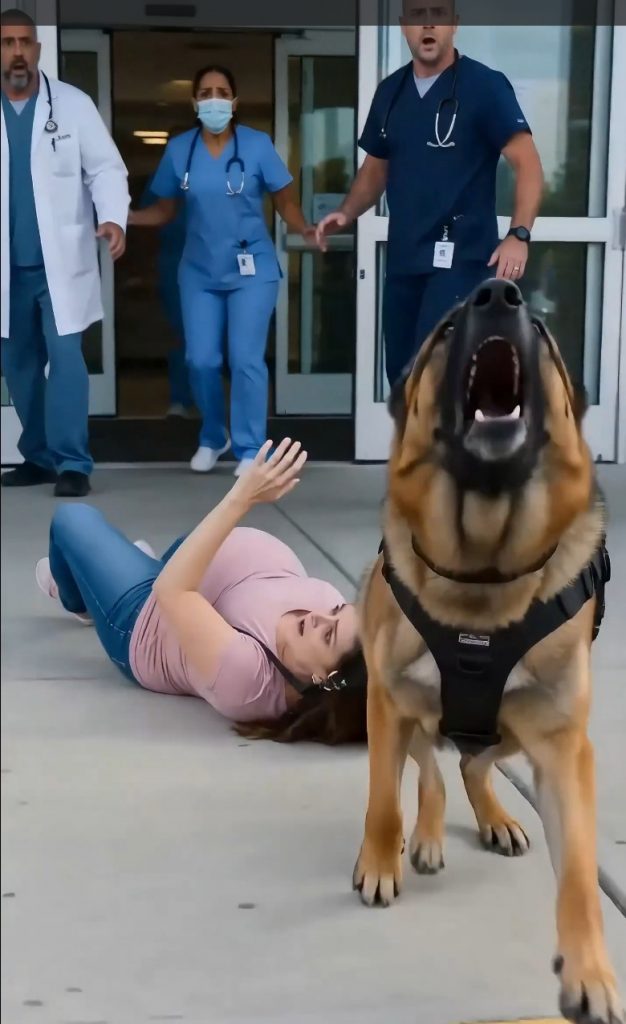
One second, Claire Bennett was walking toward the hospital entrance with one hand under her pregnant belly and the other gripping her medical folder. The sliding doors opened ahead of her. A nurse in blue scrubs smiled from just inside.
Then the dog hit the curb like a storm.
He wore a tactical harness. His paws skidded across the concrete. His bark tore through the bright morning air with a force that made everyone turn.
Before Claire could move, the dog grabbed the loose strap of her maternity bag and pulled.
She screamed.
Her knees buckled, and she slid down onto the pavement as the dog dragged her away from the doors. Nurses shouted. A security guard stumbled forward. Cars stopped at the curb.
“Get away!” the nurse yelled, rushing toward them. “Get away from her!”
The dog released the strap instantly.
But he did not run.
He spun toward a gray minivan parked along the hospital curb and barked so violently his whole body shook.
Claire lay on the pavement, trembling, one arm wrapped protectively around her belly.
“What is happening?” she gasped.
The nurse crouched beside her. “Stay still. Don’t try to get up.”
The dog sprinted to the minivan.
He jumped against the rear passenger-side door, front paws slamming onto the window. His claws scraped the glass. His muzzle struck it again and again, each dull impact making hospital staff flinch.
“Someone stop that dog!” a man shouted.
But the dog would not stop.
He barked at the window.
Scratched it.
Hit it.
Barked again.
A police officer near the emergency entrance ran over, one hand raised as he approached.
“Back up,” he ordered. “Everyone back up.”
The German Shepherd’s barking became desperate.
The officer leaned toward the rear-side window where the dog had marked the glass with frantic paw strikes.
At first, his face showed annoyance.
Then focus.
Then horror.
He jerked back with a sharp inhale.
“Get a gurney out here,” he shouted. “Now!”
Claire pushed herself up on one elbow.
The officer looked toward her, pale and stunned.
“Ma’am,” he said, voice shaking, “is this your minivan?”
Claire stared at the gray vehicle.
Her breath stopped.
Because the minivan belonged to her husband.
And her husband had been missing since dawn.
Act II
Claire had not wanted to come to the hospital alone.
That was what she would remember later, long after the sirens and statements and news vans. She would remember standing in the kitchen at seven that morning, arguing softly with Mark because she hated how worried he looked.
“It’s just a checkup,” she had said.
Mark stood by the sink with his keys in one hand and his phone in the other. He was a tall man with tired eyes, the kind of husband who read every pregnancy pamphlet twice and still asked the doctor too many questions.
“You had cramps last night.”
“I had one cramp.”
“You scared me.”
That softened her.
She stepped closer and touched his shirt.
“I know.”
Their German Shepherd, Ranger, sat beside the back door, watching them with the seriousness of a retired soldier.
Ranger had been Mark’s K9 partner before a training injury forced him into early retirement. Officially, he belonged to Mark now. Unofficially, he had appointed himself Claire’s guard the day she became pregnant.
He followed her from room to room.
Sat outside the bathroom door.
Growled at delivery men.
Once shoved his entire body between her and a neighbor’s overexcited Labrador.
Claire used to joke that Ranger was more prepared for fatherhood than Mark was.
That morning, Ranger would not get in the minivan.
He stood in the driveway, barking toward the street.
Mark frowned.
“What’s wrong with him?”
Claire checked the time.
“Maybe a squirrel committed a crime.”
Mark almost smiled, but Ranger barked again, sharper this time.
Then Mark’s phone rang.
His expression changed when he saw the caller ID.
“Who is it?” Claire asked.
“Hospital billing office,” he said too quickly. “Probably about the insurance form.”
He stepped outside to answer.
Claire watched through the kitchen window as he walked toward the minivan. Ranger followed, stiff-legged and alert. Mark opened the driver’s door, then looked back toward the house and held up one finger.
One minute.
Claire never got that minute.
A wave of dizziness forced her to sit down. When she looked up again, the minivan was gone.
So was Mark.
So was Ranger.
At first, she thought Mark had driven ahead to bring the car around.
Then twenty minutes passed.
No call.
No text.
Claire tried his number.
Straight to voicemail.
By the time her neighbor drove her to the hospital, Claire had convinced herself there was a simple explanation. Mark’s phone died. Ranger jumped in the car. He stopped for gas. He got pulled into some urgent errand because Mark was the kind of man everyone called when something broke.
But the dread stayed.
It sat under her ribs like a stone.
Now the gray minivan was parked outside the hospital, and Ranger was covered in rain-dark harness marks, barking himself hoarse at the rear window.
Claire looked at the officer.
“What did you see?”
He did not answer right away.
That terrified her more than anything.
“Ma’am,” he said carefully, “stay with the nurse.”
Claire’s voice cracked.
“Is it Mark?”
The officer looked toward the hospital doors where staff were rushing out with a gurney.
Then his eyes moved back to her.
“Yes,” he said. “And he’s not alone.”
Act III
The back door of the minivan would not open.
Someone had jammed it from the inside.
The officer used a window tool from his belt while Ranger paced and barked, limping slightly now from the force he had used against the glass. Claire tried to stand, but the nurse held her gently by the shoulders.
“No,” the nurse said. “You need to sit.”
“My husband is in there.”
“And we are getting him out.”
The glass broke safely into the door frame with a controlled crack. The officer reached in, unlocked the rear door, and pulled it open.
For one second, everyone around the curb went silent.
Then the hospital moved like a single body.
Mark Bennett lay partly across the folded rear seats, pale and barely conscious, one hand pressed protectively over a small child curled beside him. The child looked around six years old, wearing a yellow sweater and one pink sneaker, her face streaked with tears.
She was breathing.
So was Mark.
But barely.
“Two patients,” the officer shouted. “Adult male and child. Possible exposure, possible trauma, both responsive but weak.”
Claire’s hands flew to her mouth.
“Child?”
The little girl blinked toward the daylight.
Ranger whined and tried to climb into the van.
“Easy, boy,” the officer said, voice softer now. “You did good.”
Mark’s eyes opened halfway.
“Claire?”
She broke free from the nurse just enough to reach the edge of the open door.
“I’m here.”
His lips moved.
“Don’t let them take Lily.”
The name hit the officer first.
He straightened.
“Lily?”
The nurse beside Claire whispered, “Lily Hart?”
The child in the minivan flinched at the name.
For two weeks, Lily Hart’s picture had been on every local news station. Six years old. Missing from a supervised custody exchange outside a family services office. Believed to have been taken by her noncustodial father, Evan Hart, a man with a history of disappearing when courts told him no.
Claire had seen the poster in the hospital lobby that morning.
Brown hair.
Yellow sweater.
Pink sneakers.
Missing child.
Her husband had found her.
Mark tried to speak again, but the paramedics were already moving him.
The child clutched his sleeve.
“No,” she whimpered. “He said don’t let the bad man come.”
The officer crouched by the door.
“Lily, I’m Officer Daniels. You’re safe now.”
She shook her head.
“He has the key.”
“Who?”
Her eyes moved toward the hospital entrance.
Claire followed her gaze.
A man stood near the sliding doors, half-hidden behind a column, wearing a visitor badge and a baseball cap pulled low.
Ranger saw him too.
The dog’s bark changed.
Lower.
Sharper.
The man turned and ran.
Act IV
Officer Daniels chased him across the ambulance bay.
Ranger tried to follow, but his front paw slipped, and he staggered. Claire shouted for someone to help the dog while two hospital security guards joined the chase. The man made it as far as the parking lot exit before Daniels tackled him onto the grass beside the curb.
His cap came off.
The nurse beside Claire gasped.
“That’s Dr. Keller.”
Dr. Stephen Keller was not Lily’s father.
He was a pediatric specialist at the hospital.
A respected one.
A man with framed awards on the third floor and a warm voice parents trusted when they were too frightened to question him.
Inside his coat pocket, officers found a key fob for the gray minivan.
And Mark’s phone.
The story came out in fragments over the next twelve hours.
Mark had not received a call from the hospital billing office. He had received a call from a blocked number telling him to check the end of his driveway if he wanted to stop “a child from being moved.”
When he stepped outside, he found Lily hiding behind the hedge near the mailbox, barefoot except for one shoe, shaking so hard she could barely speak.
Ranger had smelled her first.
That was why he barked.
Mark carried Lily to the minivan and tried to call police, but someone struck the back of the vehicle and the doors locked remotely. His phone was taken through the cracked front window. Before Mark could break out, the ventilation system shut down and the rear child lock engaged.
He managed to pull Lily into the back, keep her calm, and wedge his jacket near the window to create a narrow gap.
Then Ranger did what no human could.
The dog ran.
He followed the one scent he trusted most: Claire.
The hospital.
The place Mark had been taking her.
But when Ranger found Claire outside the entrance, she did not understand. No one did. He dragged her away from the sliding doors because she was the only person he knew would make people stop. Then he ran back to the minivan and nearly broke himself against the window until someone finally looked.
Dr. Keller denied everything at first.
Then Lily spoke.
Not in front of cameras. Not to a crowd.
In a quiet pediatric room with a child advocate, a nurse, and a stuffed bear in her lap.
She said Dr. Keller had been helping her father hide her.
She said he told her hospitals were safe places only when adults behaved.
She said Mark promised her, “My dog will get help.”
Claire sat outside the room, one hand on her belly, the other wrapped around Ranger’s leash while a veterinarian cleaned the dog’s scraped paws and muzzle.
The vet said Ranger would recover.
Claire cried harder at that than she had at anything else.
Mark woke properly that night.
He asked first about Lily.
Then Ranger.
Then Claire.
She sat beside his hospital bed and placed his hand on her belly.
“We’re okay,” she whispered.
His eyes filled.
“Ranger found you?”
Claire nodded.
“He dragged me halfway across the sidewalk.”
Mark tried to laugh, but it came out broken.
“Good boy.”
Ranger, resting on a blanket near the bed with bandaged paws, lifted his head at the words.
His tail thumped once.
Act V
The hospital changed its security policy before the investigation was even complete.
That was how serious the case became.
No one wanted to admit a missing child had been hidden inside a minivan parked just feet from emergency doors while a respected doctor walked the halls with a badge. But the body camera footage, surveillance logs, key fob records, and Lily’s statement made denial impossible.
Dr. Keller was arrested.
So was Lily’s father two days later at a motel outside the county line, after phone records tied him to the plan. Keller had been promised money to help move Lily through the hospital system under a false name, then into a private transport vehicle before authorities could track her.
Mark had interrupted the transfer by accident.
Ranger had finished the rescue on purpose.
Lily was reunited with her mother in a hospital conference room away from the press. Claire saw it only from the hallway, but she heard the sound the little girl made when her mother walked in.
It was not a scream.
Not a word.
It was the sound of a child letting go of terror because someone safe had finally arrived.
Claire turned into Mark’s chest and sobbed.
Weeks passed.
Mark came home with bruises fading and a new habit of checking locks twice. Claire’s doctor monitored her closely, and every appointment became a family operation: Mark driving, Claire in the passenger seat, Ranger in the back wearing a softer harness because the old one had been taken into evidence.
At first, Ranger refused to sit still.
Every time they passed the hospital entrance, he stood and watched the curb.
The minivan was gone, impounded for investigation, but dogs remember places by more than sight.
They remember panic.
Duty.
The exact point where no one listened.
Claire understood.
She had nightmares too.
In them, Ranger dragged her across the pavement and she could not hear why.
Then she woke to the dog sleeping outside her bedroom door.
Always guarding.
Always listening.
The baby arrived six weeks later, early but healthy.
A boy.
They named him Samuel, after Mark’s father, though Claire joked they should have named him Ranger since the dog had done more prenatal work than half the staff.
When they brought Samuel home, Ranger approached the carrier with the solemn caution of an officer inspecting a royal guest. He sniffed once, looked at Claire, then lay down beside the bassinet and refused to move for three hours.
Mark took a photo.
Claire kept it framed in the nursery.
Lily visited them months later with her mother.
She brought Ranger a blue rope toy and a handmade card covered in paw prints drawn in crayon. The message inside was written carefully in large letters:
Thank you for finding the grown-ups.
Ranger accepted the toy with dignity, then dropped it at Lily’s feet so she could throw it.
She laughed.
That laugh was worth every scar on the glass.
During the trial, Officer Daniels testified about the moment he looked into the minivan window.
The defense tried to make the dog’s behavior sound chaotic.
Daniels shut that down.
“That dog was not attacking anyone,” he said. “That dog was directing us.”
The courtroom stayed quiet.
He continued.
“He got a pregnant woman’s attention because nobody understood him any other way. Then he led us to a vehicle where two people needed immediate help. He did not stop until we saw what he was trying to show us.”
Claire sat behind Mark, one hand over Samuel’s carrier, listening.
Ranger was not allowed in the courtroom, but she wished he had been.
He deserved to hear himself described correctly.
Not dangerous.
Not wild.
Not aggressive.
Determined.
The case ended with convictions.
Keller lost his license, his reputation, and his freedom. Lily’s father lost custody permanently. The hospital faced investigations, reforms, and painful public questions about who had access, who had looked away, and why a dog had done what systems failed to do quickly enough.
A plaque appeared months later near the hospital entrance.
Not large.
Not dramatic.
Just a small bronze plate beside the emergency doors.
In honor of Ranger, whose warning saved lives.
Listen when protection does not look the way you expected.
Claire cried the first time she saw it.
Mark pretended not to until she caught him wiping his eyes.
Ranger sniffed the plaque, sneezed, and then stared at the sliding doors as if waiting for someone inside to do their job.
Life moved forward.
Not cleanly.
Not without fear.
But forward.
Claire still carried the memory of concrete under her shoulder, the shock of being dragged, the first terrible thought that the dog she trusted had turned on her. Then she remembered the officer’s face at the window and understood what Ranger had known from the first bark.
The danger had never been him.
One bright morning a year later, Claire returned to the hospital for Samuel’s checkup. Mark parked at the curb. Ranger sat in the back, now gray around the muzzle but still alert, still proud, still convinced every doorway needed supervision.
Claire opened the side door and let him look out.
The same curb.
The same sliding doors.
Different day.
Samuel babbled in his stroller, waving a tiny fist at the dog.
A nurse leaving the building stopped when she recognized Ranger.
“Is that him?” she asked softly.
Claire smiled.
“Yes.”
The nurse crouched, careful and respectful.
“Good boy,” she said.
Ranger accepted the praise like a professional receiving a delayed report.
Then he turned his head toward Samuel.
Back to work.
Claire laughed for the first time at that curb.
A real laugh.
Mark looked at her.
“What?”
She shook her head.
“Nothing. Just thinking.”
“About?”
Claire looked at Ranger, then at the hospital doors, then at the place where the gray minivan had once sat.
“About how everyone thought he was causing the emergency.”
Mark put his arm around her.
“He was the only one solving it.”
Claire leaned into him.
The world had misunderstood Ranger because he was loud, forceful, and impossible to ignore.
But sometimes saving someone means breaking the calm.
Dragging the right person into the truth.
Scratching at the glass until your own paws hurt.
Refusing to let humans mistake silence for safety.
That morning outside the hospital, Ranger had not been attacking a pregnant woman.
He had been begging everyone to look where the real emergency was hidden.
And because he refused to stop, a husband came home, a missing child was found, and a baby named Samuel grew up with a guardian who slept beside his crib like listening was sacred work.