Act I
The house was too quiet when Nathan Vale opened the front door.
He came in with his suitcase dragging behind him, his charcoal overcoat still carrying the cold air from the airport. His flight had landed early. For once, there had been no delay, no late meeting, no client dinner stretching past midnight. He had imagined surprising his children before bedtime.
Then he heard the baby scream.
Nathan stopped in the dark entryway.
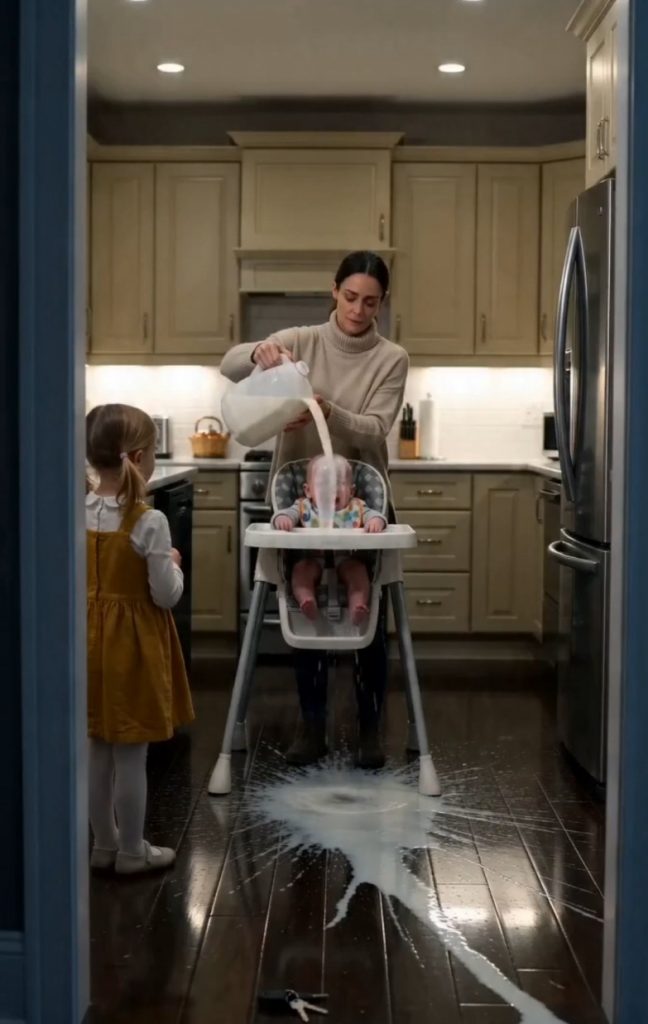
At the end of the hall, the kitchen glowed warm and golden. Cream cabinets. Under-cabinet lights. A polished wood floor. The kind of calm, beautiful room people posted in magazines and called a dream home.
But inside that light, something was wrong.
Celia stood beside the high chair with a white pitcher in both hands.
She was not rushing. She was not panicked. She was not trying to clean a spill.
She was pouring milk over his baby.
The stream fell over little Oliver’s head, soaking his colorful bib and splashing onto the floor. The infant thrashed in the high chair, crying so hard his small body shook. His hands waved blindly near his face, searching for comfort that was not coming.
Nathan’s keys slipped from his hand.
They struck the floor with a bright, terrible sound.
Celia turned her head.
She did not look ashamed.
She looked interrupted.
Beside the island, his six-year-old daughter, Mia, stood frozen in her yellow dress. Her pigtails were uneven. Her hands were clenched at her sides, and her eyes were red from crying she had clearly been trying to swallow.
Nathan could not move.
His mind rejected the scene, then accepted it all at once.
The woman he had trusted. The woman he had paid to protect his children. The woman who texted him smiling photos while he was away.
Standing in his kitchen like this was normal.
The pitcher emptied.
The last drops hit the floor.
Nathan dropped the suitcase handle and stepped forward.
“What are you doing?”
His voice did not sound like his own.
Celia placed the pitcher on the counter with chilling care.
“He needed to learn.”
Mia made a tiny sound.
Nathan crossed the kitchen and pulled Oliver from the high chair, wrapping him against his chest with shaking hands. The baby clung to him, sobbing, his little face pressed into Nathan’s coat.
Nathan looked at Mia.
She did not run to him.
That frightened him more than anything.
“Mia,” he whispered. “Sweetheart, come here.”
Her eyes flicked to Celia.
Then to the ceiling.
And with one trembling finger, Mia pointed upward.
Act II
For eight months, Nathan had believed Celia Voss was the reason his house had not fallen apart.
After his wife, Laura, died, people told him he was strong.
They said it at the funeral. At the office. In grocery store aisles when they saw him carrying Oliver in one arm and holding Mia’s hand with the other.
You’re so strong, Nathan.
He hated the words.
Strong was what people called you when they did not know what else to say.
In truth, he was surviving minute by minute. He signed documents, changed diapers, packed lunchboxes, answered emails, and fell asleep in hallways with one child pressed against his shoulder and another crying behind a bedroom door.
Laura had been the warmth of the house.
She remembered the songs Mia liked when she was scared. She knew how to make Oliver stop crying by humming against his hair. She left sticky notes in cabinets and birthday candles in labeled drawers. She could turn an ordinary Tuesday into something soft.
When she was gone, the house became too large.
Celia arrived through an elite childcare agency three months after the funeral.
She was calm, organized, and almost unnervingly efficient. She wore beige sweaters, kept her dark hair tied back, and spoke in the low, measured voice of someone who never lost control. The agency described her as “highly experienced with grieving families.”
At the interview, Mia hid behind Nathan’s chair.
Celia crouched and said, “Children need structure after loss.”
Nathan wanted to believe that.
He wanted to believe the tight schedules, the quiet meals, the sudden order in the laundry room were signs of healing. He wanted to believe Mia’s silence was grief. He wanted to believe Oliver cried when Celia held him because babies were unpredictable.
But there had been signs.
Mia stopped singing in the bath.
She stopped running to the door when Nathan came home.
She began asking permission for things she had never needed permission to do before.
“Can I drink water?”
“Can I hug Oliver?”
“Can I tell you something if it’s not bad?”
Each time, Nathan felt a flicker of concern.
Each time, Celia had an answer ready.
“Mia is testing boundaries.”
“Mia is seeking attention.”
“Mia becomes emotional when routines are disrupted.”
And Nathan, exhausted and afraid of failing, believed the adult who sounded certain.
Two weeks before his business trip, Mia drew a picture at school.
It showed their kitchen. A small yellow stick figure. A baby in a chair. A tall gray shape with no face.
Above them, in the corner, she had drawn a black dot.
Nathan asked what it was.
Mia whispered, “Mommy’s eye.”
He thought it was grief.
He kissed her forehead and told her Mommy was always watching over them.
Now, standing in the kitchen with Oliver shaking against him and Celia’s face still blank, Nathan understood something that made his knees nearly give way.
Mia had not been speaking in metaphor.
She had been trying to tell him where the truth was hidden.
Act III
The black dot was a camera.
Nathan had forgotten about it.
Laura had installed a small home security system after someone tried to break into a neighbor’s house during her pregnancy with Oliver. Not the obvious cameras Celia knew about near the front door and garage. Laura disliked making the house feel watched, so she chose tiny ceiling devices that looked like smoke sensors.
The kitchen camera had been her idea.
“If anything ever happens when we aren’t looking,” she had said, holding Oliver’s newborn socks in one hand and the installation guide in the other, “the house should remember.”
Nathan had laughed.
Now he almost broke under the memory.
Celia saw his eyes move toward the ceiling.
For the first time, her composure cracked.
“Nathan,” she said quickly, “you’re misunderstanding what you saw.”
He turned toward her slowly.
“You poured milk over my son.”
“He was screaming for no reason.”
“He is a baby.”
“He manipulates you,” she snapped.
The words were so absurd, so cold, that the room seemed to tilt.
Mia flinched.
Nathan saw it.
He shifted Oliver higher against his chest and reached for his daughter with his free hand.
“Mia,” he said softly. “Come to me.”
Her little face crumpled.
She ran.
The moment she hit his side, she began sobbing into his coat, one hand gripping his scarf, the other reaching toward Oliver.
“I tried to help him,” she gasped. “I tried, Daddy, I tried.”
Nathan lowered himself to the floor, holding both children as carefully as his shaking arms allowed.
“I know. I know, baby.”
Celia stepped forward.
“Nathan, don’t encourage this. She lies when she wants attention.”
Mia buried her face deeper.
Nathan looked up.
“Do not speak about my daughter again.”
Celia stopped.
Something in his voice reached her at last.
Nathan carried the children out of the kitchen and into the living room. He wrapped Oliver in a soft blanket from the couch, then checked Mia’s arms, face, shoulders, searching for signs he was terrified to find.
She understood what he was doing.
“She didn’t do that to me,” Mia whispered.
Nathan closed his eyes in brief relief.
Then she added, “She just made me watch.”
His heart shattered in a quieter way.
He called emergency services first. Then the police. Then his sister, Rachel, who answered on the second ring and stopped breathing when she heard his voice.
While waiting, Nathan opened Laura’s old security app on his phone.
He had not touched it in months.
Celia had told him the system was glitching. Too many alerts. Too many unnecessary clips. He had turned off notifications during a conference call and never turned them back on.
But the recordings had continued.
Nathan found the kitchen folder.
One clip.
Then another.
Then another.
Mia standing in the corner while Celia scolded Oliver for crying.
Celia taking food away when Mia spilled water.
Celia smiling into her phone seconds after Nathan sent a message asking, How are the kids?
Celia crouching in front of Mia and saying something the camera captured clearly.
“If you tell your father, he will send you away because he’ll know you are too difficult.”
Nathan stopped breathing.
Mia was sitting beside him, wrapped in a blanket, eyes fixed on the floor.
She had heard it again.
He locked the phone and pulled her into his arms.
“You are not difficult,” he said, voice breaking. “You are my daughter.”
Mia shook against him.
“And Oliver?”
“He is your brother. And nobody is taking either of you from me.”
In the kitchen, Celia was still standing near the puddle on the floor.
But now the house remembered.
And it had remembered everything.
Act IV
By the time the police arrived, Celia had changed her face.
The blankness was gone. The calm cruelty tucked away. In its place came tears, trembling hands, and a soft wounded voice that might have fooled anyone who had not seen the kitchen fifteen minutes earlier.
“It was an accident,” she told the officers. “The pitcher slipped. Mr. Vale is grieving and exhausted. He walked in at the worst possible angle.”
Nathan stood in the living room with Oliver in his arms and Mia pressed against Rachel’s side.
He said nothing at first.
He simply handed over his phone.
The officer watched one clip.
Then a second.
Then his expression changed.
Celia stopped crying.
“I need context,” she said.
The officer looked at her.
“You’ll have a chance to provide that.”
Her mouth tightened.
That was the second mask falling.
The first was kindness.
The second was victimhood.
Without them, there was only the cold, calculating woman who had ruled a grieving house by making children afraid to speak.
Rachel held Mia tighter.
Celia’s eyes flicked to the little girl.
“You caused this,” she said.
Nathan moved before the officer could.
He stepped between Celia and his daughter, Oliver still wrapped securely against his chest.
“No,” he said. “She ended it.”
For a moment, nobody spoke.
Then Mia lifted her face from Rachel’s sweater.
Her voice was small, but it did not disappear.
“Mommy’s eye saw you.”
Celia’s expression went slack.
That was the sentence that broke her.
The investigation moved quickly after that.
The agency tried to protect itself first. They called Celia an independent contractor. They claimed no prior complaints had been verified. They sent Nathan a carefully worded email expressing concern while avoiding responsibility.
Rachel, who was a family attorney and had never trusted Celia’s perfect references, made three phone calls.
By morning, they learned the truth.
Celia Voss was not the name she had used with two previous families. In one household, a toddler had become terrified of bath time. In another, an older child had developed sudden panic around meals. No charges had been filed because the families had signed quiet settlements with the agency.
The agency had not failed to know.
It had chosen not to ask.
Nathan spent the next week in a blur of statements, doctors, child therapists, police meetings, and nights sleeping on the floor between Mia’s bed and Oliver’s crib.
He did not go back to work.
He did not answer client calls.
He did not care who waited.
For years, Nathan had believed providing meant leaving the house to secure the future. Now he understood the future had been crying in his kitchen while he was away earning money for rooms that did not feel safe.
One evening, Mia found him in the hallway staring at Laura’s photograph.
“Are you mad?” she asked.
He turned quickly.
“No, sweetheart.”
“At me?”
The question wounded him more deeply than any accusation could have.
He knelt.
“Never.”
She looked unconvinced.
Nathan took a breath.
“I am mad at myself because I didn’t listen sooner.”
Mia’s eyes filled.
“I tried to tell you.”
“I know.”
Her lip trembled.
“You thought I was sad because of Mommy.”
Nathan’s voice broke.
“I did.”
“I was sad because of Mommy,” Mia whispered. “But not only.”
He pulled her close, and this time she did not stiffen. She folded into him like a child finally allowed to be tired.
In the kitchen, the floor had been cleaned.
But Nathan could still see the puddle.
He suspected he always would.
Act V
Celia was charged before the month ended.
The agency collapsed in public after three families came forward, then seven, then twelve. Parents who had been told they were overreacting finally saw their fears turn into evidence. Children who had been dismissed as difficult were believed.
Nathan did not attend every hearing.
Rachel did most of the legal fighting. Nathan focused on the smaller, harder work.
Breakfast.
Bedtime.
Trust.
Mia began therapy with a woman who kept colored pencils in glass jars and never made her sit still while talking. For weeks, she said almost nothing. She drew kitchens, doors, high chairs, and black dots in ceilings.
Then one day, she drew herself holding Oliver.
The therapist showed Nathan the picture afterward.
Mia had drawn a yellow dress, messy pigtails, and a smile so faint it could have been an accident.
“It’s a start,” the therapist said.
Nathan took the drawing home and placed it on the refrigerator.
Not hidden in a folder.
Not treated like evidence.
Displayed.
Oliver recovered faster in body than in sleep. He cried when placed in the high chair at first, so Nathan stopped using it. He fed him in his lap, then beside him, then finally in a new chair chosen by Mia, bright green and ridiculous and covered in cartoon frogs.
“It looks happy,” she said.
That was reason enough.
The kitchen changed too.
Nathan replaced the dark wood floor where the milk had spread. People told him it was unnecessary. The boards were fine. The stain had not lasted.
But memory had.
He chose warm oak instead.
Mia helped pick a rug.
Rachel hung Laura’s favorite copper pans back over the island, the ones Celia had removed because they looked “messy.”
The house slowly became imperfect again.
Toys in corners. Crumbs under chairs. Oliver banging spoons against bowls. Mia singing softly when she thought no one could hear.
The first time Nathan heard her sing, he stood in the hallway and covered his mouth with one hand.
He did not interrupt.
He let the sound fill the house.
On the anniversary of Laura’s death, Nathan expected the day to break them.
Instead, Mia asked to bake her mother’s lemon cake.
They made a terrible version of it.
Too dense. Too sweet. Frosting sliding down one side.
Mia laughed when Oliver stuck both hands into the middle.
Nathan laughed too, then cried without turning away.
Mia saw.
This time, she was not afraid of tears.
“Daddy?”
“Yes?”
“Are we okay?”
Nathan looked at his children. His daughter with flour on her cheek. His son smearing frosting across the tray. The kitchen warm, messy, alive.
He wanted to say yes.
He wanted to promise the kind of safety that no human being can fully guarantee.
Instead, he told the truth.
“We’re healing.”
Mia thought about that.
“Is healing okay?”
He kissed the top of her head.
“Healing is very okay.”
That night, after both children were asleep, Nathan stood in the kitchen and looked up at the small black camera in the ceiling.
Laura’s eye.
For months, he had thought grief lived only in things left behind. Clothes in closets. Photos on shelves. A mug nobody used but nobody moved.
Now he understood that love could live there too.
In a camera installed by a mother who wanted the house to remember.
In a daughter brave enough to point upward when her voice was too scared to rise.
In a father finally willing to see what pain had been asking him to notice.
Nathan opened the security app one last time.
He saved the evidence where the lawyers needed it.
Then he changed the system name.
It had been listed as Kitchen Camera.
He renamed it Laura’s Light.
Not because he wanted the children watched forever.
But because one day, when Mia was older and asked how the truth survived, he wanted to tell her this:
Her mother had left protection in the ceiling.
Her daughter had found the courage to point to it.
And the woman who thought fear could silence a child had forgotten one simple thing.
A house built with love can remember what cruelty tries to hide.