Act I
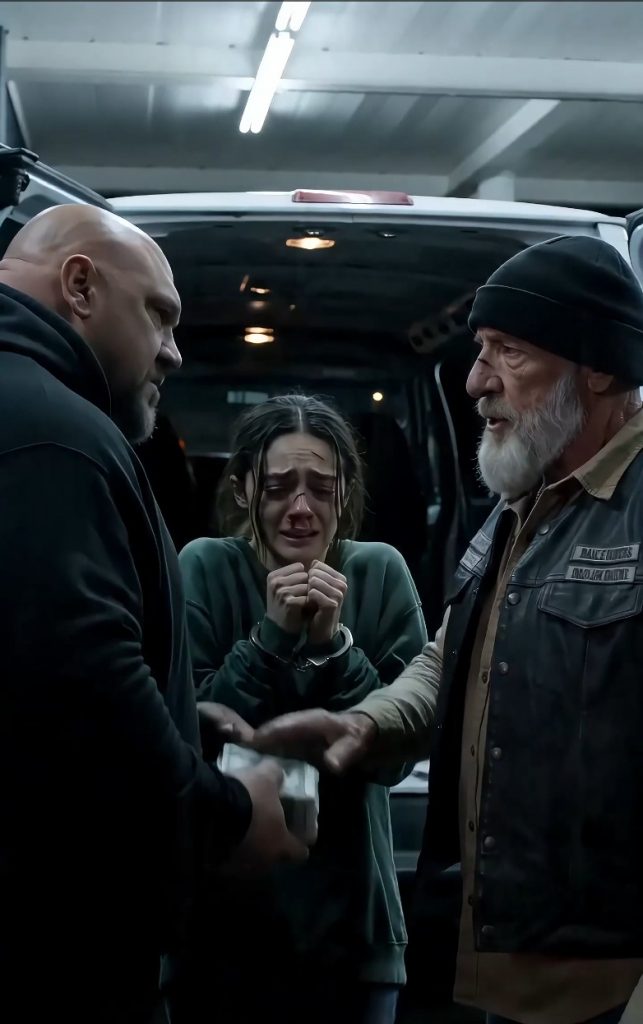
The old biker pressed the cash into the kidnapper’s stomach like it was not money at all, but a warning.
“Take it and drive,” he said.
His voice was low enough to disappear beneath the buzz of the fluorescent lights, but the man in the black hoodie heard every word. So did the young woman standing between them with her wrists locked in metal handcuffs and her shoulders folded inward as if she was trying to make herself vanish.
The place was wrong for mercy.
A gas station loading area after midnight. Brick walls. Cold concrete. Shadowed corners. A white van parked behind them with its rear doors open like a mouth.
The biker stood under the harsh light, white beard cut short, black beanie low on his forehead, leather vest creaking over a tan shirt. His face was weathered and calm, but his eyes were not calm.
They were counting everything.
The kidnapper’s hands. The van doors. The girl’s breathing. The cash.
The bald man grabbed the stack of hundred-dollar bills with both hands, greedy even when scared.
“That’s all of it?” he muttered.
The biker did not blink.
“That’s what you asked for.”
The kidnapper smiled, but it had no confidence in it.
Then, as he turned away, he struck the young woman lightly on the shoulder, just hard enough to make her flinch.
She gasped and stumbled back.
The biker’s jaw tightened.
For one second, the air changed. The old man’s whole body seemed to become still in a way that promised violence without moving toward it.
But he did not chase the kidnapper.
He watched him step toward the van, money tucked close to his chest.
The woman suddenly broke away, backing toward the brick wall with her cuffed hands lifted in front of her face.
“Don’t touch me!” she cried. “Don’t touch me!”
The biker stopped immediately.
He raised one hand, then lowered it when he saw her panic.
“I’m not coming closer,” he said.
She shook so hard the handcuffs clinked against each other. Her brown hair was tangled around her face. A faint scratch marked her forehead, and a small dark smear near her nose made her look even younger than she was.
Her eyes stayed on his hands.
Not his face.
His hands.
“Please,” she whispered, voice breaking. “Please don’t lie.”
The biker’s expression softened.
He kept his boots planted where they were.
“Nobody’s touching you,” he said.
Behind him, the van door shifted in the dark.
And the biker finally moved his eyes away from her.
Act II
Cal Granger had spent thirty years learning how not to look afraid.
Truck stops. Border towns. Back-road bars where men confused volume with strength. Military funerals. Hospital waiting rooms. Court benches. Doorways where mothers clutched children and asked if the bad men were really gone.
Fear had been with him so long it felt like an old passenger.
But he had never felt fear like the moment Nora Ellis’s mother called him.
“She’s gone,” Maribel said.
Cal was standing in his garage, rebuilding a carburetor that did not need rebuilding. His club brothers teased him for fixing machines that were already fine, but Cal had always preferred engines to silence.
“What do you mean gone?”
“She was closing the pharmacy. She texted me she was on her way. Then nothing.”
Cal wiped his hands slowly on a rag.
“Nora’s phone?”
“Off.”
“Police?”
“They said wait. They said maybe she left with someone. Cal, she wouldn’t.”
No, she would not.
Nora Ellis was twenty-four, stubborn, and too responsible to scare her mother for sport. She had grown up around Cal’s motorcycle club because her late father, Miguel, had once ridden beside him. Miguel saved Cal’s life in a storm on Route 17 and died three years later from a bad heart, leaving behind a wife, a daughter, and one request.
“Look out for my girls.”
Cal had promised.
He had kept that promise in ordinary ways.
Oil changes. Grocery runs. Fixing porch lights. Sitting in the back row at Nora’s college graduation in a black leather vest while Maribel cried into a tissue.
Then Nora vanished.
Two hours after Maribel called, a message arrived from Nora’s phone.
No police. Cash only. Old service station off Knox Road. Come alone or she disappears.
There was a photo.
Cal looked at it once, then put the phone down because his hands had started shaking.
Nora in a green sweatshirt.
Wrists cuffed.
Eyes wide with a terror that did not belong on the face of the girl who used to steal fries from his plate and call his Harley “the loud chair.”
Maribel begged to come.
Cal said no.
Then he called the only people he trusted more than rage.
The Iron Saints were not saints, despite the name. They were retired mechanics, veterans, nurses, truckers, and one former bailiff who looked harmless until he spoke. They had made enough mistakes in youth to know exactly why old men should not improvise justice under adrenaline.
So Cal did not go alone.
Not really.
He drove alone because the message demanded it. But two blocks out, in dark lots and side streets, men and women who loved Miguel Ellis’s daughter waited with phones, cameras, and steady hands.
The cash was real.
The serial numbers were recorded.
The police had been called after Maribel handed the threat to a detective who listened faster once Cal placed his own phone on the desk and said, “You have one chance to arrive before I solve this badly.”
The detective believed him.
Now the kidnapper had the money.
Nora was alive.
But the white van’s rear doors were still open.
And Cal had just heard movement inside.
Act III
Cal looked past Nora toward the van.
The kidnapper had stopped halfway there.
That alone was wrong.
A man who took ransom and had any sense would leave fast. This man paused as if waiting for something. Or someone.
Nora saw Cal’s eyes shift and panicked again.
“Don’t leave me,” she choked.
“I won’t.”
“You said I could go.”
“You can.”
“No.” Her voice cracked. “He said everybody says that.”
Cal felt the words like a fist.
The kidnapper turned, money still in one hand.
“Old man,” he called. “We’re done.”
Cal did not answer him.
He spoke only to Nora.
“Can you tell me your name?”
She blinked through tears, confused by the gentleness of the question.
“Nora.”
“Full name.”
“Nora Ellis.”
Cal nodded once.
“Your father was Miguel Ellis.”
Her face changed.
The fear did not vanish, but something else broke through it.
Recognition.
“You knew my dad?”
“He gave me the worst advice of my life and the best leather jacket I ever owned.”
A sob came out of her, unexpected and raw.
Cal kept his voice steady.
“He told me to look out for you and your mother.”
Her cuffed hands lowered an inch.
“He said you were dead.”
The words were barely audible.
Cal’s eyes hardened.
“Who did?”
She looked toward the van.
“The man inside.”
Cal’s blood went cold.
The bald kidnapper took a step back.
From inside the van came a muffled sound.
Not loud.
Not clear.
But human.
Nora squeezed her eyes shut.
“There’s another girl,” she whispered.
The parking lot seemed to tilt.
Cal did not move closer to Nora. He did not rush the van. He did not do anything that would give the man in the hoodie a reason to grab her again.
Instead, he lifted his left hand and touched two fingers to the edge of his leather vest.
A signal.
Across the street, a truck’s headlights flashed once.
Then went dark.
The kidnapper saw it.
His face changed.
“What the hell was that?”
Cal looked at him now.
“You should’ve driven.”
The kidnapper backed toward the van faster.
At the same time, two motorcycles turned into the far end of the lot, not roaring, not dramatic, just blocking the exit with quiet precision. A dark SUV rolled behind the white van. Red and blue lights flared silently for half a second before the sirens came alive.
Nora flinched so violently her shoulder hit the wall.
Cal spoke immediately.
“Eyes on me, Nora. Not them. Me.”
She looked at him.
“They’re here for you,” he said. “Not against you.”
The kidnapper ran.
He made it three steps before a detective came out from behind the SUV with a command sharp enough to freeze the whole lot.
“Hands where I can see them!”
The van rocked once.
A second voice screamed from inside.
Nora covered her ears with her cuffed hands.
Cal stepped between her and the chaos, still careful not to touch her.
“Nobody’s getting through me,” he said.
But when the police reached the van, the truth inside was worse than the ransom.
Act IV
The second girl was seventeen.
Her name was Emma Reed.
She was alive, frightened, and curled behind a row of taped boxes in the back of the van. A paramedic wrapped her in a blanket while an officer cut the plastic ties from her wrists. She kept asking for her older brother, then for her phone, then for someone to tell her mother she had not run away.
That sentence made Detective Mara Sloane stop writing for half a second.
Not run away.
Nora heard it and began crying again, but this time the tears were different. Not panic alone. Rage had entered them.
“They said that about me too,” she whispered.
Cal stood beside her while another officer unlocked the handcuffs. The moment the metal opened, Nora pulled her wrists to her chest and turned toward the wall as if freedom itself needed privacy.
“Nobody touches her unless she says,” Cal told the officer.
The officer nodded.
“Yes, sir.”
The kidnapper lay facedown on the concrete near the van, cuffed and furious. His name was Vince Colter. He had a record long enough to make every adult in that parking lot regret every delay that had put him back on the street.
But he was not the man Nora feared most.
That became clear when Detective Sloane found the second phone in the van.
Not Vince’s.
A clean phone. No contacts. No saved names. Just recent messages with instructions.
Bring Ellis girl first.
Old biker will pay.
Second pickup after midnight.
No mistakes.
Cal read the message over the detective’s shoulder and felt the old passenger return.
Fear.
Because someone had known exactly who to use against him.
Someone knew Miguel.
Someone knew Nora.
Someone knew Cal would come with cash.
Detective Sloane looked up.
“Who else knew your connection to her?”
Cal did not answer quickly.
Nora did.
“Marcus Vale.”
Cal turned toward her.
“Who?”
Nora’s voice shook, but she forced the words out.
“He came to the pharmacy last week. Said he knew my dad. Said Mr. Granger was dangerous and my dad had owed him money.”
Cal’s face went still.
Miguel had never owed him a cent.
Nora swallowed hard.
“He said if anything happened, I shouldn’t trust bikers. I should only trust him.”
Detective Sloane looked at Cal.
“Marcus Vale the attorney?”
Cal’s eyes narrowed.
Miguel’s old lawyer.
The man who had handled the insurance settlement after Miguel’s death. The man who told Maribel there were no hidden benefits, no club fund, no survivor account. The man who disappeared from Cal’s calls whenever questions became specific.
The man who had known about the life-insurance payout Cal helped Miguel set up privately for Nora when she was a child.
The payout that would fully release to her on her twenty-fifth birthday.
Two months from now.
Cal looked toward the cash in the evidence bag.
“This wasn’t about ransom.”
Nora lifted her head.
“What?”
Detective Sloane’s expression darkened as she followed the thread.
“They needed you scared, discredited, maybe missing long enough for legal access to something.”
Nora looked sick.
“My father’s trust.”
The words turned the night colder.
Vince Colter, still on the ground, started laughing.
Cal turned toward him slowly.
Detective Sloane moved first.
“Don’t.”
Cal stopped.
Not because he was calm.
Because Miguel’s daughter was watching.
And she had already seen enough men use fear as a language.
So Cal took one breath, stepped back, and looked at Nora.
“We do this clean,” he said.
She stared at him through tears.
“For my dad?”
“For you,” Cal said. “Your dad already knew you were worth protecting.”
Act V
Marcus Vale was arrested before sunrise.
He was not dragged from a mansion or caught trying to flee across a border. He was found in his office above a downtown bank, shredding documents while wearing a monogrammed robe and telling officers they had no idea who they were embarrassing.
They knew.
They had the burner phone records. The trust documents. Payments to Vince Colter through a shell company. Emails about declaring Nora “unstable and unreachable” if she missed the trust release hearing.
They also had Emma Reed’s statement.
Emma had been taken because she saw the van near the pharmacy and took a photo of its plate. She became a loose end. That was the phrase Marcus used in one message.
Loose end.
Her mother nearly collapsed when Detective Sloane brought Emma home.
Maribel did collapse when she saw Nora.
Only for a second.
Then she was on her knees in the police station lobby, holding her daughter without touching the places that hurt, whispering in Spanish and English and every language grief knows when relief finally arrives.
Nora clung to her mother with both free hands.
Cal stood near the vending machines, giving them space.
He did not expect Nora to look for him.
But she did.
Over her mother’s shoulder, her eyes found his.
“Don’t leave,” she said.
So he stayed.
Through statements.
Through medical exams.
Through the awful practical hours after rescue when the world asks survivors to explain the worst night of their lives in rooms that smell like coffee and copier paper.
Cal stayed with his hands visible and his voice low.
He asked permission before handing Nora water. Before placing his jacket over her shoulders. Before sitting beside her.
Every time, he waited for her answer.
That mattered.
By the next evening, the news had the broad shape of the story. Attorney arrested. Kidnapping plot uncovered. Missing teen found alive. Ransom exchange becomes police sting.
The headlines loved Cal.
He hated that.
They called him heroic. Fearless. A biker guardian. A legend in leather.
Cal knew better.
He had been afraid from the moment Maribel called until the moment Nora’s cuffs came off. Bravery, he thought, was mostly terror forced to walk in a straight line.
Nora refused interviews.
Emma did too.
That was one of the first choices the world gave back to them, and both girls took it.
Weeks passed before Nora visited the Iron Saints garage.
She came with Maribel and stood just inside the open bay door while motorcycles gleamed under afternoon light. The same vest Cal had worn that night hung on a hook near his workbench.
Nora stared at it.
“I thought you were buying me,” she said quietly.
Cal set down his wrench.
Every man in the garage suddenly became busy somewhere else.
Cal wiped his hands.
“I know.”
“I thought the money meant I belonged to whoever paid.”
His face tightened.
“No.”
She looked at him.
“You didn’t explain.”
“I didn’t want to argue with a man holding you cuffed beside a van.”
Nora nodded slowly.
That answer made sense, but sense did not erase what fear had done with the image.
Cal stepped back, giving her room.
“The money was never what you were worth,” he said. “It was bait. It was time. It was the easiest thing to hand over if it kept you breathing until help closed in.”
Nora’s eyes filled.
“And if the police hadn’t come?”
Cal held her gaze.
“They came.”
“That’s not an answer.”
“No,” he admitted. “It isn’t.”
She appreciated that more than a promise he could not honestly make.
On the workbench lay something wrapped in cloth.
Maribel placed it in Nora’s hands.
It was Miguel’s old riding patch, the one Cal had kept after the funeral because Maribel could not bear to look at it then. The edges were worn. The stitching had faded. But the name was still there.
MIGUEL.
Nora pressed it to her chest.
Cal’s voice roughened.
“Your dad made me promise to look out for you. I should’ve told you that sooner.”
Nora looked at the patch.
“He used to say bikers were loud because they were bad at asking politely for space.”
Cal smiled despite himself.
“That sounds like him.”
The trust was restored to Nora under court supervision. Marcus Vale’s polished career collapsed into evidence boxes and testimony. Vince Colter tried to trade names for mercy, but the paper trail already spoke louder than he could.
Emma Reed went back to school slowly.
Nora returned to the pharmacy months later, not to close alone, but to reclaim the last place she had stood before fear interrupted her life. Cal waited outside on his motorcycle with a cup of terrible gas station coffee and no questions.
When she locked the door, her hands shook.
Then steadied.
She walked to him under the white fluorescent lights.
“I did it,” she said.
Cal nodded.
“Yes, you did.”
The white van was gone by then, impounded and stripped for evidence. The loading area had been repainted. The gas station owner installed brighter cameras and a new emergency call box. The brick wall where Nora had stood was still there, but someone had washed away the scuff marks from her shoes.
Nora noticed.
For a moment, she seemed upset.
Then she touched the wall lightly.
“I remember it anyway,” she said.
Cal stood beside her.
“So do I.”
She looked at him.
“That night, when I said please don’t lie?”
“Yes.”
“I wasn’t asking if you were the good guy.”
Cal waited.
Nora swallowed.
“I was asking if safety was real.”
The old biker’s eyes softened in a way most people never saw.
“It is,” he said. “But sometimes it has to be rebuilt one minute at a time.”
Nora nodded.
Then, for the first time, she reached out first.
Not for a hug.
Not yet.
She touched two fingers to the edge of his leather vest, right where he had given the signal that night.
Cal understood.
A thank-you would have been too small.
A full embrace too much.
This was enough.
Years later, the Iron Saints would still tell the story carefully. Not as a tale of ransom or revenge. Not as a legend about an old biker staring down a kidnapper in the dark.
They told it as a lesson.
That rescue is not ownership.
That protection does not demand trust before it is earned.
That the strongest thing a frightening-looking man can do for a terrified woman is stop moving when she says stop.
And Nora, whenever she passed harsh fluorescent lights or heard van doors slam, remembered one sentence more clearly than all the others.
Not the threat.
Not the money.
Not the sirens.
The promise.
Nobody’s touching you.
It did not fix everything.
But it was the first true thing anyone said after the fear began.