Act I
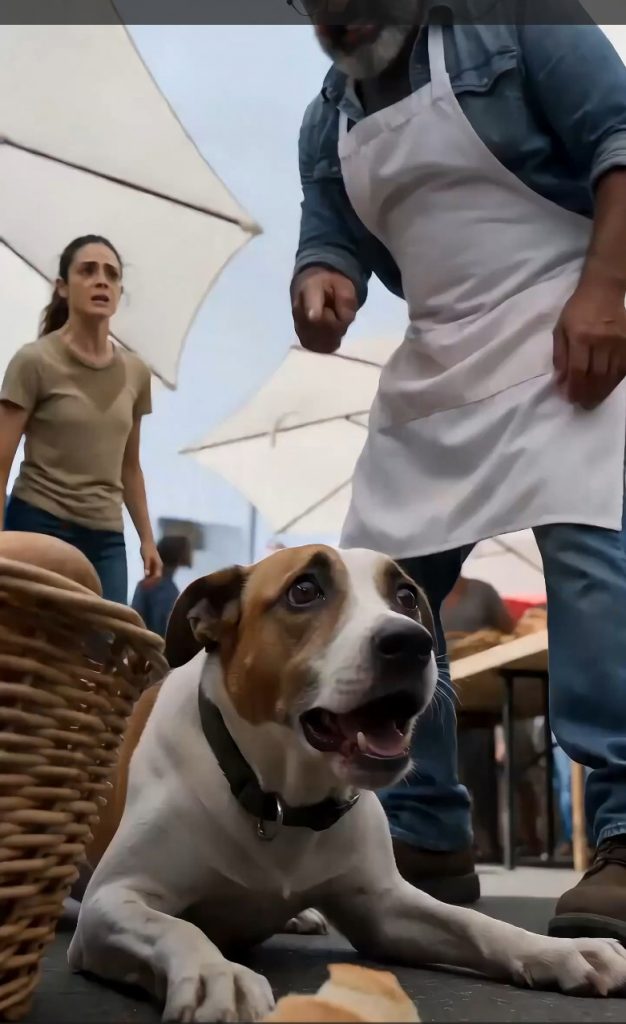
The dog only wanted bread.
That was what Nora Bell saw before anyone else moved.
A white-and-brown stray slipped between two market stalls, ribs faint beneath its patchy coat, nose lifted toward the warm baskets of baguettes on Frank Doyle’s wooden table. The farmers market was bright and crowded, full of white umbrellas, sunlit fruit crates, flowers wrapped in brown paper, and shoppers pretending the world was gentle because the morning smelled like coffee and fresh bread.
Then Frank kicked the dog.
The sound was quick.
Hard.
Ugly.
The dog yelped and stumbled backward, paws scrambling on the pavement. A baguette rolled from the table and landed near its feet.
Gasps rose from the shoppers.
Nora stepped forward before she realized she had moved.
“Frank, stop!”
Frank turned toward her, gray beard bristling, glasses flashing in the sunlight. He wore his usual white apron over a denim shirt, flour still dusted across his hands like innocence.
“This ain’t the first time,” he snapped, pointing down at the cowering animal. “That thing keeps stealing from me.”
The dog lowered itself near the fallen bread, trembling too hard to eat.
Nora stared at Frank.
“It’s hungry.”
“So feed it from your own pocket.”
A few shoppers murmured. One woman covered her mouth. Another looked away, suddenly very interested in tomatoes.
The dog’s eyes flicked from Frank to Nora.
Then it ran.
Past the bread table.
Past the flower buckets.
Past the edge of the sunny market and into the narrow alley beside the loading dock.
Nora followed.
“Hey, buddy,” she called softly. “It’s okay.”
The market noise faded behind her.
The alley smelled of hot concrete, cardboard, and trash bags baking beside green dumpsters. The dog slowed near a worn cardboard box, collapsed beside it, and turned its head toward her with wet, pleading eyes.
Nora stopped.
The dog was not just scared.
It was guarding something.
Then the cardboard box moved.
Act II
Nora had known Frank Doyle since she was twelve years old.
Everyone at Hawthorne Market knew him.
Frank’s Bread.
That was what the sign said in cheerful black letters above baskets of sourdough, rye loaves, and baguettes tied with twine. He arrived every Saturday before sunrise, parked his old delivery truck near the service alley, and stacked his bread like a man building a church.
People trusted him because he knew their names.
He gave end pieces to children.
He donated day-old rolls to the church pantry when cameras were nearby.
He told stories about his late wife, his bad knee, the old neighborhood before chain stores moved in. He played the part of a hard-working baker so well that people forgave the bitterness under it.
Nora never had.
Her mother, Elise Bell, used to run the little animal rescue booth at the far end of the same market. She was the woman who carried cans of food in her bag, stopped traffic for turtles, and once missed an important hospital appointment because a frightened dog would not come out from under a parked car.
Frank hated her.
Not openly at first.
He called the rescue booth “messy.” Said it attracted fleas. Said feeding strays encouraged a problem. When Elise placed a water bowl near the alley during a heat wave, Frank emptied it into the gutter.
Nora had been seventeen then.
She remembered her mother standing over the empty bowl, face pale from illness but voice steady.
“Cruelty is not cleanliness, Frank.”
He laughed.
“You rescue women always think softness is a virtue.”
Elise died six months later.
Cancer took her slowly, but the rescue work had kept her alive longer than doctors expected. At the funeral, Nora found a folded note in her mother’s coat pocket.
Keep feeding what the world calls inconvenient.
Nora carried that sentence like a second spine.
But after her mother died, the rescue booth vanished. Nora went to college. The market changed vendors, upgraded signs, and added music on weekends. Frank stayed.
So did the alley.
Now Nora stood in that same alley, years later, watching a kicked dog tremble beside a cardboard box.
The dog made a soft sound.
Not a bark.
A plea.
Nora lowered herself slowly, palms visible.
“I’m not going to hurt you,” she whispered.
The dog watched her hand, then the box.
A tiny whimper came from inside.
Nora’s breath stopped.
She moved closer inch by inch.
Inside the box were four puppies.
Tiny.
Dirty.
Curled together against a torn piece of towel.
One lifted its head blindly and made the smallest sound Nora had ever heard.
The mother dog tried to rise, but pain folded her back down.
“Oh no,” Nora whispered.
Behind her, Frank’s voice cut into the alley.
“Don’t touch that box.”
Nora turned.
Frank stood at the alley entrance, apron bright in the sun, expression no longer irritated.
Afraid.
Act III
For one second, Nora thought she had misheard him.
Then she saw the way Frank looked at the box.
Not surprised.
Not confused.
Recognizing it.
“You knew they were here,” she said.
Frank stepped into the alley, lowering his voice.
“You don’t know what you’re talking about.”
The mother dog pulled herself closer to the cardboard box, placing her body between Frank and the puppies.
Nora’s skin went cold.
“What did you do?”
Frank glanced back toward the market, where shoppers still lingered under white umbrellas, pretending not to be listening.
“That dog has been stealing from my stall all week,” he said. “I was handling it.”
“Handling it?”
“It’s a stray.”
“She’s a mother.”
“She’s a nuisance.”
Nora stood slowly.
The dog whimpered.
Frank’s eyes narrowed.
“Move away from the box.”
“No.”
His face changed again.
The friendly baker disappeared completely now. What remained was a man who had grown comfortable being obeyed in places where no one wanted trouble before noon.
“Nora,” he said, almost gently, “don’t make this your mother’s business.”
The sentence struck harder than his shout would have.
Nora’s mother had been dead eight years.
Frank still knew where to aim.
But Nora did not step back.
“It became my business when you kicked her.”
Frank’s jaw worked.
“You always were just like Elise.”
“Thank you.”
His hand tightened at his side.
Then the dog dragged herself forward and nosed something beneath the box.
Nora looked down.
Half-hidden under the towel was a green market tag.
Not a dog tag.
A vendor badge.
She picked it up carefully.
Hawthorne Market Temporary Storage Access.
Frank Doyle.
Nora looked at him.
Frank looked toward the alley entrance again.
Too late.
Two shoppers stood there now.
A woman from the flower stall.
A man from the honey table.
Both had heard enough to stop pretending.
The flower vendor stepped forward.
“Frank,” she said slowly, “why is your storage badge in a box with puppies?”
Frank’s mouth opened.
No answer came.
The dog’s eyes stayed on Nora.
Then Nora noticed another detail.
The towel beneath the puppies was printed with faded blue letters.
Bell Rescue.
Her mother’s old rescue logo.
Nora’s hands began to shake.
Frank saw her recognize it.
And for the first time that morning, his cruelty looked less like temper and more like evidence.
Act IV
The truth came from the old loading shed.
Not all at once.
Truth rarely does when people have spent years stacking lies over it like crates.
Nora called animal control first.
Then the market manager.
Then the police, because Frank tried to leave.
He claimed he had customers waiting. Claimed Nora was hysterical. Claimed the dog had crawled into the alley on its own and the box meant nothing.
But the mother dog kept staring at the loading shed behind his stall.
Nora noticed.
So did the animal control officer when she arrived.
The shed sat behind Frank’s bread table, half-hidden by flour sacks and empty delivery crates. Frank insisted it held packaging supplies. The market manager insisted he open it.
Inside were cages.
Not many.
Enough.
Old rescue bowls.
Blankets.
A stack of missing-dog flyers torn from telephone poles.
And a plastic bin filled with items Nora recognized with a pain so sharp she had to grip the doorframe.
Her mother’s rescue leashes.
Her mother’s donation tins.
Her mother’s old sign, cracked down the middle.
BELL RESCUE
Every Life Deserves Shelter
Nora turned toward Frank.
“What is this?”
Frank said nothing.
The flower vendor whispered, “Elise’s booth supplies disappeared after she died.”
The market manager looked sick.
“We thought the city cleared them.”
Frank adjusted his glasses with a shaking hand.
“I was cleaning up.”
“No,” Nora said. “You were hiding it.”
Then the animal control officer found the records.
A folder at the bottom of the bin.
Complaints Elise had filed years earlier about animals disappearing near the market.
Photos.
Notes.
Dates.
Frank’s name mentioned again and again.
Nora remembered her mother working late at the kitchen table, coughing into a tissue, writing down license plates and times. She remembered asking why it mattered so much.
Elise had smiled tiredly.
“Because someone is hurting what no one bothers to count.”
After Elise died, Frank took the files.
He buried the proof.
And for years, he kept controlling the alley.
The mother dog had not simply been stealing bread.
She had been surviving near the same shed where other animals had disappeared.
Her puppies had been hidden in a box lined with a towel from the rescue Frank tried to erase.
When police asked Frank why he kept the dogs, he became angry before he became afraid.
“People dump them here,” he snapped. “They ruin business. They dig through trash. They scare customers.”
“So you locked them up?” Nora asked.
“I kept them out of sight.”
The mother dog growled weakly from beneath the animal control officer’s blanket.
Frank looked at her with disgust.
“That one kept coming back.”
Nora looked down at the dog.
No.
Not coming back.
Escaping.
Returning to feed her puppies.
Frank had kicked a starving mother in front of a crowd because she had taken bread to keep her babies alive.
The market went silent when that understanding spread.
The same people who had gasped and frozen now stood beneath white umbrellas, looking at Frank’s baskets of bread as if they had changed shape.
One woman stepped away from the stall.
Then another.
Then everyone.
Frank looked around, suddenly aware that the market he had controlled with charm and routine had turned its back.
Nora picked up one of the fallen baguettes from the ground.
She placed it on his empty table.
“You were right about one thing,” she said.
Frank glared at her.
“This wasn’t the first time.”
Act V
The mother dog survived.
That was the first good news.
The veterinarian said she was bruised, dehydrated, underfed, and exhausted, but her heart was strong. The puppies were cold and hungry but otherwise alive. Four small bodies, four stubborn breaths, four chances the world had not yet taken away.
Nora stayed at the clinic until midnight.
She sat on the floor beside the recovery kennel while the mother dog watched her with tired eyes. The staff asked if she had a name.
Nora looked at the dog’s white coat, the large brown patches over her back and head, the way she kept lifting her nose every time one of her puppies squeaked.
“Maisie,” she said.
It had been her mother’s middle name.
The vet smiled softly.
“Maisie it is.”
The next morning, Hawthorne Market opened without Frank’s Bread.
His stall was covered by a white tarp.
People tried not to stare.
Then the flower vendor arrived carrying a folding table. The honey seller brought a water bowl. The woman who sold jams brought towels. Someone printed a temporary sign in thick black marker.
BELL RESCUE RETURNS TODAY
Nora stood in front of it for a long time.
She had not planned to reopen anything.
She had spent years telling herself rescue work belonged to her mother, that love like that was too costly, too exhausting, too full of endings that broke the people who tried to help.
But the alley had taught her something.
Walking away was costly too.
By noon, the table was covered with donations.
Dog food.
Blankets.
Leashes.
Cash in a glass jar.
A child placed a small stuffed animal beside the jar and whispered, “For the puppies.”
Nora had to turn away for a moment.
The investigation into Frank widened quickly.
Animal control found more records. Police found old complaints that had gone nowhere because no one wanted to accuse the friendly baker without proof. Former market workers came forward with stories of dogs vanishing, water bowls dumped, rescue flyers removed, and Frank laughing whenever Elise Bell tried to intervene.
Frank claimed he was protecting his business.
The court called it cruelty.
His vendor license was revoked. His bakery closed after customers stopped coming. A judge ordered restitution to the rescue fund and banned him from owning or handling animals.
Some people said his punishment was too harsh for “just a dog.”
Nora learned to answer that calmly.
“It was never just a dog. It was a pattern. Maisie was the one who finally made you see it.”
Maisie recovered slowly.
At first, she trusted no one near food. She would take a piece of bread, carry it to the corner of the kennel, and stand over it until all four puppies had sniffed it. She flinched at heavy shoes. Turned away from men with gray beards. Trembled whenever metal doors slammed.
Nora never rushed her.
Every day, she came to the clinic with soft food, warm blankets, and her mother’s old rescue leash washed clean. She sat outside the kennel and read aloud from whatever book she had in her bag.
One afternoon, Maisie stood, limped to the kennel door, and placed her nose against Nora’s fingers.
The gesture was small.
Nora cried anyway.
The puppies grew fat and loud.
One had Maisie’s brown head and white body. One had a patch shaped like a heart on its side. One tried to bite every shoelace in the clinic. The smallest one, a sleepy little female with speckled paws, refused to nap unless tucked against Maisie’s neck.
They were adopted into careful homes after weeks of checks, visits, and more paperwork than some people expected.
Nora made no apologies.
Love without caution was how vulnerable creatures ended up in alleys.
Maisie stayed with Nora.
No one was surprised.
The first time Nora brought her home, Maisie stood at the doorway of the small apartment and looked uncertain, as if homes were promises she had learned not to trust. Nora placed a piece of bread on the floor just inside.
Maisie sniffed it.
Then looked at Nora.
“You don’t have to steal it,” Nora whispered. “It’s yours.”
Maisie stepped inside.
That was how a rescue became a home.
Months later, Hawthorne Market held its first adoption day under the old white umbrellas. The Bell Rescue table stood where Elise’s booth had once stood. Nora hung her mother’s cracked sign behind it, repaired with two brass hinges and a strip of wood.
Not hidden.
Not replaced.
Repaired.
People came all day.
Some to donate.
Some to apologize.
Some because guilt had finally matured into action.
The onlookers from the day Frank kicked Maisie arrived too. The women who had gasped but not moved stood in front of Nora with bags of dog food and eyes full of shame.
“I should have done more,” one said.
Nora looked at her.
“Yes.”
The woman flinched, then nodded.
“I will next time.”
Nora believed her.
Not completely.
But enough to accept the dog food.
Near the end of the day, a little boy dropped a piece of baguette near Maisie’s paws by accident. Maisie lowered her head, sniffed it, and froze.
Nora watched carefully.
The boy’s mother reached for him.
But Maisie only picked up the bread gently and carried it to Nora’s feet.
Not to hide it.
Not to guard it.
To share.
Nora crouched and pressed her forehead lightly to Maisie’s.
“You’re safe,” she whispered.
Maisie sighed, as if she was beginning to believe that word could belong to her.
The market never felt the same after Frank.
That was a good thing.
People began noticing the water bowls. The rescue flyers. The stray cat near the flower stall. The elderly man who needed help carrying groceries. The teenager crying behind the jam table. Once a community learns how silence helped cruelty, it either changes or proves the lesson meant nothing.
Hawthorne changed.
Slowly.
Imperfectly.
But it changed.
Every Saturday morning, Nora arrived early with Maisie trotting beside her. They passed the loading shed, now cleaned out and painted blue. They passed the alley where the green dumpsters had been moved and the cardboard cleared away. A small mural covered the brick wall now: a white-and-brown dog standing beneath painted sunflowers, four puppies at her feet.
Underneath, in Elise Bell’s handwriting copied from an old note, were the words:
Keep feeding what the world calls inconvenient.
Nora touched the wall every market day.
Sometimes people asked her if seeing the mural made her sad.
She always said no.
It made her remember.
There was a difference.
Years later, the story of Frank and Maisie became something people told newcomers at the market. Some told it as scandal. Some as rescue. Some as proof that bad people eventually get caught.
Nora knew it was simpler and harder than that.
A hungry dog was kicked in public.
Most people gasped.
One person followed.
That was the entire hinge of the story.
Not heroism.
Not fate.
Not destiny dressed in sunlight.
Just one decision not to let pain disappear into an alley.
Maisie lived to be old, soft around the muzzle, stubborn about rain, and deeply committed to stealing socks from Nora’s laundry basket. She never stole bread again, though market vendors offered it constantly.
She preferred to sit beneath the rescue table, watching the crowd with calm brown eyes.
Every so often, a frightened dog would arrive at the booth, pulling back from hands, startled by voices, unsure whether kindness was another trick.
Maisie always knew.
She would rise slowly, walk over, and sit nearby.
Not touching.
Not crowding.
Just present.
And more often than not, the frightened dog would look at Maisie first.
Then at Nora.
As if asking the same question Maisie once asked beside a cardboard box in a dark alley.
Can I trust her?
Maisie’s answer was always silent.
But it was always yes.