Act I
The boy’s whisper was softer than the rain.
“Please,” he said. “Cut it off.”
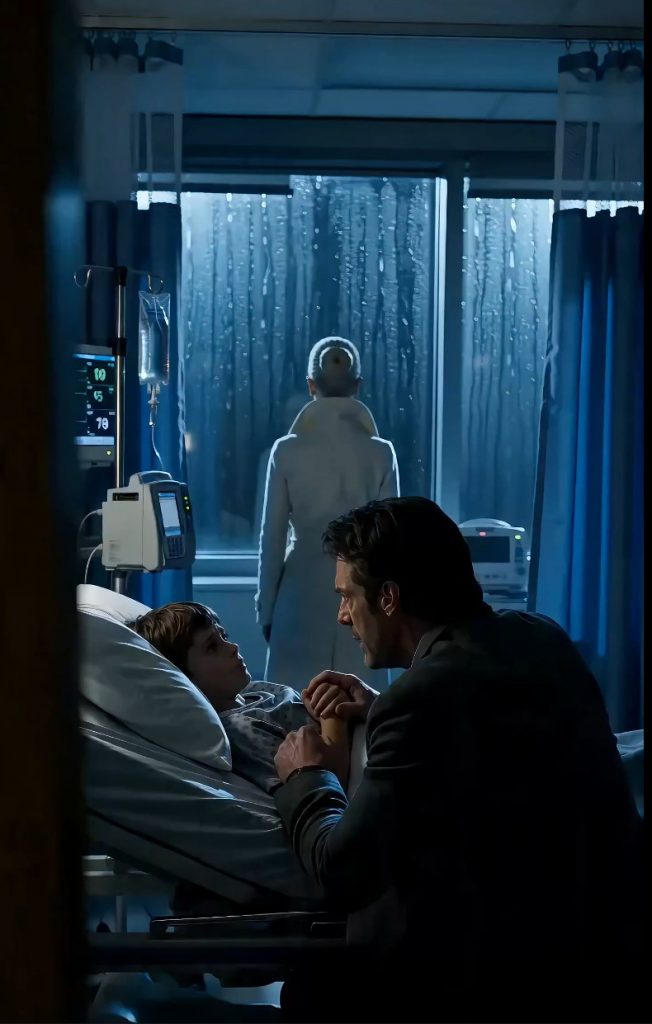
His father froze beside the hospital bed.
The room was dim and blue with night. Rain streaked the large window in silver lines. A monitor beeped quietly near the boy’s pillow, steady enough to feel cruel against the panic in his face.
Noah West lay under a thin hospital blanket, his light hair damp at the temples, a patterned gown loose around his small shoulders. A white bandage wrapped his left arm. His fingers clutched it as if something beneath it might move if he let go.
His father, Adrian, knelt beside him in a dark suit jacket and black shirt, one hand holding Noah’s unbandaged fingers.
“What are you talking about?” Adrian asked, voice tight with fear.
Noah’s eyes filled.
“There’s something inside my arm.”
Across the room, beside the rain-black window, Vivian Hale stood perfectly still.
She wore white.
A long, elegant coat. Pale blonde hair pinned into a smooth low bun. Calm face. Calm hands. Calm voice.
Too calm.
“He’s confused,” she said, walking toward the bed with a gentle smile that did not reach her eyes. “The medication is affecting him.”
Noah shook his head hard.
“No.”
Adrian looked from his son to Vivian.
For weeks, he had trusted her explanations. Shock. Stress. Pain medication. Anxiety after the accident. Children imagined things when they were frightened.
But Noah’s grip on the bandage had gone white.
His fear was not vague.
It was specific.
“Dad,” Noah cried. “Please.”
The door opened.
A younger woman stepped into the room carrying a black leather bag. Her chestnut-brown hair was loose around a sharp, focused face. Rain dotted her charcoal coat. Her hazel eyes moved once from Noah to Vivian, then to the bandaged arm.
“No,” she said. “He’s telling the truth.”
Vivian turned.
For the first time, her polished expression tightened.
“Who let you in here?”
The woman did not answer her.
She walked to the bed, opened the black bag, and took out a small silver utility knife.
Adrian rose halfway.
“What are you doing?”
The specialist looked at him.
“Opening the bandage,” she said. “Not touching his skin.”
Noah stopped crying for one stunned breath.
The blade caught the hospital light.
And Vivian stepped forward too fast.
Act II
Three months earlier, Adrian West would have sworn he knew every danger around his son.
He knew about the staircase in the old house where Noah liked to slide on socks. He knew the foods that triggered his allergies. He knew the way Noah pretended to be fine when he was getting a fever because he hated missing school.
He knew the ordinary fears of fatherhood.
He did not know Vivian Hale was one of them.
Vivian entered his life as a solution.
After Adrian’s wife, Elise, died, the house became too quiet. Noah stopped sleeping through the night. Adrian stopped answering calls unless they came from the school or the office. He ran a medical software company during the day and walked through grief at night like a man trying not to wake the dead.
Vivian was introduced by a board member.
A “family care consultant,” they called her.
She was poised, discreet, expensive, and remarkably good at making difficult things feel managed. She organized appointments. Rescheduled therapy sessions. Spoke to teachers. Brought groceries. Replaced the flowers by Elise’s portrait before they wilted.
Adrian mistook efficiency for kindness.
Noah did not.
He said Vivian smelled like hospitals.
He said she watched him when Adrian was not home.
He said once, very quietly, “She doesn’t like when I talk about Mom.”
Adrian told himself the boy was grieving.
That was the easiest explanation.
Then came the night Noah collapsed.
Vivian said she found him at the bottom of the stairs.
There were no broken bones, only bruising, shock, and confusion. The hospital admitted him for observation. Vivian stayed close, speaking to nurses in that polished voice that made everyone assume she belonged wherever she stood.
But Noah got worse at night.
He woke trembling. He complained of pressure in his arm. He said the bandage felt wrong. When Adrian asked the doctors, Vivian answered before they could.
“He’s frightened,” she said. “He keeps fixating.”
The doctors checked the chart. Medication had been given. Tests were pending. The bandage covered an IV site and mild irritation, nothing urgent.
That was what the chart said.
But there was one person Adrian had not known to call.
Dr. Mara Ellison.
Elise had known her.
Years before, when Elise served on a patient safety board, Mara had exposed a clinic that hid unapproved medical devices under routine dressings during a private trial. She had a reputation for being difficult, which in hospitals often meant she asked questions people hoped would stay buried.
Before Elise died, she left Adrian a sealed folder.
He did not open it until the third night Noah begged him to remove the bandage.
Inside was a letter.
If anything ever happens and someone tries to control Noah’s care without listening to him, call Mara Ellison. Trust Noah before you trust calm adults.
Adrian called Mara at 1:12 in the morning.
By 2:03, she was outside the hospital room with a rain-soaked coat, a black leather bag, and a copy of Noah’s chart already marked in red.
And the first thing she noticed was that the bandage on Noah’s arm was not hospital standard.
Act III
Vivian reached for Mara’s wrist.
Mara stepped back before contact.
“Do not touch me.”
Her voice was not loud, but everyone in the room stopped moving.
Vivian’s smile returned in a thinner shape.
“This child is under medical care. You cannot walk in here with a knife and start playing hero.”
Mara looked at Adrian.
“Did you authorize me to examine the dressing?”
Adrian’s throat worked.
“Yes.”
“Say it clearly.”
“Yes,” he said, stronger. “I authorize it.”
Vivian’s eyes flashed.
“He’s exhausted. He doesn’t understand what he’s agreeing to.”
Mara turned toward her.
“You’ve been speaking for everyone all night. That ends now.”
Noah stared at Mara, breathing in little broken pulls.
She lowered the blade so he could see it clearly.
“Noah, I’m going to cut the tape on the outside,” she said. “I won’t hurt you. You can tell me to stop.”
He nodded quickly.
“Please.”
Adrian held his other hand.
Mara slid the tip beneath the edge of the outer wrap and cut with tiny, careful motions. No drama. No blood. No sudden movement. Only the soft rasp of tape giving way and the rain tapping against the window.
The bandage loosened.
Noah squeezed his father’s hand.
Vivian stood too still.
That stillness betrayed her more than panic would have.
Mara peeled the outer wrap back.
Beneath it was not a simple gauze pad.
A flat white adhesive patch had been pressed against Noah’s skin, hidden beneath layers of medical tape. Attached to the patch was a thin plastic module no larger than a coin, with a faint blinking light nearly covered by the wrap.
Adrian stared.
“What is that?”
Mara’s face went cold.
“Not on his chart.”
Vivian spoke too quickly.
“It’s a standard monitoring patch.”
“No,” Mara said. “It isn’t.”
Noah began sobbing again, but this time from relief.
“I told you.”
Adrian bent over him.
“I know. I know, buddy. I’m sorry.”
Mara removed the patch carefully and placed it into a sterile tray without pressing any buttons on it. Then she pointed to the bandage layers.
“This was placed under the wrap after the nurse signed off on his dressing change. It was meant to look like part of the hospital work.”
Vivian’s voice sharpened.
“You’re making accusations without evidence.”
Mara looked at the small blinking device.
“No. I’m preserving evidence.”
The door opened again, this time with a nurse and the night supervisor rushing in.
Vivian’s face changed.
She was losing the room.
Mara reached into her bag and pulled out a printed medication log.
“Someone added a sedating medication request under Dr. Patel’s name at 11:48 p.m.,” she said. “Dr. Patel was in surgery at 11:48.”
Adrian turned slowly toward Vivian.
The rain beat harder against the glass.
And Vivian, for the first time, looked afraid of a child telling the truth.
Act IV
The hospital became very quiet around Noah’s room.
Not calm.
Quiet.
The kind of quiet that happens when people realize a mistake has become a crime scene.
The night supervisor called security. The nurse removed herself from the room and returned with another nurse as a witness. Dr. Patel was contacted in surgery and confirmed he had not ordered any additional sedative. The medication request was frozen in the system before anyone could erase it.
Vivian tried to leave.
Adrian blocked the doorway.
He did not touch her. He did not shout. He only stood there, taller than she remembered, no longer confused enough for her to guide.
“Stay,” he said.
Her face hardened.
“You’re making a terrible mistake.”
“No,” Adrian said. “I already made one. I let you speak over my son.”
The words struck both of them.
Noah heard them from the bed and closed his eyes.
Mara stood beside the tray holding the hidden patch.
“This module may contain dosage history,” she said. “It needs to go to hospital security and then law enforcement.”
Vivian laughed once.
It sounded nothing like amusement.
“You have no idea what you’re interfering with.”
Mara’s eyes narrowed.
“Then explain it.”
Vivian looked at Adrian.
“You were drowning after Elise died. I kept your family standing.”
“You isolated my son.”
“I protected him from your grief.”
“You drugged him.”
Her mouth shut.
The silence after that was worse than denial.
The truth came out in pieces over the next forty-eight hours.
Vivian was not a doctor. She was not a licensed therapist. She had once worked for a private medical consulting firm that specialized in managing “high-value family transitions,” a phrase that sounded harmless until investigators learned what it meant.
She had been hired first by Adrian’s company board to keep him functional after Elise’s death.
Then she stayed for herself.
Elise had left her shares in Adrian’s company to Noah through a protected trust. If Noah was declared medically unstable or mentally impaired, control of those shares could temporarily pass to a court-appointed medical guardian. Vivian had been preparing to recommend one.
A man connected to her old firm.
A man who had already drafted documents.
The hidden patch was not the whole plan.
It was only the pressure.
Keep Noah frightened. Keep him confused. Make his warnings sound like symptoms. Make Adrian doubt his son long enough to sign the next form.
The old trick was simple.
Turn a child’s truth into a child’s problem.
But Elise had seen more than Vivian ever knew.
The sealed folder Adrian opened contained not only Mara’s number, but copies of Elise’s concerns, notes about Vivian’s background, and a line written in Elise’s handwriting that Adrian could barely read without breaking.
Noah notices what adults hide. Believe him.
At the hospital, Noah asked to see the patch once it was sealed in evidence.
Mara showed him through a clear bag.
He stared at it.
“That was what I felt?”
“Yes,” she said. “It was under the bandage, pressing against your arm. You were right.”
He looked at his father.
“You thought it was the medicine.”
Adrian’s face folded with shame.
“I did.”
Noah’s lower lip trembled.
“I wasn’t lying.”
Adrian sat beside the bed and took his hand.
“I know. And I will spend the rest of my life making sure you never have to prove fear that hard again.”
Noah cried then.
So did his father.
Mara turned toward the rain-dark window and gave them the privacy Vivian had never understood how to offer.
Act V
Vivian left the hospital in handcuffs two days before Noah went home.
Noah did not watch.
Adrian asked if he wanted to.
Noah shook his head.
“I don’t want her to see me.”
That was enough.
The investigation widened quickly. The consulting firm denied wrongdoing until digital records from Vivian’s laptop connected her to forged medication requests, unauthorized access to Noah’s chart, and draft guardianship papers that had never been shown to Adrian.
The hospital issued statements.
The board hired lawyers.
Vivian claimed she had acted out of concern.
Mara read that line aloud once, in a conference room full of administrators, and then placed the sealed patch on the table.
“Concern does not hide under a bandage,” she said.
Nobody argued.
Noah recovered slowly.
The medication cleared. His sleep returned in pieces. The bandage came off for good, replaced by nothing but clean skin and the occasional protective glance from his father, who had to learn not to ask are you sure every time Noah said he felt something.
Trust was not restored by apology.
It was restored by behavior.
So Adrian listened.
When Noah said a nurse made him nervous, Adrian asked if they wanted a different one. When Noah said he wanted Mara in the room during discharge instructions, Adrian called her. When Noah said he did not want to return to the old house yet because Vivian’s perfume was still in the hallway, Adrian booked a quiet apartment near the park and let the house sit empty until Noah was ready.
One evening, weeks after the hospital, Noah found the sealed letter from his mother on the kitchen table.
Adrian had not meant to leave it there.
Noah picked it up carefully.
“Mom wrote this?”
“Yes.”
“Can I read it?”
Adrian hesitated only because grief makes parents want to protect children from the very love they need most.
Then he nodded.
Noah read slowly.
He stopped at the line about believing him.
His eyes filled, but he smiled.
“She knew.”
Adrian swallowed.
“She always did.”
Noah folded the letter and held it against his chest.
For the first time since the hospital, the room felt warm.
Mara remained part of their lives in the strange way people do after arriving at the exact moment a family almost breaks. She did not become sentimental. She did not soften her sharp edges for comfort. She checked on Noah’s case, testified when needed, and once brought him a model airplane because she remembered from his chart that he liked engineering.
Noah studied the pieces.
“You’re bad at gifts,” he told her.
Mara raised an eyebrow.
“It has wings.”
“It’s for ages twelve and up. I’m nine.”
“You said you wanted to be an engineer.”
Noah considered that.
Then he smiled.
“I’ll allow it.”
Adrian laughed from the kitchen, and the sound surprised him. It had been months since laughter came without guilt attached.
The court eventually locked Noah’s trust beyond the reach of Adrian’s board, Vivian’s firm, or any future “consultant” who believed grief made families easy to rearrange. Adrian stepped down temporarily from his company and exposed the board members who had brought Vivian into their lives.
Some called it a scandal.
Adrian called it a correction.
Months later, on a clear night after weeks of rain, Noah returned to the hospital for one final follow-up. He walked past the room where everything had happened and stopped in the hallway.
The door was open.
The bed was empty.
The window reflected city lights instead of stormwater.
Noah stared inside.
Adrian stood beside him, waiting.
Finally, Noah said, “I thought nobody would believe me.”
Adrian’s voice was quiet.
“I should have believed you sooner.”
“Yeah.”
The honesty hurt.
It also healed more than a softer answer would have.
Noah looked up.
“But you called Dr. Mara.”
“I did.”
“Because of Mom.”
“At first,” Adrian said. “Then because of you.”
Noah nodded.
That mattered.
At the end of the hall, Mara appeared in her charcoal coat with the black leather bag over one shoulder.
Noah pointed at it.
“Do you still have the scary knife?”
Mara’s mouth twitched.
“It’s a utility tool.”
“It was scary.”
“It got your bandage open.”
Noah thought about that.
“Then it can be both.”
Mara accepted the correction with a solemn nod.
Outside, the sky had cleared. The city pavement still held the shine of old rain, but the storm had moved on.
Noah walked between his father and the specialist toward the elevator, no bandage on his arm, no hidden device beneath tape, no polished voice in white telling the room he was confused.
For the rest of his life, he would remember that night in fragments.
The rain.
The beeping monitor.
His father’s hand.
Vivian’s smile.
The click of Mara’s bag.
The flash of silver.
But most of all, he would remember the sentence that changed everything.
No. He’s telling the truth.
It was not a cure.
It was not magic.
It was something stronger.
It was the moment an adult listened before the lie could become his diagnosis.