Act I
The rope should have come loose.
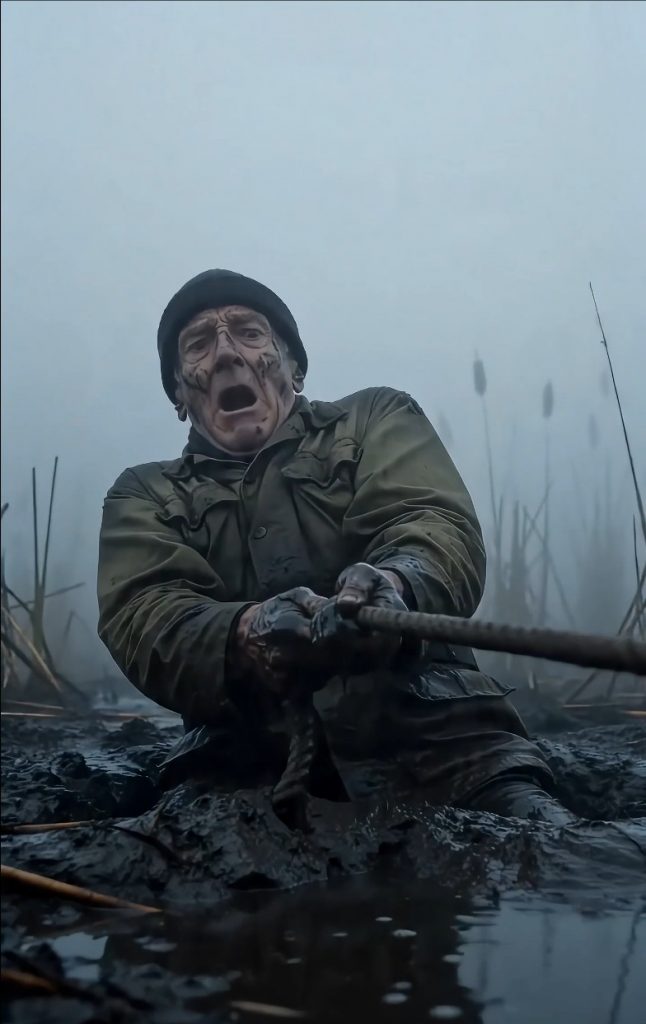
That was what Harlan Reed kept telling himself as he pulled with both hands, mud slicking his fingers, swamp water dripping from the thick fibers onto his already ruined jacket.
It should have been a stump.
A sunken branch.
A rusted trap.
Something dead.
Something simple.
But the rope pulled back.
Harlan stood waist-deep in the swamp, boots swallowed by mud, green military jacket plastered to his shoulders, black beanie wet with fog. His breath came hard through clenched teeth. Every time he leaned back, the swamp answered with a deep sucking sound, as if the ground itself had teeth.
“Come on!” he shouted.
His voice vanished into the gray fog.
There was no road in sight. No house. No boat engine. No person close enough to hear him if the mud took him down.
Only reeds. Water. Fog. And the rope.
It disappeared beneath the murky surface in front of him, stretched tight as a wire. Harlan wrapped it around his forearm, planted his feet, and pulled again.
The water bubbled.
Not little bubbles.
Large ones.
They rolled up from beneath the surface with a thick, rotten gurgle that made his shoulders lock.
The rope jerked downward.
Harlan gasped and nearly lost his grip.
For one awful second, he thought something alive had the other end.
Then the surface swelled.
Mud rose.
Water pushed outward in slow, heavy ripples.
A large rounded shape began to emerge from beneath the swamp, coated in black sludge, curved like the back of some buried animal waking after years in the dark.
Harlan stopped pulling.
His eyes widened.
The muddy dome rose higher.
Water slid off it in sheets.
Something metal glinted beneath the mud.
Harlan’s mouth opened, but no words came.
The shape turned slightly with the pull of the rope, and under a smear of sludge, he saw three faded letters.
W-A-R.
Not warning.
Warden.
Harlan stumbled backward, breath catching in his throat.
Because the object beneath the swamp was not alive.
It was worse.
It was his son’s patrol truck.
Act II
For eighteen years, people in Marrow County said Mason Reed had run.
They said it quietly at first, because Harlan was still strong then and had the kind of eyes that made cowards lower their voices. Then they said it louder as the years passed, as Harlan’s hair went white, as his wife stopped coming to church, as the missing posters peeled from gas station windows and became local history instead of news.
Mason ran.
Mason took money.
Mason got scared.
Mason left his family to carry shame he had earned.
Harlan never believed one word of it.
Mason had been a wildlife warden for the county, the kind of man who stopped for injured birds and fixed broken fence posts that were not his. He knew the swamp better than anyone alive. He knew which ground was safe, which water hid old sinkholes, and which channels turned dangerous after rain.
He also knew men were dumping things in Blackfen Swamp.
Not trash.
Not old tires.
Chemical drums from a closed manufacturing plant outside town. Barrels moved at night. Paperwork signed by people who never came near the mud. A private development company wanted the land cleared, drained, and rezoned. The swamp was supposed to become a resort with boardwalks, rental cabins, and a fake lake clean enough for brochures.
Mason started collecting proof.
Photographs. Water samples. License plate numbers. Copies of transfer forms.
Then he vanished.
His patrol truck vanished with him.
Two days later, Sheriff Dale Mercer stood on Harlan’s porch with his hat in his hands and a lie already polished.
“Mason was under investigation,” Mercer said. “We think he may have fled.”
Harlan’s wife, Ruth, made a sound like something inside her had torn.
Harlan only stared.
“My son doesn’t run.”
Mercer looked past him toward the dark fields.
“Good men do bad things when they’re desperate.”
Harlan stepped forward.
“Bad men say that when they need good men buried.”
That was the last honest conversation Harlan ever had with the sheriff.
After that came searches that ended too early. Reports that contradicted witnesses. Evidence that disappeared before it reached the state office. The county sealed Mason’s personnel file. The development company sold the swamp project to another shell business, then another.
Ruth died six years later still sleeping with Mason’s last voicemail saved on her phone.
Harlan played it every Sunday.
Hey, Mama. Tell Dad I found something ugly. Don’t let him come looking yet. I’ll explain tomorrow.
Tomorrow never came.
Then, after a summer drought dropped the swamp lower than anyone had seen in decades, Harlan found the rope.
It was tied to a cypress root using a knot Mason had learned from him as a boy.
A double bowline.
Strong. Practical. Almost impossible to slip by accident.
Beside it, carved faintly into the bark, was one word.
PULL.
So Harlan came back at dawn with no permission, no escort, and one old grief that refused to die politely.
And now the swamp was giving back what the county had buried.
Act III
Harlan did not remember calling for help.
He only remembered standing in the mud, staring at the curved roof of Mason’s truck as fog curled around it like the swamp was trying to hide it again.
The rope was tied to the roof rack.
That was why it had pulled back.
Not because something beneath the water was alive.
Because the truck had been sealed into the mud for eighteen years, and the swamp did not surrender secrets gently.
Harlan touched the metal with one shaking hand.
Blue-green paint showed beneath the sludge.
County Wildlife Unit 4.
Mason’s truck.
His son had not driven away.
He had been hidden.
By the time Deputy Lena Ortiz arrived with two rescue divers and a county tow rig, Harlan was sitting on a patch of firmer ground, covered in mud from chest to boots, both hands wrapped around the rope like letting go would erase the truck from existence.
Lena crouched beside him.
“Harlan.”
He did not look at her.
“They said he ran.”
“I know.”
“They said he stole.”
“I know.”
He turned then, eyes wet and furious.
“They drove past my house for eighteen years knowing he was here.”
Lena had no answer.
Her father had been a deputy under Sheriff Mercer. He died before telling her everything, but in his last year he drank too much and once muttered that Blackfen had swallowed a better man than the county deserved.
Lena had carried that sentence like a stone.
Now she saw what it meant.
The divers worked slowly. Carefully. No one spoke more than necessary. They secured cables. Cut reeds. Marked the soft edges where the ground could collapse. The tow rig groaned as the truck rose inch by inch from the swamp that had held it like a fist.
The windows were black with mud.
The license plate appeared first.
Then the cracked windshield.
Then the passenger door, dented inward.
Harlan stood when the truck cleared the surface.
Lena touched his arm.
“You don’t have to watch.”
“Yes,” he said.
His voice was empty and absolute.
“I do.”
The divers opened the vehicle only after the scene was photographed. What they found inside would stay with the investigators, not the crowd that gathered later by the road.
But the glove compartment held a sealed metal evidence box.
Mason had wrapped it in plastic, duct tape, and hope.
Inside were documents.
Photographs of chemical drums.
Water test results.
A list of names.
And a small audio recorder with a battery long dead but a memory card still intact.
Lena held it like it might break under the weight of eighteen years.
“Harlan,” she said softly, “we need to get this to the state lab.”
He looked at the box.
“No.”
Her face tightened.
“You know we have to preserve chain of custody.”
“I know,” Harlan said. “I meant no more county offices.”
Lena understood.
By nightfall, the state police had taken control of the scene.
By midnight, the first file from the recorder was recovered.
And Mason Reed’s voice came out of a speaker for the first time since his mother died waiting.
Act IV
The recording began with breathing.
Then rain.
Then Mason’s voice, low and urgent.
“This is Warden Mason Reed. If this recorder is found, Sheriff Mercer is involved. So is Councilman Vale. So is Westridge Development. They’ve been dumping waste in Blackfen and falsifying transfer records through county storage.”
Harlan sat in a state police interview room with both hands flat on the table.
He did not move.
The recording continued.
“I have photos, samples, and copies in the evidence box. I’m leaving for the state office tonight. If I don’t make it, tell my parents I didn’t run.”
Lena lowered her head.
Harlan closed his eyes.
The last sentence replayed inside him with a cruelty and mercy he was not ready to hold.
I didn’t run.
Three words.
Enough to break him.
Enough to keep him alive.
The investigation moved faster than Marrow County wanted.
Old men who had retired comfortably suddenly received subpoenas. Former clerks remembered documents they had been ordered to misfile. A mechanic admitted Mason’s truck had never been brought in for inspection after the night he vanished, despite a county record claiming it had been sold at auction.
Sheriff Mercer was dead by then, buried under a polished stone and years of praise.
But the living did not escape so easily.
Councilman Vale resigned before sunrise the day his signature appeared on the transfer forms. Westridge Development denied knowledge until Mason’s photographs were matched to their subcontractors’ vehicles. A former deputy, dying in a hospice facility two counties over, gave a sworn statement saying Mercer ordered them to stop searching the south basin the morning after Mason disappeared.
“I thought I was protecting my pension,” the old deputy whispered on video. “I was protecting a lie.”
Harlan watched that statement once.
Only once.
Then he walked outside and sat on the courthouse steps until Lena found him.
Rain threatened overhead, but did not fall.
“I should feel better,” he said.
Lena sat beside him.
“No,” she said. “You shouldn’t.”
He looked at her.
She was young enough to have been Mason’s daughter, if life had been kinder.
“Then what is this?”
She thought before answering.
“Proof.”
Harlan nodded slowly.
Proof did not hug you.
Proof did not bring back your son.
Proof did not apologize for every Sunday Ruth waited by the window.
But proof had weight.
Proof could be carried into court.
Proof could force men who had lived on silence to answer out loud.
Months later, the state announced charges tied to illegal dumping, evidence tampering, obstruction, and conspiracy. The old development plan for Blackfen was terminated. Environmental crews began testing the water. Federal agencies came in with maps, equipment, and men in clean boots who learned quickly that the swamp did not care about clean boots.
The town changed too.
Not everyone.
Some still muttered that digging up the past helped no one.
Harlan heard them once outside the feed store.
He turned.
“The past was not buried,” he said. “It was hidden.”
No one answered.
Act V
They held Mason’s memorial on the edge of Blackfen Swamp.
Not in the church.
Harlan refused.
“The town lied under that roof for eighteen years,” he said.
So they gathered beneath a gray sky near the cypress tree where the rope had been tied. The swamp stretched behind them, fog moving low over the reeds. State investigators stood beside local families. Former wardens came in uniform. Children who had never known Mason held flowers because their parents told them a good man had finally been brought home in name, if not in all the ways that mattered.
Harlan wore the muddy green jacket.
Cleaned now, but permanently stained at the cuffs.
It had been Mason’s jacket before it became his.
Lena read from the official finding.
Warden Mason Reed did not abandon his post.
Warden Mason Reed did not steal county property.
Warden Mason Reed uncovered criminal activity and attempted to report it.
Warden Mason Reed was falsely accused by officials acting to conceal their own wrongdoing.
Harlan looked at the swamp while she read.
He imagined Ruth standing beside him, chin lifted, lips trembling, finally hearing the county say what she had known without evidence.
My boy didn’t run.
When Lena finished, she handed Harlan the rope.
It had been cleaned as much as possible, but the dark stains of swamp mud remained deep in the fibers. Harlan held it in both hands. The same rope that had cut into his palms. The same rope Mason tied to the root. The same rope that waited through eighteen summers, eighteen storm seasons, eighteen years of men depending on mud to keep their secrets.
Harlan stepped to the cypress tree.
For a moment, nobody moved.
Then he tied the rope around the trunk with a double bowline.
The knot was slow.
His fingers were stiff.
But he got it right.
He pressed one hand against it and whispered something no microphone caught.
Afterward, people left in small groups, quiet and careful. Lena stayed until only she and Harlan remained.
“You ready?” she asked.
He looked toward the basin where the truck had risen.
“I thought I was pulling him out,” he said.
Lena waited.
“But he was pulling me.”
The fog shifted.
For years, Harlan had lived inside the same accusation, fighting ghosts with no weapon but stubborn love. Mason’s rope had given him something else. Direction. Proof. A final instruction from a son who knew his father would understand a knot even after the world forgot his name.
Blackfen Swamp was later declared a protected recovery zone.
The resort never came.
Boardwalks were built, but not for luxury guests. They were built for researchers, school groups, and townspeople who wanted to understand what had nearly been destroyed for money. At the entrance, a plain sign went up beside the trail.
BLACKFEN BASIN
Protected in memory of Warden Mason Reed, who told the truth when silence was easier.
Harlan visited every Thursday.
At first, people thought he came because grief demanded ritual.
Maybe it did.
But over time, they saw him teaching children how to recognize bird calls, showing teenagers how to test water clarity, telling young wardens never to trust a report that arrived too neatly from someone with too much to gain.
He did not become gentle about what happened.
He became useful.
One autumn morning, Lena found him near the cypress tree with a group of students from the high school. He was showing them the rope.
“This knot held for eighteen years,” he said.
A boy raised his hand.
“Because it was strong?”
Harlan looked at the knot.
“Yes,” he said. “But also because someone tied it knowing another person would come looking.”
The students went quiet.
Behind them, the swamp breathed in low ripples and hidden movement. Mud shifted. Reeds bent. Somewhere beneath the surface, bubbles rose and disappeared.
The place was still dangerous.
Harlan never pretended otherwise.
The swamp could swallow boots, tools, trucks, and truth if people let it. It could turn secrets into sediment. It could make a man believe he was alone with something monstrous under the water.
But the thing that rose from Blackfen that day was not a monster.
It was a patrol truck.
A metal box.
A dead recorder that still remembered.
A son’s final refusal to let liars write the ending.
And an old man in a muddy jacket, pulling with everything he had left, until the swamp finally opened and gave him back the truth.