Act I
The first laugh came from the back row.
Then another.
Then the whole classroom seemed to decide that cruelty was safer when everyone joined in.
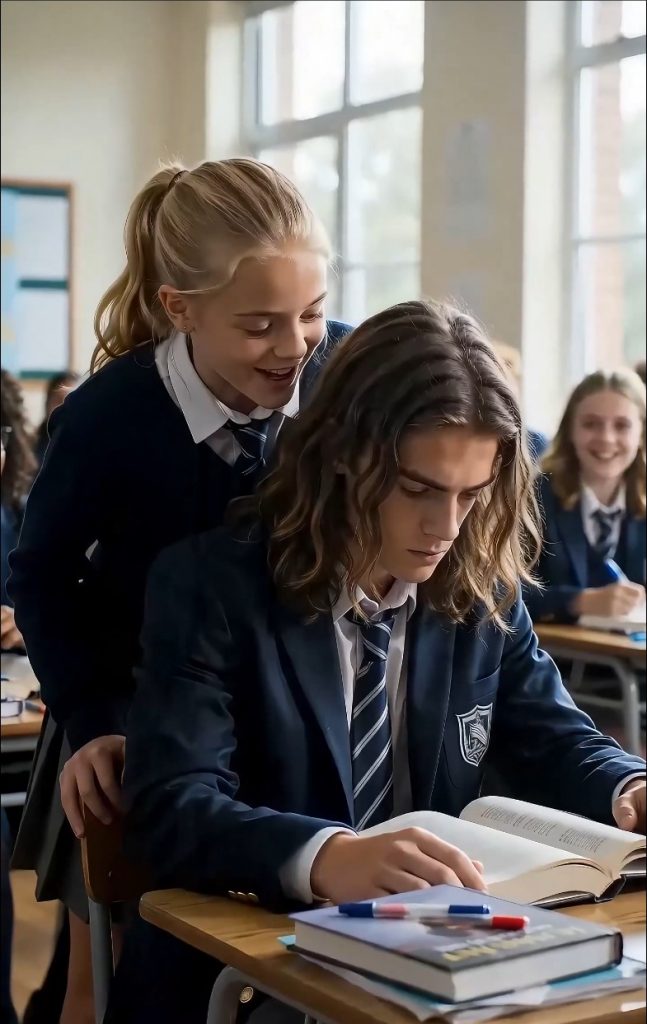
Julian Reed sat at his desk with an open book beneath his hands, his long brown hair falling forward over the edges of his navy blazer. The sunlight from the classroom windows caught the waves in it, turning them almost copper at the ends.
Behind him, Madison Vale leaned over his shoulder with her arms crossed.
She wore her blonde hair in a high ponytail and her school uniform like it was a costume made for someone who already owned the building. Dark blue sweater. White collar. Perfect tie. Perfect smirk.
“With that hair,” she said, loud enough for the entire room, “you look like a girl.”
The class burst out laughing.
Julian did not look up.
He turned one page.
Slowly.
The sound of paper sliding against wood was almost lost beneath the laughter, but Madison heard it. His silence bothered her more than any insult could have. It made her feel like she had thrown a stone into deep water and heard no splash.
So she looked around, hungry for a bigger reaction.
“Come on,” she said, smiling as the boys near the window leaned forward. “Let’s cut your hair.”
Julian’s desk had no scissors.
Only his book, his notebook, a pencil, and a folded hospital bracelet he kept tucked inside the front cover where no one was supposed to see it.
But Madison turned behind herself and reached to the rear desk.
A pair of metal classroom scissors lay beside a ruler and a half-finished art project.
She picked them up.
The blades clicked once.
The laughter changed.
It sharpened first, then thinned, as if a few students suddenly realized this was no longer a joke they could pretend was harmless.
Julian’s shoulders went still.
Madison grabbed a thick lock of his hair.
His head jerked slightly from the pull.
The scissors opened.
Someone whispered, “Madison, don’t.”
She smiled wider.
Then she cut.
The snip was small, but it split Julian’s life into before and after.
A lock of brown hair fell across his open book and landed beside the hospital bracelet.
The room went silent.
Julian stared at it.
Then he slammed the book shut so hard every student flinched.
His chair scraped backward.
He stood.
And when he turned around, Madison finally stopped smiling.
Act II
Julian had spent two years learning how to disappear in plain sight.
At Waverly Hall, that was supposed to be impossible. The school believed in visibility. Glass trophy cases. Framed honor boards. Morning assemblies. Polished shoes. Perfect uniforms. Every student was trained to shine in ways that impressed donors.
Julian did not shine.
He arrived on a scholarship from the east side of town with thrift-store blazers, careful manners, and grades so high the teachers said his name differently than the other students did.
The teachers said it with admiration.
The students said it like a warning.
Julian Reed.
The boy who curved the exam scores.
The boy who read during lunch.
The boy with the long hair.
Madison Vale noticed him immediately.
She noticed anyone who made her feel less central.
Her father chaired the Waverly board. Her mother hosted fundraisers in the gymnasium and called scholarship students “a blessing for the school’s image.” Madison had grown up understanding that rules applied to her mostly in public and only when adults were watching.
Julian became her favorite target because he never gave her the satisfaction of breaking.
She called him princess.
She asked if he needed a mirror.
She told freshmen he was only there because the school needed a sad story for brochures.
Julian reported none of it.
Not because it did not hurt.
Because he had already learned that adults often asked quiet victims to become louder before they believed them, then punished them for the noise.
So he stayed quiet.
He studied.
He went home.
At home, he was not strange. He was not a joke. He was not the boy with the hair.
He was Ava’s big brother.
Ava was nine, sharp-eyed, stubborn, and brave in a way Julian hated because children should not have to be brave inside hospitals. She had lost her hair during treatment the year Julian started at Waverly. He remembered the morning she looked in the bathroom mirror and touched her bare head like she was meeting a stranger.
Julian had not known what to say.
So he sat on the floor beside her.
“I’ll grow mine,” he said.
Ava frowned.
“Why?”
“So when yours comes back, we’ll both look ridiculous.”
She laughed for the first time in three weeks.
After that, he kept growing it.
At first, it was just for her.
Then he learned about hair donations for children who needed wigs, and the promise changed shape. He would grow it long enough to cut properly. Ava helped measure it every month with a pink ruler. She kept a chart on the fridge titled Julian’s Hero Hair, even though he begged her to change it.
He endured the jokes because they were smaller than her smile.
He endured Madison because every inch meant something.
But Madison did not know that when she reached for the scissors.
She did not know what she was cutting.
Not yet.
Act III
Madison took one step back when Julian stood.
The scissors rattled in her hand.
For a moment, everyone expected him to shout. Some expected him to swing. A few looked excited in the nervous way people get when they know something ugly is about to happen and want to pretend they are only watching.
Julian did neither.
He picked up the lock of hair from the closed book.
His fingers were steady.
That was what frightened Madison.
Not rage.
Control.
He held the hair in his palm and looked at her.
“Do you know what this was for?”
Madison swallowed, then forced a laugh.
“Relax. It’s hair.”
Julian opened the book again.
The folded hospital bracelet slid into view.
Ava Reed.
Pediatric Oncology.
The words were small, but the students closest to him saw them.
Then the girl in the front row covered her mouth.
Julian’s voice stayed low.
“My sister lost her hair last year. I promised I’d grow mine long enough to donate.”
The room changed.
Not all at once.
Guilt rarely enters a crowd with confidence. It arrives quietly, making people look down at their desks, then at their hands, then at the person they had helped hurt.
Madison’s face went pale beneath her practiced contempt.
“I didn’t know,” she said.
Julian’s eyes did not move.
“You didn’t ask.”
That landed harder than a shout.
The classroom door opened.
Mr. Ellison, the history teacher, stood in the doorway holding a stack of copied worksheets. He looked from Julian’s face to Madison’s scissors, then to the lock of hair in Julian’s hand.
“What happened?”
Nobody answered.
The silence was thick with witnesses trying to become furniture.
Julian looked around the room.
“Tell him.”
No one moved.
His gaze stopped on Theo Barnes, the boy who had laughed first.
Theo’s face reddened.
Madison whispered, “Don’t.”
That single word did more than any accusation.
Mr. Ellison stepped fully into the room.
“Theo?”
Theo stared at his desk.
“She cut his hair,” he said.
Madison turned on him.
“It was a joke.”
Another student spoke from the back.
“She took the scissors from Chloe’s desk.”
Then another.
“She pulled his hair first.”
“She said he looked like a girl.”
“She’s been doing stuff like this for weeks.”
Madison’s expression collapsed into panic.
Not because she finally understood Julian’s pain.
Because the room had stopped protecting her.
Act IV
The principal tried to keep it quiet.
That was the Waverly way.
Quiet discipline.
Quiet meetings.
Quiet apologies written in careful language and filed where donors would never see them.
By the end of the school day, Julian sat in the administration office with his mother on one side and Ava’s donation chart folded in his backpack. Madison sat across from him with her parents, her ponytail still perfect, her eyes red in a way that looked more like anger than remorse.
Principal Hargrove cleared his throat.
“This was clearly an unfortunate lapse in judgment.”
Julian’s mother looked at him.
Her name was Celeste Reed, and she worked double shifts at the county records office. She wore her work badge on a lanyard and had come straight from the bus, rain still drying on the shoulders of her coat.
“Cutting a child’s hair without consent is not a lapse,” she said. “It is an act.”
Madison’s father leaned back.
“Let’s not exaggerate.”
Julian saw his mother’s hand tighten.
Before she could respond, Ava spoke from the tablet propped on Celeste’s lap. She had insisted on video calling after Julian texted her that he was okay.
Her small face filled the screen.
“Did she ruin the donation?”
The room went still.
Julian looked down.
“I don’t know yet.”
Ava’s eyes filled, but she did not cry.
She looked at Madison through the screen.
“That was for kids like me.”
Madison looked away.
Her mother whispered, “Madison, apologize.”
Madison’s mouth trembled.
“I’m sorry.”
Julian heard the shape of it.
It was the apology of someone who wanted the consequence to stop.
Not someone who had entered the wound.
He looked at Principal Hargrove.
“I reported her before.”
The principal blinked.
Celeste turned sharply.
“What?”
Julian pulled a folder from his backpack.
Inside were printed emails.
Dates.
Screenshots.
A photo of the word princess written on his locker in pink marker.
A copy of the anonymous comment Madison posted under the school debate team video.
Mr. Ellison, standing near the door, went pale.
“You had all this?”
Julian nodded.
“I sent it to the student conduct office three times.”
Principal Hargrove’s mouth tightened.
Madison’s father stopped leaning back.
Celeste took the papers slowly, one by one, her face changing with each page.
“You told me it was fine,” she said softly.
Julian did not look at her.
“I didn’t want Ava to worry.”
Ava’s voice came through the tablet, small and fierce.
“I was already worried.”
That broke him more than the haircut.
His shoulders dropped.
For the first time that day, his anger cracked open and showed what it had been protecting.
He was not just humiliated.
He was tired.
Tired of being quiet so adults would not call him dramatic. Tired of being strong so his sister could keep smiling. Tired of pretending cruelty only hurt if people meant it deeply enough.
Celeste reached for his hand.
This time, he let her take it.
The principal looked at the folder and understood that the quiet version of the story had just died.
Act V
Madison did not get expelled immediately.
That disappointed half the students and satisfied none of them.
Real consequences moved slower than gossip.
But they moved.
Her parents fought. The board met. The conduct office suddenly discovered Julian’s old emails in its system. A counselor admitted she had marked the case as “peer teasing” without speaking to him directly. Principal Hargrove issued a statement that used too many polished words until Celeste Reed sent it back with red marks and the sentence, Say what happened.
The revised statement was shorter.
A student was bullied repeatedly. The school failed to act. The bullying escalated to a physical violation. Corrective action has begun.
Madison was suspended, then removed from student leadership and barred from campus activities pending a full conduct review. The school created a reporting process that did not route complaints through the same administrator who had ignored Julian’s. Teachers received training they should have had years earlier. Students were told that laughter could make them participants.
Some rolled their eyes.
Some listened.
Theo Barnes apologized to Julian in the hallway the next week.
Not loudly.
Not for attention.
He stood with his hands shoved into his blazer pockets and said, “I laughed because everyone else did. That’s not an excuse.”
Julian looked at him for a long moment.
“No,” he said. “It isn’t.”
Theo nodded.
“I’m sorry.”
Julian did not forgive him right there.
He did not owe anyone a clean ending on command.
But he said, “Don’t do it to someone else.”
Theo said, “I won’t.”
That was enough for the hallway.
The haircut could not be undone.
A stylist helped even it out as gently as possible. Julian sat in the chair while Ava supervised from home on video call, giving serious instructions like a tiny general.
“Not too short,” she ordered.
The stylist smiled.
“Yes, ma’am.”
Julian watched pieces fall to the floor and tried not to feel like he was losing the promise all over again.
Then Ava said, “You still grew it for me.”
He looked at the screen.
“It wasn’t long enough.”
“It was still for me.”
That was how she saved him.
Not by pretending it did not matter.
By reminding him that Madison had cut hair, not love.
Months later, Waverly held its annual charity assembly. In previous years, the event had been polished and empty, full of speeches about compassion delivered by students who had never been asked to practice it when it cost them popularity.
This year, Ava attended in person.
She wore a yellow cardigan and a soft cap with tiny stars on it. Julian walked beside her into the auditorium with shorter hair, a navy blazer, and a quiet face that made the room look twice.
He had not planned to speak.
But when the head of school invited him, he stood.
The auditorium became so silent he could hear Ava shifting in the front row.
Julian looked out at the students.
Some had laughed that day.
Some had watched.
Some had looked away.
He did not soften it for them.
“My hair was supposed to become something useful,” he said. “A wig, maybe. A little comfort for someone who needed it.”
He paused.
“But this isn’t really about hair.”
Madison was not there. Her family had withdrawn her from Waverly before the final board decision. Some said she transferred because the school was unfair. Others said her parents were embarrassed. Julian no longer cared which version she told herself.
He continued.
“It’s about how easy it is to turn a person into a joke when you don’t want to see the reason they’re quiet.”
Ava watched him with shining eyes.
Julian’s voice remained steady.
“You don’t have to be the one holding the scissors to cut someone down. Sometimes laughing is enough. Sometimes silence is enough. Sometimes pretending you didn’t see it is enough.”
No one clapped when he finished.
Not immediately.
That was good.
He had not given them something to celebrate.
He had given them something to carry.
Then Ava stood in the front row and clapped once.
Twice.
The whole auditorium followed her.
Julian looked down, embarrassed and overwhelmed.
Afterward, students donated enough to fund more than the assembly had ever raised before. Hair donations came from three seniors, two teachers, and one boy from the soccer team who admitted he had never thought about it until Julian spoke.
Julian’s own hair was not long enough anymore.
But the promise survived in other people’s hands.
At home that night, Ava updated the fridge chart.
She crossed out Julian’s Hero Hair and wrote Our Hero Hair instead.
Julian groaned.
“That’s worse.”
“It’s accurate,” she said.
He laughed.
For the first time in months, the sound did not feel borrowed.
The next morning, he returned to class.
Same room.
Same windows.
Same wooden desk.
The rear desk no longer had scissors on it. None of them did. The art supplies had been moved to a locked cabinet, not because scissors were evil, but because adults had finally learned that ordinary objects become dangerous in cruel hands.
Julian sat down and opened his book.
A few students looked over.
No one laughed.
He turned a page.
This time, the sound was not an act of hiding.
It was peace.
And when sunlight touched the shorter waves of his brown hair, Julian did not reach up to cover them.
He kept reading.
Not because nothing had happened.
Because something had.
The room had seen him stand.
And once a person has stood in the place everyone expected him to shrink, the silence around him never sounds the same again.