Act I
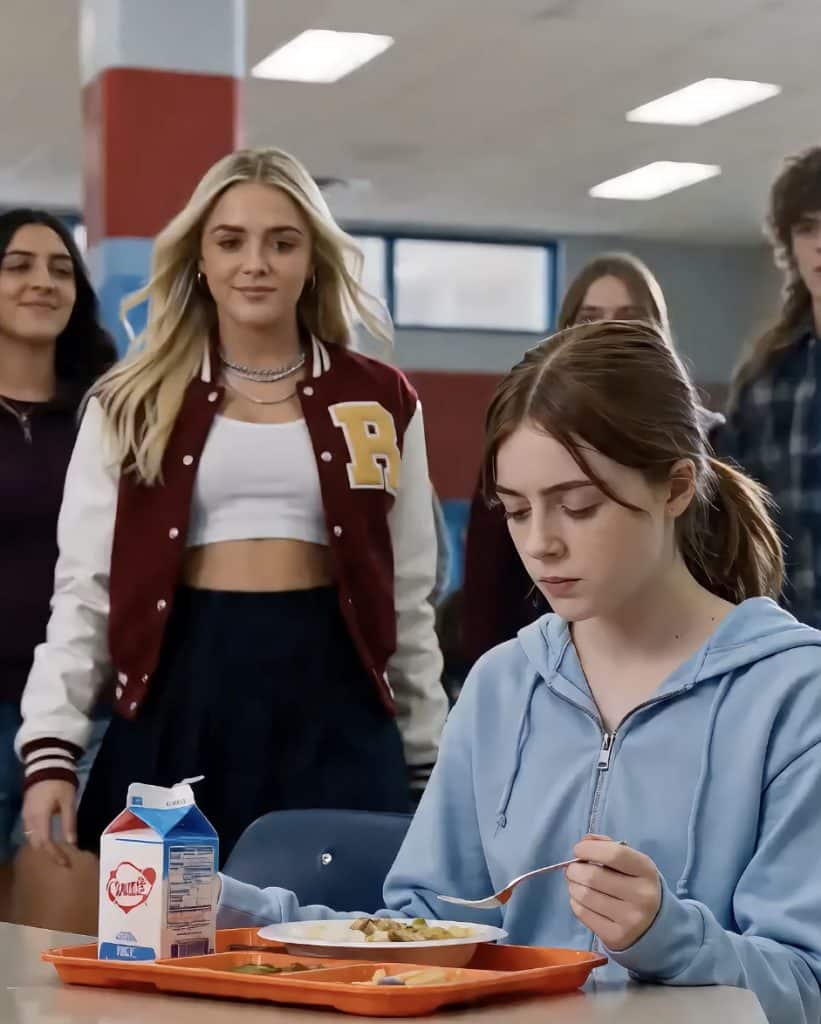
The cafeteria was loud until the milk carton hit the tray.
Then everything changed.
The sharp splash echoed across the room.
Conversations slowed.
Heads turned.
Students looked up from their lunches just in time to see milk spreading across a plastic tray, soaking a carefully packed meal.
At the center of the scene sat Hannah Brooks.
She stared down at the ruined food.
The sandwich her grandmother had made that morning was now drenched.
The fruit cup had tipped over.
The napkin floated in the growing puddle.
Standing above her was Madison Cole.
Blonde.
Popular.
Captain of the cheer squad.
The kind of girl who walked through school like she owned it.
She took another sip from the small milk carton she had stolen from Hannah’s tray.
Then she laughed.
“Poor girls really eat like this every day?”
A group of students behind her burst into laughter.
Some recorded with their phones.
Others simply watched.
No one stepped forward.
No one told Madison to stop.
Hannah remained seated.
Her hands clenched beneath the table.
Her eyes fixed on the ruined lunch.
The cafeteria assumed they knew exactly what would happen next.
The quiet girl would stay quiet.
The bully would walk away smiling.
The crowd would move on.
That was how these stories usually ended.
But nobody in the room truly knew Hannah Brooks.
And that was about to become a very expensive mistake.
Act II
Hannah had never cared much about popularity.
Growing up, she learned early that attention was often temporary.
Character wasn’t.
After her parents died in a car accident when she was ten, she moved in with her grandmother.
Life became simpler.
Smaller.
Harder.
But also clearer.
Her grandmother taught her lessons no textbook ever could.
Respect people.
Keep your word.
Work hard.
And never mistake kindness for weakness.
Every morning before school, Hannah helped around the house.
Every afternoon, she worked at her grandmother’s small bookstore.
Every evening, she studied.
While many students chased social status, Hannah chased goals.
Most of her classmates barely noticed.
That suited her perfectly.
There was another part of her life almost nobody knew.
Years earlier, her grandfather—a retired martial arts instructor—had begun teaching her self-defense.
Not because he expected violence.
Because he believed confidence came from discipline.
For years she trained quietly.
No competitions.
No social media videos.
No attention.
Just practice.
Again and again.
Until calm became instinct.
Until focus became second nature.
Most people looked at Hannah and saw a shy girl in an oversized hoodie.
They never saw the years of discipline beneath it.
Madison certainly didn’t.
To Madison, Hannah was simply an easy target.
Someone unlikely to fight back.
Someone unlikely to challenge her.
Someone unlikely to surprise her.
She was wrong on all three counts.
Act III
The laughter continued.
For a few seconds.
Then it stopped.
Because Hannah stood up.
Slowly.
Quietly.
Deliberately.
The cafeteria fell silent.
Something about her expression had changed.
The sadness was gone.
The embarrassment had disappeared.
Only determination remained.
Madison smirked.
Still confident.
Still convinced she controlled the situation.
“You got something to say?”
Hannah looked at the spilled lunch.
Then at Madison.
Then at the students surrounding them.
For years she had ignored comments.
Ignored rumors.
Ignored insults.
But today wasn’t about food.
It was about dignity.
And there comes a moment when silence stops being strength and starts becoming surrender.
This was that moment.
Madison reached toward her again.
A dismissive gesture.
A mistake.
Everything happened quickly after that.
Not like a movie.
Not like a spectacle.
Just a sudden loss of control.
Madison expected fear.
Instead, she encountered resistance.
Real resistance.
The confidence vanished from her face.
The crowd gasped.
Students stumbled backward.
Chairs scraped against the floor.
For the first time, Madison realized she wasn’t dealing with the helpless target she imagined.
She was dealing with someone who had spent years learning discipline while Madison spent years learning arrogance.
And discipline almost always wins eventually.
Seconds later, Madison found herself on the floor amid overturned chairs.
The laughter was gone.
Completely gone.
Act IV
The cafeteria remained silent.
Hundreds of students watched.
Nobody cheered.
Nobody celebrated.
Because what they were seeing wasn’t victory.
It was consequences.
Madison lay stunned among the scattered chairs.
Her friends stood frozen.
Not one stepped forward.
Not one offered support.
The same crowd that had laughed moments earlier now avoided eye contact.
Hannah looked down at her.
Calm.
Steady.
Composed.
Not angry.
Not triumphant.
Just finished.
She glanced at the ruined lunch.
Then back at Madison.
“Guess stealing lunch didn’t feed your ego.”
The words hit harder than any physical confrontation.
Because they exposed the truth.
This had never been about food.
Or money.
Or popularity.
It had been about power.
Madison enjoyed making other people feel small.
And now, for the first time, she understood what that felt like herself.
Around the cafeteria, students began seeing the situation differently.
Not as entertainment.
Not as gossip.
But as a reflection of something ugly they had all allowed to happen.
Many of them had witnessed similar moments before.
Many had laughed.
Many had stayed silent.
And suddenly that silence felt much heavier than before.
Act V
By the next day, the story had spread through the entire school.
Not because Hannah had stood up for herself.
Because of what happened afterward.
When administrators reviewed witness statements, they discovered a pattern.
Madison’s behavior wasn’t new.
Numerous students described months of harassment.
Humiliation.
Mockery.
Bullying disguised as jokes.
Many had seen it.
Few had reported it.
That realization disturbed teachers far more than the cafeteria incident itself.
Because cruelty often survives through participation.
But it survives just as often through silence.
Meanwhile, Hannah returned to her normal routine.
She attended classes.
Worked at the bookstore.
Helped her grandmother.
She didn’t seek attention.
She didn’t enjoy being talked about.
And she certainly didn’t enjoy becoming famous for one afternoon in the cafeteria.
Several students approached her over the following weeks.
Some apologized for laughing.
Others apologized for saying nothing.
One freshman asked a question that stayed with Hannah.
“Were you scared?”
Hannah smiled slightly.
“Of course.”
The student looked surprised.
“But you stood up anyway.”
Hannah nodded.
“Being brave doesn’t mean you’re not scared.”
The freshman thought about that for a long moment.
Then smiled.
Years later, many students would forget the details of that afternoon.
The spilled milk.
The overturned chairs.
The crowd.
But they remembered the lesson.
Because it had never been about a lunch tray.
It had been about self-respect.
About boundaries.
About refusing to let someone else define your worth.
And most importantly, it was about understanding that kindness and weakness are not the same thing.
Hannah Brooks remained the quiet girl in the oversized hoodie.
But after that day, everyone saw her differently.
Not because she fought back.
Because she finally reminded an entire school that dignity is not something you ask permission to keep.
It is something you refuse to surrender.