Act I
The fog made the road look unfinished.
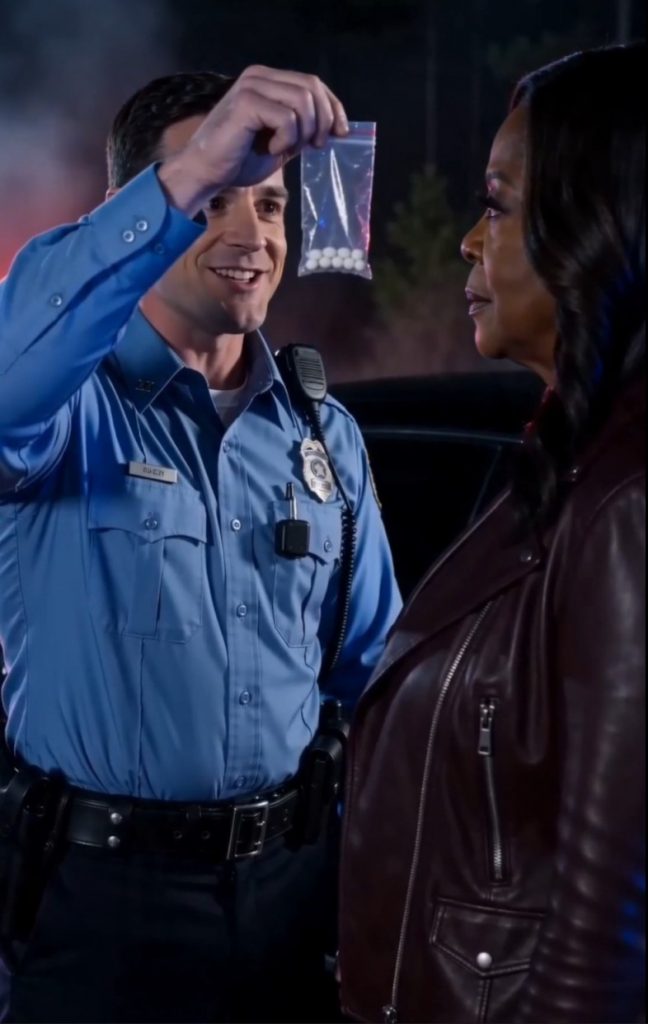
It rolled low across the wet pavement, swallowing the tree line, catching flashes of red and blue from the police cruiser parked behind the black sedan. The lights pulsed across the woman’s leather jacket, across the chrome trim of her car, across the officer’s polished badge as he straightened from the open passenger door.
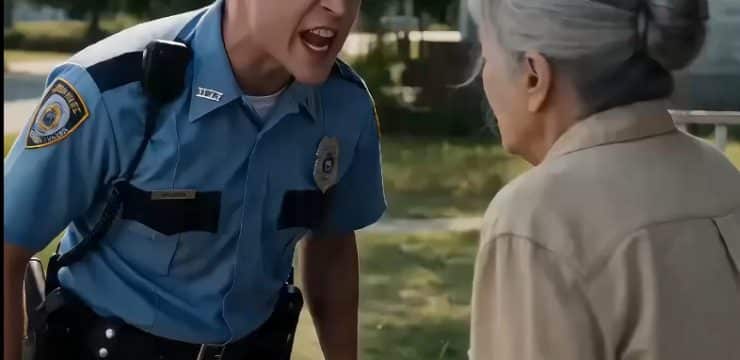
Officer Ryan Keller smiled before he turned around.
It was not the smile of a man who had found the truth.
It was the smile of a man who had planted it.
In his right hand, dangling between two fingers, was a small clear bag filled with white pills. He lifted it slowly, letting it swing in front of the woman’s face as if he were showing her the end of her life.
“Well, well,” he said. “Look what I just found under your seat.”
The woman did not flinch.
She stood beside the sedan with her hands loose at her sides, dark brown leather jacket zipped halfway, black blouse beneath it, boots steady on the wet shoulder. She was in her late forties, maybe older, with the calm posture of someone who had stopped wasting energy on fear years ago.
Her name, though Keller had not asked it properly, was Althea Monroe.
She looked at the bag.
Then at him.
The fog thickened between the trees.
Keller tilted his head. “You’re quiet now.”
Althea’s eyes were cold enough to make the night feel warmer by comparison.
“You mean the bag you just hid there yourself?” she said.
Keller’s smile twitched.
For half a second, something hard and ugly flashed behind his face. Then he laughed.
“That’s a serious accusation.”
“No,” Althea said. “It’s a recorded observation.”
The word recorded moved through the air like a warning shot.
Keller’s fingers tightened around the bag.
Althea leaned in slightly, her voice low and steady.
“I don’t think you know who I am.”
The officer’s grin disappeared.
He looked at her more carefully now. Not at her car. Not at her clothes. Her face.
Recognition did not arrive all at once.
It came in pieces.
The cheekbones he had seen on the news. The eyes from the press conference. The name printed at the top of the leaked memo every officer in his unit had pretended not to read.
His hand began to tremble.
The bag shook between his fingers.
Althea watched the realization drain the blood from his face.
Behind them, somewhere beyond the fog, another engine approached without headlights.
Then another.
Keller turned his head just enough to hear the road filling with vehicles he had not called.
And for the first time that night, the man with the badge understood that he was not the trapper.
He was the one standing inside the trap.
Act II
Fifteen minutes earlier, Keller had thought it would be easy.
A luxury sedan. Out-of-county plates. A Black woman driving alone after midnight on the old forest road outside Millhaven. No witnesses. No nearby homes. No traffic cameras for six miles.
To him, it looked like opportunity.
He had pulled her over for a broken taillight that was not broken.
He had walked to her window with one hand near his belt and the lazy confidence of a man who believed the night belonged to him.
“License and registration.”
Althea had handed them over without argument.
Keller barely looked.
That was his first mistake.
If he had read the name, he might have stopped. If he had looked closely at the federal credential tucked behind her driver’s license, he might have understood. If arrogance had allowed curiosity, he might have saved himself.
But Keller had already decided who she was.
A woman alone.
A driver he could scare.
A body on a dark road with no one important watching.
He asked where she was going. She said home. He asked where she had been. She said a meeting. He asked why she looked nervous. She told him she did not.
That annoyed him.
He told her to step out of the car.
She did.
He asked whether there was anything illegal in the vehicle.
She looked him in the eye and said, “Not unless you brought it.”
He laughed then.
A short, sharp laugh.
Then he opened her passenger door.
Althea stood by the hood of her sedan and watched him search. She watched his left shoulder dip. Watched his right hand disappear into the side pocket of his uniform jacket. Watched his body block the view of his own dashboard camera.
He thought he was careful.
Men like Keller always did.
They confused repetition with skill. They had done the wrong thing so many times without consequence that they began to mistake impunity for intelligence.
Althea saw the bag before he “found” it.
She saw the angle of his wrist.
She saw him press it under the seat, pause, then perform surprise for the empty road.
What Keller did not see was the pinhole camera sewn into the seam of her jacket.
He did not see the second recorder inside the sedan’s overhead console.
He did not know that three unmarked vehicles were waiting two turns back with lights off and engines running.
And he certainly did not know that Althea Monroe had spent eight months building a case against him.
Not against a bad cop.
Against a system that had learned to protect bad men as long as their arrests looked productive on paper.
Millhaven County called Keller a star officer.
The local papers called his drug stops “aggressive but effective.”
His captain called him dependable.
Althea called him what the evidence said he was.
A predator with a badge.
The first complaint against Keller came from a nurse driving home after a double shift. Then a college student. Then a mechanic. Then a grandfather taking his wife to dialysis. Different people. Same road. Same officer. Same miracle discovery under the passenger seat.
Some pleaded guilty because they were scared.
Some lost jobs.
Some lost children to custody hearings where a planted charge looked like proof of bad character.
Most were poor.
Many were Black or Latino.
All of them had been chosen because Keller thought no one powerful would care.
Then he stopped the wrong woman’s nephew.
Act III
Althea Monroe had not planned to become famous.
She had spent most of her career avoiding cameras. She was a prosecutor first, then a federal civil rights attorney, then the special counsel appointed after Millhaven County’s arrest numbers became impossible to explain away.
Her reputation was not loud.
It was worse than loud.
It was patient.
She built cases the way stone walls were built, one piece at a time, each document locked into another until the whole thing became too heavy to move. She did not chase headlines. She chased patterns.
And Keller had given her plenty.
Traffic stops with missing audio.
Searches that began before consent was recorded.
Evidence bags logged late.
Body cameras that mysteriously failed only during certain arrests.
Judges noticed pieces.
Public defenders noticed more.
Families noticed everything.
But fear kept them quiet.
Until Althea’s nephew Marcus was stopped on Route 11.
Marcus was twenty-two, a quiet kid who helped his mother at her bakery and had never so much as missed a parking ticket. He was driving home with a birthday cake in the passenger seat when Keller pulled him over.
By midnight, Marcus was in a holding cell.
By morning, his name was online.
By the end of the week, people who had known him since he was a child were whispering as if the accusation had rewritten his entire life.
Althea visited him behind thick glass.
Marcus tried to be brave.
He failed when he saw her.
“Auntie,” he said, voice breaking, “I didn’t do it.”
She believed him before he finished the sentence.
Not because he was family.
Because she had heard that exact sentence from too many people who had no reason to lie and everything to lose.
The charge against Marcus was eventually dismissed after a convenience store camera showed Keller searching the car before the official report claimed he had probable cause. But dismissal did not undo the damage. It did not return Marcus’s scholarship interview. It did not stop strangers from looking twice.
And it did not touch Keller.
He stayed on patrol.
That was when Althea stopped waiting for the department to police itself.
She found the others.
A mother who had lost her nursing license.
A delivery driver who sold his truck to pay legal fees.
A veteran who still shook when he saw blue lights.
A teenager who had learned, too early, that innocence was not enough if the wrong person controlled the story.
Althea sat at kitchen tables, church basements, public libraries, and cramped apartments while people told her what humiliation had sounded like when it came from a man in uniform.
The same phrase kept coming back.
Look what I just found.
Keller liked saying it.
He liked the performance of discovery.
So Althea gave him a stage.
She drove the road at night in the kind of car he hated and admired at once. Expensive enough to make him curious. Solitary enough to make him bold. She made sure the taillights worked. She made sure the cameras worked better.
Then she waited.
Keller did exactly what the file said he would do.
Now he stood beneath his own flashing lights, holding the planted bag while the woman he tried to frame watched him realize he had just performed his crime for the people sent to arrest him.
Act IV
The first unmarked SUV appeared from the fog behind Keller’s cruiser.
Then a second.
Then a third.
Their headlights cut through the mist, white and merciless. Doors opened in sequence. Men and women stepped out in dark jackets marked with federal lettering, state investigators behind them, county deputies from outside Millhaven at the rear.
Keller stumbled back.
“No,” he said.
Althea did not move.
A tall agent with cropped gray hair approached, one hand resting near his holster but not reaching for it.
“Officer Keller,” he said, “place the bag on the hood and step away.”
Keller looked at the agent, then at Althea.
“This is a setup.”
Althea’s mouth did not change, but her eyes sharpened.
“Yes,” she said. “A legal one.”
His breathing quickened.
“You can’t do this.”
“I can,” she said. “And I did.”
Keller’s radio hissed. A dispatcher called his unit number. He did not answer.
The bag trembled harder in his hand.
The agent spoke again. “On the hood.”
Keller obeyed slowly, as if his body had become unfamiliar to him. He placed the bag on the wet metal. It sat there under the flashing lights, small and pathetic now that it was no longer a weapon.
One investigator photographed it.
Another moved to Keller’s cruiser.
A third collected the officer’s body camera.
Keller’s face twisted. “She’s lying.”
Althea looked toward the agent. “Play the first clip.”
A tablet was brought forward.
Keller stared as video appeared on the screen.
The angle came from Althea’s jacket.
There he was, opening the passenger door.
There was his hand entering his pocket.
There was the bag.
There was the placement.
Clean.
Clear.
Undeniable.
Keller’s mouth opened, but no words came out.
Althea watched him with the same calm she had given him from the beginning.
“You had a script,” she said. “You used it on people who were scared, tired, broke, alone, or already convinced no one would believe them.”
Keller shook his head.
“I was doing my job.”
“No,” she said. “You were borrowing the law to commit crimes.”
His face hardened suddenly, one last burst of arrogance trying to save him.
“You think this ends with me? You think I’m the only one?”
Althea stepped closer.
“No. I’m counting on you not being the only one.”
That was when Keller truly understood.
The traffic stop was not the whole operation.
It was the doorway.
Behind him, investigators were already removing sealed boxes from his cruiser. Others were on radios, confirming search warrants at the Millhaven evidence locker, the narcotics office, the captain’s house, and the private towing company that handled impounds for the department.
Keller looked at the road as if escape might still exist somewhere in the fog.
It did not.
The agent turned him gently but firmly toward the cruiser.
Keller’s shoulders dropped.
The badge on his chest flashed once in the red light, then vanished as the agent stepped between him and Althea.
“Hands behind your back.”
Keller flinched at the words he had used on so many others.
For the first time, he heard how final they sounded.
Act V
By morning, Millhaven County could not pretend anymore.
The news broke before sunrise. A veteran officer arrested in a federal corruption sting. Evidence logs seized. Past convictions under review. Senior supervisors placed on leave. A special counsel expected to expand the investigation.
The official statements were careful.
Althea was not.
At noon, she stood in front of the courthouse beneath a gray sky, wearing the same leather jacket from the roadside. Cameras lined the steps. Reporters shouted questions. Families of Keller’s victims stood behind her, some holding photographs, some holding court papers, some holding nothing because grief did not always need a prop.
Althea looked straight into the cameras.
“Trust cannot be demanded by people who abuse power,” she said. “It has to be rebuilt by truth, accountability, and repair.”
She paused.
Behind the press, Marcus stood with his mother.
He looked older than he had before the arrest. Not in years. In the way young people age when the world teaches them suspicion too early.
Althea found his eyes.
Then she continued.
“Every case touched by Officer Keller will be reviewed. Every complaint dismissed without proper investigation will be reopened. Every officer who helped hide this will be identified.”
A reporter called out, “Are you saying the department is corrupt?”
Althea’s gaze did not move.
“I’m saying the evidence will speak. And this time, no one will be allowed to mute it.”
The trials took time.
Real justice always does.
Keller’s attorneys tried to argue entrapment, misunderstanding, stress, bad procedure, anything except the truth visible on video. But there were too many recordings. Too many evidence bags with matching irregularities. Too many people with the same story, the same road, the same phrase.
Look what I just found.
One by one, cases collapsed.
People walked out of courthouses carrying dismissals that should have come years earlier. Some cried. Some laughed. Some looked angry because an apology from the system felt insulting after the system had stolen so much.
The nurse got her license reinstated.
The delivery driver received compensation, though it did not fully replace the business he lost.
The veteran testified in a steady voice and shook only after he stepped down.
Marcus reapplied for the scholarship and sent Althea a photo of the acceptance email without a caption.
She cried when she saw it.
Not in public.
In her kitchen, alone, where powerful women are allowed to be human without turning it into a headline.
Months later, Althea returned to the same roadside.
No cameras.
No agents.
No flashing lights.
Just her, the black sedan, and the fog moving through the trees.
The county had installed new dash-linked roadside cameras after the investigation. Keller’s unit had been disbanded. His captain had resigned before indictment. The evidence locker was under outside control.
The road looked the same anyway.
That troubled her.
Places remembered things even after people pretended they had changed.
She stood on the shoulder where Keller had held up the bag and smiled.
For a moment, she heard his voice again.
Well, well.
Then another voice came from behind her.
“You okay?”
Marcus stood near the sedan, hands in his jacket pockets.
Althea turned.
“I’m fine.”
He gave her the look family gives when they love you enough to know when you are lying.
She smiled faintly.
“I’m getting there.”
He stepped beside her.
They stood together in the quiet.
After a while, Marcus said, “I used to think justice meant they admit they were wrong.”
Althea looked at him.
“What do you think now?”
He stared down the road.
“I think it means they can’t do it to the next person.”
Althea nodded slowly.
“That’s a good start.”
The fog moved across the pavement, softer now without the sirens. Somewhere far off, a car passed on the main highway, headlights briefly glowing through the trees before vanishing.
Marcus glanced at her.
“Did you know he’d take the bait?”
“I knew he’d see what he wanted to see.”
“A Black woman alone in a nice car.”
“Yes.”
Marcus swallowed.
“And he thought that made you weak.”
Althea’s face hardened, but only for a second.
“No,” she said. “He thought it made me useful.”
Marcus understood.
Keller had not just misjudged her power.
He had misjudged her patience.
Before they left, Althea walked to the edge of the road and looked back once at the empty shoulder. In her mind, she saw all of them there: the nurse, the driver, the veteran, the teenager, Marcus, every person who had stood under flashing lights while a man with a badge turned fear into evidence.
She could not give them back every lost night.
She could not unsay what had been said about them.
But she had done what power is supposed to do when it finally lands in the right hands.
She had turned the lights around.
Marcus opened the passenger door for her.
Althea raised an eyebrow. “I can open my own door.”
“I know,” he said. “I’m being dramatic.”
She laughed then.
A real laugh.
The sound moved into the fog and disappeared, but the feeling stayed.
As the black sedan pulled away, the road behind them fell dark again. No sirens. No planted bag. No officer grinning because he thought the truth belonged to whoever wore the uniform.
Just wet pavement.
Trees.
Mist.
And the memory of one woman standing calmly in the flashing lights, telling a corrupt man the sentence that ended him.
“I don’t think you know who I am.”