Act I
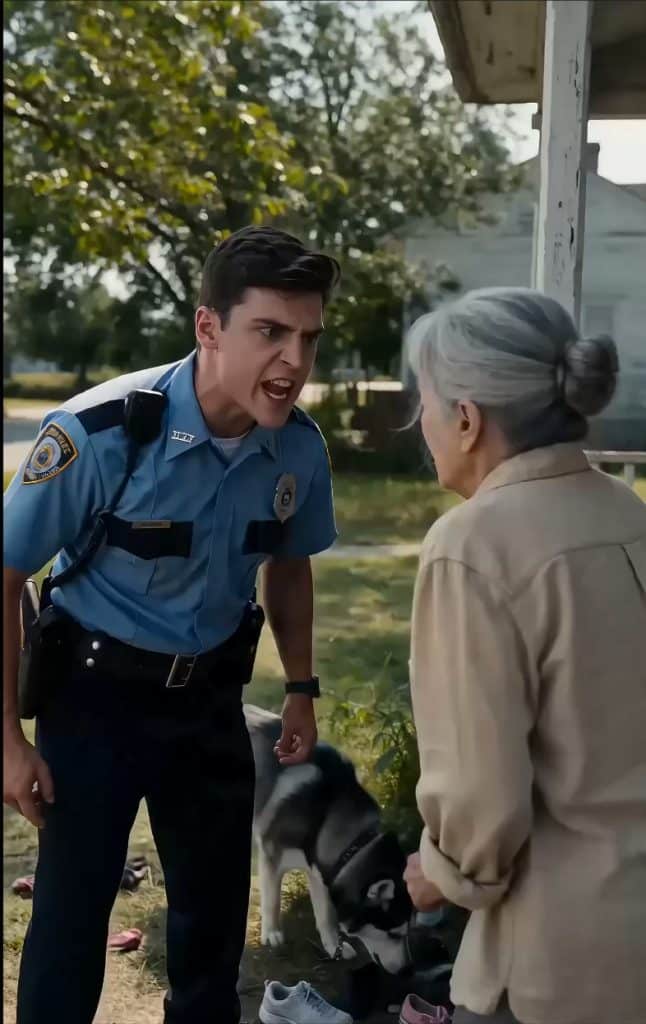
The young officer kicked the first shoe like it had insulted him.
It skidded across the overgrown grass, flipped once, and landed near a rusted trash bin at the edge of the sidewalk. Then he kicked another. A cracked leather loafer. A muddy sneaker. A child’s rain boot with no match.
The black-and-white Husky moved behind him with its nose low to the ground, ignoring the officer’s anger.
“Get that dog under control,” Officer Ryan Nash snapped.
The elderly woman at the yard’s edge flinched.
Her name was Ruth Harlan, though the neighbors mostly called her Mrs. Harlan in the careful way people use when they want distance to sound respectful. She stood in a tan shirt with her gray hair pinned into a trembling bun, both hands tight against her chest.
“I tried to tell you,” she whispered. “He keeps bringing them from that house.”
Ryan turned toward the rundown two-story home behind her.
The place had peeling white paint, boarded windows, a sagging porch, and grass high enough to hide broken glass. It had been empty for years. Kids dared each other to touch the porch steps. Adults complained about the property and then drove past it with their windows up.
Ryan pointed at the scattered shoes.
“I’m calling animal control right now,” he said. “People like you are a menace to this street.”
Ruth’s mouth opened, but no defense came out.
The Husky stopped.
His ears lifted.
He nosed through the pile carefully, pushing aside a work boot, a sandal, and a torn canvas sneaker. Then his muzzle found something buried beneath the others.
A small pink shoe.
Everything changed when he picked it up.
Ryan’s anger drained from his face.
The shoe was tiny. Too tiny for a teenager. Too clean on one side, too dirty on the other, with a little silver star stitched near the toe.
The Husky carried it toward the boarded-up house and dropped it near the cracked path.
Then he faced the dark front door and barked.
Not like a nuisance.
Like a warning.
A police car door slammed at the curb.
Senior Officer Martin Vale stepped into the yard, gray-haired and broad-shouldered, his eyes moving from the Husky to the pink shoe to the broken house.
He did not shout at Ruth.
He did not reach for animal control.
He raised one hand sharply.
“Stop,” he commanded. “Nobody moves.”
The Husky stood beside the pink shoe, panting hard, eyes locked on the boarded entrance.
And for the first time, Ryan Nash understood he had not been standing in the middle of a mess.
He had been standing in the middle of evidence.
Act II
Ruth Harlan had called the police four times in six days.
The first call was about barking.
Not ordinary barking. Not the bored, endless noise of a restless dog behind a fence. This was sharp, urgent, deliberate barking that began every morning before sunrise and ended only when the Husky returned to Ruth’s porch carrying a shoe.
The dispatcher asked if the dog was hers.
Ruth said no.
That was not entirely true.
The Husky had belonged to nobody for almost a year, but he had chosen Ruth’s porch the way abandoned animals sometimes choose the softest person on a hard street. He appeared one winter morning, ribs visible under thick fur, eyes bright and suspicious.
Ruth fed him.
He stayed.
She named him Ghost because he came and went without sound, slipping between yards, watching the old white house across the street as if it owed him something.
The neighbors disliked him.
He dug under fences. Barked at the boarded house. Dragged shoes from somewhere no one could explain and dropped them on Ruth’s lawn like offerings.
By the third call, Ryan Nash was tired of it.
He was twenty-six, new to the neighborhood patrol, and eager to prove he could handle small problems before they became big ones. To him, Ruth looked like another lonely old woman feeding a stray she could not control.
The shoes looked like trash.
The house looked empty.
So he stopped listening before she finished speaking.
“I heard crying,” Ruth told him that morning.
Ryan frowned. “From the dog?”
“No. From inside the house.”
His impatience sharpened.
“Mrs. Harlan, that house has been vacant for five years.”
“I know what I heard.”
“You also said the dog was bringing shoes.”
“He is.”
Ryan looked at the lawn and saw only disorder. Old shoes scattered through weeds. A nervous elderly woman. A stray Husky with dirt on his nose.
He did not see what Ghost had been building.
A trail.
The old white house had once belonged to Edmund Price, a landlord who bought properties, ignored repairs, and died before the city could force him to fix anything. After his death, ownership was tied up in court. The house became a neighborhood bruise.
Windows boarded.
Porch rotting.
Basement door chained from the outside.
Children were told to stay away.
Which was why everyone assumed no child would be inside.
But six blocks away, a little girl named Hannah Moore had gone missing two days earlier.
Seven years old. Brown pigtails. Pink sneakers with silver stars.
Ryan had seen the alert on his phone that morning.
He had glanced at the picture, felt the quick sadness everyone feels at terrible news, and gone back to his coffee.
He never connected that child to Ruth Harlan’s lawn.
Ghost did.
For two days, the Husky had crossed the street, squeezed through a broken gap near the side foundation, and returned with shoes from inside the house. Adult shoes first. Old, forgotten, useless. Then smaller ones. A rain boot. A school sneaker.
Each time, Ruth called.
Each time, someone told her to keep the dog off private property.
That morning, Ghost found the pink shoe.
And this time, he did not bring it to Ruth’s porch.
He brought the police to the door.
Act III
Senior Officer Vale crouched beside the shoe without touching it.
Ryan stood behind him, throat tight.
He had been trained to notice details, but training means nothing when arrogance gets there first. Now every detail screamed at him.
The size.
The color.
The silver star.
The fresh mud along the heel.
Vale looked over his shoulder.
“Nash.”
“Yes, sir.”
“Pull up the missing child alert.”
Ryan’s hand moved too quickly for his phone. He opened the alert and saw Hannah Moore’s smiling face fill the screen.
Pink shoes.
Silver stars.
His stomach dropped.
Vale saw his expression and did not need to ask.
“Call it in.”
Ryan radioed with a voice that no longer sounded young and irritated.
“Possible evidence connected to missing child Hannah Moore. Location is 418 Briar Lane. Request backup, supervisor, and medical standby.”
Ruth covered her mouth with both hands.
“Oh Lord,” she whispered. “I told them.”
Ryan heard her.
He wished he had not.
Because there are sentences that do not accuse loudly but still cut clean through a person.
Vale stood.
The Husky barked once at the house, then paced toward the side yard.
“He wants us around back,” Ruth said.
Ryan almost told her to stay out of it.
He stopped himself.
Vale noticed that too.
“Let the dog lead,” the senior officer said.
Ghost moved along the fence line, nose to the ground. He passed the porch, ignored the front door, and reached a narrow gap where a section of lattice had rotted away beneath the side of the house.
The crawl-space opening was barely visible behind tall weeds.
Ghost lowered his head and whined.
Vale drew his flashlight.
Ryan stepped forward.
“I’ll check.”
Vale caught his arm.
“Slowly. We don’t know what’s inside.”
Ryan nodded.
His mouth was dry.
He knelt near the opening and shined his light into the dark space beneath the house. Dust floated in the beam. Old pipes. Fallen insulation. Dirt.
Then something shifted deeper inside.
Ryan froze.
A small voice came from the darkness.
“Mom?”
Ruth sobbed behind him.
Ryan nearly dropped the flashlight.
Vale moved beside him instantly.
“Hannah?” he called, voice steady in a way Ryan envied. “This is Officer Vale. We’re here to help you.”
A pause.
Then the voice again, weaker.
“I can’t get out.”
Ghost pressed himself flat to the ground and crawled halfway into the opening, whining toward the darkness.
Ryan’s eyes burned.
The dog had known.
The old woman had known.
He had kicked the evidence across the grass.
Vale grabbed the radio from Ryan’s shoulder.
“We have a live child located beneath the structure. Need fire rescue now. Child conscious. Possible confined space extraction.”
The neighborhood began to gather at the edges of the street.
Nobody spoke loudly now.
The boarded house seemed to shrink under the weight of everyone finally seeing it.
And beneath the floor, Hannah Moore began to cry.
Act IV
Fire rescue arrived in six minutes.
To Ruth, it felt like six years.
The crew moved fast, cutting back weeds, stabilizing the side opening, and speaking to Hannah through the crawl space while a medic lay flat on the ground with a flashlight and a soft voice.
“Hannah, sweetheart, we’re going to get you out. Can you wiggle your toes?”
“Yes,” she answered faintly.
“Good. Keep talking to me.”
Ghost refused to leave the opening.
A firefighter tried to move him back gently, but the Husky planted himself beside the pink shoe and growled low, not at the rescuers, but at the house, as if warning it not to take the child any deeper.
Vale looked at Ruth.
“Can you hold him?”
Ruth nodded through tears.
Ghost let her loop both arms around his neck. He trembled against her, every muscle focused on the dark gap.
Ryan stood near the curb, useless for the first time all day.
He had wanted authority that morning.
Now he wanted forgiveness he had not earned.
Hannah had not been taken far by a stranger in a van, as the rumors had said. Later, they would learn she had run from a barking loose dog near the bus stop, slipped through a broken gate, and cut across the abandoned property because she knew it was a shortcut home.
The porch boards gave way under her.
She fell into an old storage space beneath the house, a narrow chamber connected to the crawl area but blocked by debris and collapsed wood. She had shouted until her voice weakened. Cars passed. Neighbors stayed inside. The boarded house swallowed every sound.
Except Ghost heard her.
He could not reach her at first.
So he did the only thing he could do.
He pulled out whatever carried her scent.
Shoes.
One after another.
The firefighters removed a section of rotted lattice and cut through part of the side paneling. A medic crawled in with protective gear and reached Hannah first. The whole street went silent when he called back, “I have her.”
A minute later, they brought her out.
Hannah was dusty, frightened, and wrapped in a rescue blanket almost immediately. Her pink socks did not match. One shoe was missing because it lay in the grass beside the Husky.
Her mother arrived at a run before the ambulance doors opened.
“Baby!”
Hannah turned her head.
“Mom!”
The sound that came from Mrs. Moore broke the street open.
She reached her daughter and folded around her carefully, crying into her hair while medics worked around them. Hannah kept one small hand wrapped in her mother’s shirt and the other reaching outward.
“Dog,” she whispered.
Ruth brought Ghost closer.
The Husky lowered his head gently until Hannah’s fingers touched his fur.
“He stayed,” Hannah said.
Ruth cried harder.
“Yes, honey,” she said. “He stayed.”
Ryan watched from ten feet away.
Hannah’s mother looked up at him, searching for someone to thank, someone to blame, someone to ask why it had taken two days and a dog dragging shoes across a lawn.
Ryan could not hold her gaze.
Vale walked to him.
“You all right?”
Ryan shook his head.
“No, sir.”
“Good.”
Ryan looked at him, startled.
Vale’s voice was quiet.
“If you felt fine after this, I’d worry about you.”
Ryan swallowed.
“I treated Mrs. Harlan like she was the problem.”
Vale looked toward Ruth, still holding Ghost’s collar with both hands.
“Then start there.”
Act V
Ryan apologized in front of everyone.
Not later.
Not privately.
Not in the polished language officers sometimes use when they want regret without humiliation.
He walked across the lawn to Ruth Harlan, removed his cap, and stood in the grass where he had kicked the shoes.
“Mrs. Harlan,” he said, voice rough. “You called for help. I didn’t listen.”
Ruth looked at him with wet eyes.
He continued.
“I was wrong. I’m sorry.”
The street was quiet.
Ghost leaned against Ruth’s leg, the pink shoe still on the grass beside him.
Ruth took a long breath.
“You were loud,” she said.
Ryan nodded once.
“Yes, ma’am.”
“But you came back to yourself.”
He did not know what to say to that.
She bent slowly and picked up the pink shoe with a tissue a medic gave her, then handed it carefully to Vale for evidence.
“Don’t lose that,” she said.
Vale’s expression softened.
“No, ma’am. We won’t.”
The official investigation cleared the house as a crime scene, then condemned it by sunset. The city moved faster in twenty-four hours than it had in five years. Boards came down. Fences went up. Inspectors arrived. Records surfaced showing complaints ignored, fines unpaid, ownership disputes used as excuses while a dangerous property sat in the middle of a neighborhood full of children.
But the story people remembered was not about municipal neglect.
It was about the dog.
Ghost became a local legend by breakfast.
News crews stood outside Ruth’s house. Children left dog treats on her porch. Someone taped a handmade sign to the fence across from the abandoned property:
THANK YOU, GHOST.
Ruth hated the attention but loved the sign.
Hannah spent one night in the hospital for observation and went home the next day. When she was strong enough, her mother brought her to Ruth’s porch.
Ghost was waiting.
The moment he saw Hannah, his tail swept so hard against the railing that Ruth laughed for the first time in days.
Hannah held out a new pink shoe.
Not evidence.
A gift.
Her mother had bought a replacement pair, but Hannah insisted Ghost deserved one.
“For finding the other one,” she said.
Ruth crouched beside the Husky.
“I don’t think he’ll wear it, sweetheart.”
Hannah smiled shyly.
“He can keep it.”
Ghost sniffed the shoe, then rested his chin on Hannah’s knee.
Her mother covered her mouth.
Ryan watched from the sidewalk.
He had come without being called, standing at a respectful distance in uniform, hands clasped in front of him. Hannah saw him and waved.
That made it worse somehow.
Children forgive in ways adults should not take for granted.
Ryan stepped closer.
“I’m glad you’re safe, Hannah.”
She looked up at him.
“Ghost told you where I was.”
Ryan nodded.
“He did.”
“And Mrs. Harlan told you too.”
His throat tightened.
“Yes,” he said. “She did.”
Hannah looked satisfied, as if the record now showed the truth.
That mattered more than Ryan expected.
In the weeks that followed, he changed.
Not suddenly. Not perfectly.
But visibly.
He stopped treating nuisance calls as interruptions. He listened longer. Asked one more question. Looked twice at the things that seemed messy, strange, inconvenient, or easy to dismiss.
Vale noticed.
So did Ruth.
One afternoon, Ryan knocked on her door holding a bag of dog food and a new collar for Ghost.
Ruth opened the door and raised an eyebrow.
“Animal control?”
Ryan smiled faintly.
“No, ma’am. Search-and-rescue recommendation.”
The new collar was blue with a small tag.
GHOST HARLAN.
Ruth read it twice.
Then she blinked hard.
“He’s not officially mine.”
Ryan looked past her to where Ghost lay in a patch of sunlight like he owned the whole porch.
“With respect, ma’am, I think he made that decision.”
Ruth laughed softly.
The abandoned house was eventually torn down.
The city built a small pocket park on the lot, with a bench, new grass, and a low fence safe enough for children to lean on. At Hannah’s request, the park included a bronze paw print set into the path near the entrance.
Beside it was a plaque.
For Ghost, who followed the trail when people didn’t.
Ryan attended the dedication. He stood at the back, letting others take the front. Hannah cut the ribbon with her mother’s hands over hers. Ruth held Ghost’s collar while the Husky looked bored by fame and interested only in a squirrel near the oak tree.
Senior Officer Vale leaned toward Ryan.
“You still thinking about the shoes?”
Ryan nodded.
“I kicked them.”
“You learned from it?”
Ryan looked at Ruth. At Hannah. At Ghost.
“Yes, sir.”
“Then don’t waste the lesson.”
Ryan never did.
Years later, when new officers rode with him, he brought them past the little park on Briar Lane. He told them about the scattered shoes, the elderly woman, the Husky, and the pink sneaker that turned a complaint into a rescue.
He told the story without making himself look better.
That was the point.
“I thought I knew what I was looking at,” he would say. “That was my first mistake.”
Then he would point to the paw print in the path.
“The dog didn’t care what it looked like. He cared what it meant.”
And somewhere in Ruth Harlan’s yard, Ghost would lift his head at the sound of children laughing in the park where the old house used to be.
The street no longer looked haunted.
The grass was cut. The windows gone. The porch that nearly hid a child forever replaced by sunlight, benches, and a safe place to play.
But nobody on Briar Lane forgot the day the Husky picked up the pink shoe.
Because sometimes the truth does not arrive clean.
Sometimes it comes covered in mud, carried in a dog’s mouth, dropped at the feet of people too angry to listen.
And sometimes all it takes to save a child is one creature stubborn enough to keep bringing the evidence home.