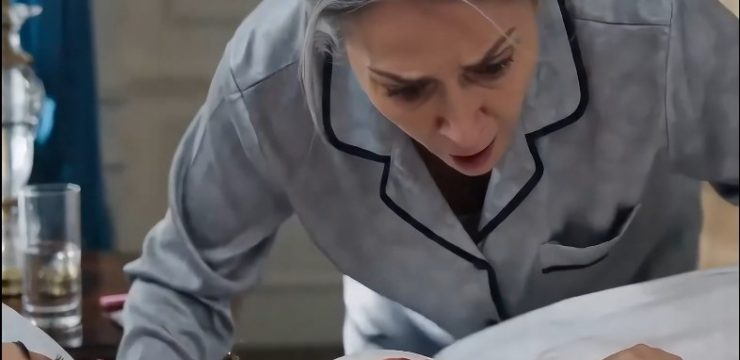
Act I
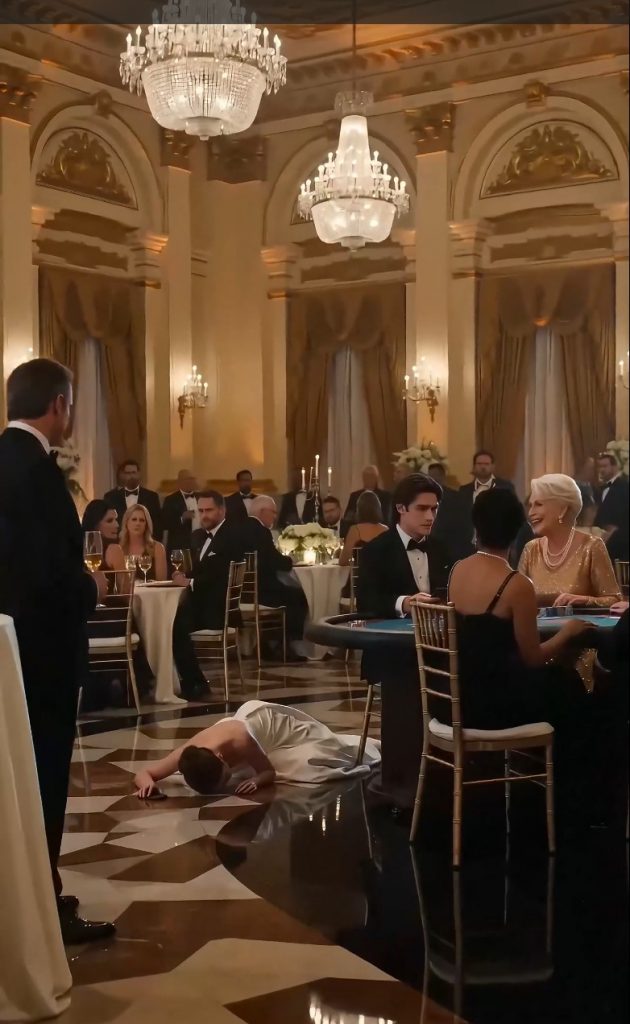
The chandelier kept sparkling while Amelia Hart lay on the floor.
That was the part she would remember later.
Not the pain in her cheek, not the cold polish of the ballroom floor beneath her shoulder, not the white gown twisted around her legs like something torn from a photograph.
The chandelier.
Hundreds of crystals catching gold light above a room full of people who saw her fall and still lifted their glasses.
At the casino-style table near the center of the ballroom, cards slid across green felt. Champagne flutes chimed. Women in silk gowns leaned toward each other with careful smiles, pretending not to stare.
Veronica Ashford did not pretend.
She sat beneath the chandelier in a gold sequined dress and pearl necklace, laughing as if the young woman on the floor was entertainment arranged for the evening.
“Some people always make a scene,” she said.
A few guests laughed.
Not loudly.
Just enough to show which side they had chosen.
Across the room, Nathan Ashford stood in his black tuxedo, one hand wrapped around his phone, his face pale but distant. He had not run to Amelia. Had not asked if she was hurt. Had not even stepped away from the table where his mother’s friends watched him like judges.
Amelia pushed one trembling hand against the floor.
Her phone was still in her fist.
The screen was cracked at the corner, but it worked.
She lifted her head toward Nathan.
“You never even looked at me,” she whispered.
The room quieted slightly.
Nathan frowned as if the accusation inconvenienced him.
“Amelia, not now.”
That almost made her laugh.
Not now.
Not while his mother’s charity gala glittered around them.
Not while the donors were here.
Not while the Ashford name floated above the room like a crown no one was allowed to touch.
Amelia pressed her thumb to the phone screen.
The projector hummed.
At first, no one noticed.
Then the massive screen near the banquet tables flickered to life.
The casino game disappeared from conversation.
The room turned.
A video appeared on the screen.
It showed the same ballroom.
The same chandelier.
The same white gown.
Amelia on the floor.
Guests stepping around her.
Veronica laughing from the card table.
Nathan looking down at his phone.
He finally looked up now.
“Wait,” he said, voice thin. “Is that from tonight?”
Amelia rose slowly, one hand braced against a chair.
The faint red mark on her cheek caught the projector light.
Her voice steadied.
“Now everyone can see what really happened.”
And then the video rewound.
Act II
Amelia had never wanted an Ashford gala.
She wanted a small wedding in the garden behind her father’s old house, with folding chairs, wildflowers, and music soft enough for people to hear each other laugh. Nathan said he wanted that too, back when he was still the man she believed she loved.
Before his mother turned the engagement into a campaign.
Veronica Ashford came from a family that treated reputation like inherited property. Her late husband had built Ashford Capital into a name whispered in rooms where ordinary people were discussed only as markets, staff, or risk.
After his death, Veronica became the guardian of the family image.
No scandal.
No weakness.
No one unsuitable.
Amelia was unsuitable from the beginning.
She was not poor, exactly, but she was not Ashford rich. Her father had been a public school music teacher. Her mother ran a small tailoring shop. Amelia had built her own career as a documentary editor, spending years cutting together footage other people wanted hidden.
That was the first thing Veronica disliked.
The second was that Nathan loved her before asking permission.
At first, Veronica was polite.
Polite people can be cruel for months without raising their voices.
She corrected Amelia’s pronunciation of wine names. Suggested different dresses. Sent guest lists already edited. Referred to Amelia’s family as “sweetly modest.” Asked, in front of donors, whether documentaries paid in exposure or actual checks.
Nathan always apologized later.
“She’s from another generation,” he would say.
“She knows exactly what she’s doing,” Amelia would answer.
He never denied it.
He simply became quieter.
Then came the prenup.
Veronica’s attorney delivered it in a silver folder three weeks before the engagement gala. It was not a simple agreement. It was a cage with legal language. Amelia would waive future claims, accept strict confidentiality terms, and agree that any “public conduct damaging to the Ashford reputation” could void her rights to shared property after marriage.
Amelia slid it back across the table.
“No.”
Nathan looked startled.
Veronica smiled.
“Surely you understand why families like ours protect what they have.”
Amelia met her eyes.
“I understand why people hide behind paperwork when they don’t trust love.”
The room froze.
Nathan said nothing.
That silence stayed with Amelia.
A week later, strange things began happening.
A donor claimed Amelia had insulted his wife. A jeweler said Amelia had tried to exchange the engagement ring for cash. A caterer reported she had demanded free upgrades. Each story was small enough to deny, but large enough to stain.
Nathan believed her.
At first.
Then Veronica began using softer words.
Concerned.
Unstable.
Overwhelmed.
Not ready for our world.
The engagement gala became Veronica’s final test.
A casino-night fundraiser for the Ashford Children’s Hospital Wing, held in the grand ballroom of the Barrington Hotel. Guests were told it would celebrate Nathan and Amelia before the wedding.
Amelia knew better.
The event was not designed to welcome her.
It was designed to measure whether she could be broken in public.
So she came prepared.
Because Amelia Hart knew how cameras worked.
And more importantly, she knew how people behaved when they thought no one useful was recording.
Act III
The first insult came before dinner.
Veronica introduced Amelia to a circle of donors as “Nathan’s creative little project,” then laughed as if it were affectionate.
The second came at the card table.
A woman Amelia had never met asked whether she was nervous about marrying into responsibility. Another said Veronica must be relieved to have “guidance clauses” in the wedding paperwork.
Amelia looked at Nathan.
He was on his phone.
Again.
He had been on it all night.
Every time Veronica’s smile sharpened, Nathan’s screen lit up. Every time Amelia’s shoulders stiffened, Nathan read something urgent, typed something brief, stepped half a foot away from her.
Avoidance disguised as importance.
Then Veronica approached with two security staff and a small velvet pouch.
Her expression was grave.
Too grave.
“Amelia,” she said loudly enough for surrounding guests to turn, “there’s something we need to discuss privately.”
Amelia looked at the pouch.
“What is that?”
Veronica opened it.
Inside was a diamond bracelet from the silent auction table.
Gasps moved through the nearest guests.
Veronica’s voice lowered, but not enough.
“It was found in your clutch.”
Amelia stared at her.
“That’s impossible.”
Nathan finally looked up.
His face did not show belief.
It showed embarrassment.
That was worse.
“Nathan,” Amelia said.
He glanced at the bracelet, then at the guests, then at his mother.
“Let’s not do this here.”
Amelia felt the floor vanish beneath her, though she was still standing.
“Do you think I took it?”
He hesitated.
That hesitation was the end of something.
Veronica touched his sleeve.
“She’s under pressure. People make desperate choices when they feel they don’t belong.”
Amelia’s phone was already in her hand.
She had synced it earlier to the ballroom’s AV system through an old colleague working the event. Not to embarrass anyone. Not at first. She had done it because Veronica kept rewriting reality, and Amelia no longer trusted truth without backup.
“What are you doing?” Veronica asked.
“Showing the security angle from the auction table.”
Veronica’s face changed.
Only for half a second.
But Amelia saw it.
Then Veronica stepped close.
“Don’t you dare.”
Amelia looked at Nathan.
“Ask her why she’s scared.”
He did not answer.
Veronica grabbed for the phone.
Amelia pulled back.
The movement was small.
The reaction was not.
Veronica’s hand struck Amelia’s cheek as she lunged, the phone nearly flying loose. Amelia stumbled against the edge of the casino table. Cards scattered. Someone gasped. Her heel caught the hem of her gown, and she went down hard onto the ballroom floor.
For a moment, the room stopped.
Then Veronica laughed.
“Some people always make a scene.”
And no one helped.
Not Nathan.
Not the guests.
Not the women who had called themselves charitable while raising money for children they would never have to look in the eye.
Amelia lay there with her phone clutched in her hand and understood something with terrible clarity.
She had not fallen out of place.
She had been shown exactly where they thought her place was.
On the floor.
So she pressed play.
Act IV
The projector rewound past Amelia lying on the floor.
Past Veronica’s laugh.
Past Nathan staring at his phone.
The screen jumped to the silent auction table thirty minutes earlier.
A camera angle from above showed guests moving around champagne buckets and glass cases. The diamond bracelet rested beneath a small spotlight. Veronica stood near it, smiling at a donor.
Then she looked around.
Reached into the display.
Removed the bracelet.
And dropped it into Amelia’s clutch while Amelia was speaking to a waiter three feet away.
The ballroom went silent so quickly the projector hum sounded loud.
Someone near the banquet tables whispered, “Oh my God.”
Nathan took one step forward.
“Mother?”
Veronica stood rigid beside the card table.
“That footage is manipulated.”
Amelia tapped her phone.
Another angle appeared.
This one was from a guest’s livestream, captured accidentally from across the room. It showed the same motion from a different direction. Veronica’s gold sleeve. The bracelet. The clutch.
No editing.
No ambiguity.
Amelia looked at Nathan.
“You asked me not to do this here.”
Her voice shook, but did not break.
“You didn’t ask her why she planted evidence in my bag.”
Nathan’s mouth opened.
No words came.
The video continued.
It showed Veronica confronting Amelia.
Showed Amelia holding up the phone.
Showed Veronica grabbing.
Showed the strike.
The stumble.
The fall.
The room watched itself fail.
That was the part no one could hide from.
A man in a tuxedo stepped around Amelia’s dress without kneeling. A woman lifted her champagne glass out of the way as if the greatest danger was spilling it. Two guests looked directly at Amelia on the floor, then turned back to the card table.
Nathan appeared in frame too.
Phone in hand.
Eyes down.
Amelia stopped the video there.
His face on the screen remained frozen in the glow of the device.
The room did not look at Veronica now.
It looked at him.
Nathan stared at his own image.
“I didn’t see,” he whispered.
Amelia’s eyes filled.
“No. You chose not to.”
Veronica found her voice.
“This is absurd. She is trying to humiliate this family.”
Amelia turned toward her.
“No, Veronica. You tried to humiliate me. I only made it harder to lie about.”
A security director from the hotel approached the table, expression grim.
“Mrs. Ashford, we need to speak with you regarding the auction item and the incident.”
Veronica lifted her chin.
“I am the chair of this event.”
The director looked at the screen.
“Not anymore.”
A ripple moved through the guests.
For the first time that night, Veronica Ashford looked smaller than the room she had controlled.
Then the hospital board president stood from the front table.
The older woman removed her glasses slowly.
“Veronica,” she said, voice cold, “you used a children’s charity gala to frame your future daughter-in-law for theft.”
Veronica’s face flushed.
“That is not what happened.”
The board president looked toward the projector.
“We all just watched what happened.”
Act V
The gala ended without dessert.
People left in clusters, speaking in low voices, avoiding Amelia’s gaze now that guilt had made her dangerous to look at. Some tried to apologize on the way out.
“I didn’t realize.”
“I thought it was private.”
“I assumed someone else would help.”
Amelia listened without answering.
There are apologies meant to heal the injured person, and apologies meant to rescue the person offering them from shame. That night, most belonged to the second kind.
Nathan stayed near the edge of the ballroom, still holding his phone like an object he no longer trusted.
When the room finally emptied, he approached her.
“Amelia.”
She was standing beside the projector screen, white gown wrinkled, cheek faintly marked, hair loosened from its bun. She looked exhausted.
She also looked taller.
“I’m sorry,” Nathan said.
She studied him.
“For what?”
The question startled him.
“For tonight.”
“That’s not specific.”
He swallowed.
“For not helping you.”
She waited.
“For doubting you.”
She kept waiting.
His voice cracked.
“For letting my mother decide what I was allowed to see.”
That one reached her.
Not enough to fix anything.
But enough to prove he had finally found the right wound.
Amelia looked toward the empty casino table where cards still lay scattered.
“Do you know what hurt the most?”
Nathan shook his head.
“It wasn’t the bracelet. It wasn’t your mother. It wasn’t even falling.”
Her eyes met his.
“It was looking for you and realizing you were relieved not to look back.”
Nathan’s face crumpled.
“I was afraid of making it worse.”
“You did.”
The simplicity of it broke him more than anger would have.
He nodded, tears gathering.
“What happens now?”
Amelia slipped the engagement ring from her finger.
His breath stopped.
She placed it on the white tablecloth between them.
“Now everyone can see what really happened,” she said. “Including me.”
She left before he could ask for another chance.
Not because she did not love him.
Because love had become a place where she was expected to stand alone while everyone judged the way she survived.
The aftermath came fast.
The hospital board removed Veronica as gala chair by morning. The hotel released a statement confirming cooperation with the investigation. The diamond bracelet was returned to the auction display, then quietly withdrawn because no donor wanted to bid on evidence.
Veronica claimed the video lacked context.
Then the hotel released its internal report.
There is only so much context a planted bracelet can survive.
The Ashford family attorney contacted Amelia with language about privacy, mutual pain, and avoiding unnecessary public harm. Amelia sent the footage to her own lawyer and declined every request for a private meeting.
For two weeks, her name filled gossip columns.
Some called her brave.
Some called her dramatic.
Some said she should have handled it privately, which usually meant they preferred cruelty to happen off-camera where it could remain comfortable.
Amelia returned to work.
That saved her.
Editing footage was different after that night. She no longer saw video as just a record. She saw it as memory with a spine. A witness that did not care about wealth, pearls, family names, or who sounded more believable at dinner.
Three months later, the Ashford Children’s Hospital Wing received a new chair.
Not Nathan.
Not Veronica.
A pediatric surgeon named Dr. Elena Reyes, who invited Amelia to consult on a transparency campaign for donors. Amelia almost said no.
Then Dr. Reyes said, “People gave money in that room while ignoring someone hurt in front of them. I think we need to talk about what charity means when no one is applauding.”
Amelia said yes.
The campaign was simple.
No glamour shots.
No gold lighting.
Just nurses, families, hospital staff, patients, and one sentence printed at the bottom of every poster:
Compassion is what you do before anyone is watching.
The line traveled farther than Amelia expected.
Schools requested the video.
Workplaces played it in training rooms.
A foundation asked her to speak about bystander silence and public cruelty. She stood on a stage months after the gala, wearing a navy dress instead of white, and looked into a crowd that was listening for the right reasons this time.
“I used to think the opposite of cruelty was kindness,” she said. “But that night taught me something else. Sometimes the opposite of cruelty is attention. Looking. Staying. Refusing to let someone disappear on the floor because helping them would be inconvenient.”
In the back row, Nathan sat alone.
Amelia knew he would be there because he had written first and asked permission to attend.
She had said yes.
Not because she was returning to him.
Because people should be allowed to learn from the truth after it ruins the lie.
After the speech, he did not approach her immediately. That was new. He waited until everyone else had left, then stopped several feet away.
“You were right,” he said.
She gave a faint smile.
“I know.”
He almost laughed, then looked down.
“I’m in therapy.”
“I’m glad.”
“I’m not saying that to earn anything.”
“Good.”
He nodded.
“My mother is selling the Ashford house.”
Amelia felt no satisfaction.
Only distance.
“And you?”
“I resigned from the foundation board. I’m starting over somewhere smaller.”
“That sounds difficult.”
“It should be.”
For the first time, she saw him without the Ashford shadow around him. Still flawed. Still late. But looking.
Really looking.
It did not change her decision.
But it softened the memory of him enough that it no longer cut the same way.
One year after the gala, Amelia returned to the Barrington Hotel for a film fundraiser.
The ballroom had been redecorated. New flowers. New table settings. No casino table. No Ashford crest. The projector screen stood at the front again, but this time it displayed student documentaries from young filmmakers.
Amelia paused near the spot where she had fallen.
For a moment, she saw it all.
The chandelier.
The guests.
Veronica’s smile.
Nathan’s phone.
Her own hand gripping the device that would make the room look at itself.
Then a young volunteer approached.
“Ms. Hart? We’re ready for you.”
Amelia turned.
On the screen behind the stage was the title of the scholarship she had founded with the campaign funds.
The Look Back Fund.
For students documenting overlooked truths.
Amelia walked to the front of the ballroom.
No one laughed.
No one stepped around her.
No one pretended not to see.
She looked out at the faces waiting in the gold light and thought of the girl in the white gown who had pushed herself up from the floor with a cracked phone in her hand.
That girl had believed the video would expose Veronica.
It did.
But it also exposed everyone else.
The man who loved without courage.
The guests who chose comfort over compassion.
The room that kept glittering while someone suffered at its feet.
And Amelia herself, finally seeing that being ignored by people who benefit from your silence is not proof that you are small.
It is proof that your voice is dangerous.
That night, she had shown them what really happened.
After that, she never needed their version of the story again.