Act I
The kitchen was too small for a man that angry.
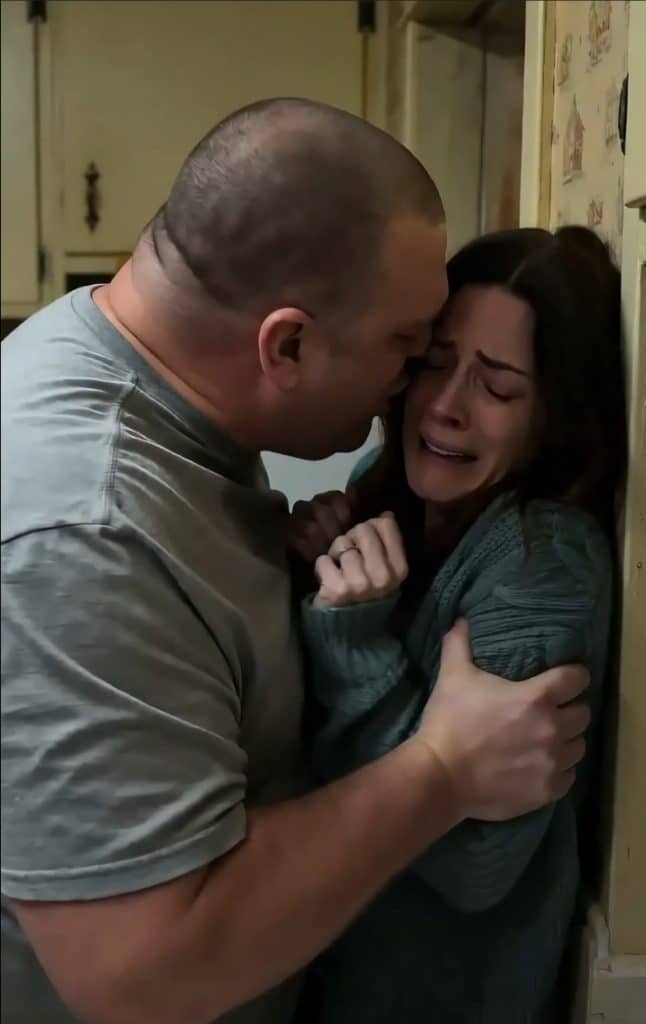
His voice slammed against the yellowed cabinets, bounced off the old refrigerator, and trapped itself beneath the buzzing fluorescent light. Every word seemed to make the room shrink around Emily Carter until there was nowhere left for her to breathe.
“You’re worthless!” Mark shouted, his hand twisted in the sleeve of her green sweater. “You hear me?”
Emily’s back hit the counter. A mug trembled near her elbow. A spoon rolled off the edge and struck the floor with a thin metallic ring that made her flinch harder than the shouting.
She did not answer.
She had learned that answering made it worse.
Mark’s face was inches from hers, red with rage, his jaw clenched so tightly that the words came out like threats instead of sentences. He gripped her arms as if she were not a person but something he owned, something he could move, corner, silence.
Emily turned her face away and shut her eyes.
Not because she wanted to disappear.
Because she hoped her son had not heard.
But upstairs, behind a half-closed bedroom door covered in old superhero stickers, Noah had heard everything.
He had heard the counter slam.
He had heard his mother gasp.
He had heard the word Mark used when he wanted to make her feel smaller than the dust under his boots.
Worthless.
Noah was only nine years old, small for his age, with shaggy light brown hair that always fell into his eyes. He still slept with a flashlight under his pillow. He still kept the blue plastic astronaut his mother had bought him from a thrift store when he was five.
But that night, something inside him broke before his voice did.
Downstairs, Mark shoved several things across the counter in one furious sweep. A dish clattered. A jar tipped over. Emily’s hand flew up to protect her face, though he had not raised his hand that time.
That time.
Mark yanked her forward by the sleeve, then forced her back against the cabinet edge. Emily’s knees weakened beneath her. Her hair fell across her damp face as she gripped the counter, trying not to collapse.
Then the kitchen went still.
Not quiet.
Still.
Because in the doorway stood Noah.
His bare feet were planted on the worn linoleum. His eyes were wide and wet. His little chest rose and fell too quickly, like he had run a mile instead of down one flight of stairs.
Emily saw him and froze.
“Noah,” she whispered, barely making a sound.
Mark turned.
For one second, his rage had nowhere to go. It hung in the air between them, ugly and exposed.
Then his mouth curled.
“Go back upstairs,” he snapped.
Noah did not move.
Mark stepped away from Emily, shoulders squared, trying to fill the room again. He had spent years being the biggest thing in every space he entered. He expected fear because fear had always worked.
But Noah looked past him.
He looked at his mother’s shaking hands.
At the sleeve stretched out of shape.
At the tears she had tried to hide from him for years.
And then the boy moved.
It happened so fast that even Emily could not understand it at first. Noah rushed forward, not with strength, but with every ounce of terror and love in his small body. Mark, caught mid-step, stumbled back, struck the corner of the wall, and lost his balance with a heavy thud that silenced the kitchen.
For the first time that night, Mark looked afraid.
Noah stood between them, fists clenched at his sides, his whole body trembling.
“Don’t you touch her!” he screamed.
His voice cracked on the last word.
Emily covered her mouth with one shaking hand.
Mark leaned against the wall, breathing hard, staring at the boy as if Noah had become something impossible in front of him.
But the real reason Mark froze was not because a child had pushed him.
It was because of what Noah was holding in his fist.
Act II
At first, Emily did not see it.
She saw only her son’s back. His thin shoulders. His blue T-shirt wrinkled from sleep. His fingers curled so tightly that his knuckles had gone pale.
Then his hand opened.
A small silver key rested in his palm.
Emily’s breath stopped.
Mark saw it too.
All the fury drained from his face so quickly it left something worse behind. Recognition. Panic. A flicker of guilt so sharp it almost looked like pain.
“Where did you get that?” he asked.
His voice was lower now.
Noah did not answer. His chin trembled, but he kept his feet planted.
Emily knew that key.
She had not seen it in six years.
It belonged to the small lockbox her husband Daniel had kept in the closet before he died.
Daniel Carter had been gentle in a way that made people trust him before they knew why. He fixed neighbors’ sinks without charging them. He wrote notes on grocery receipts and tucked them into Emily’s coat pockets. He taught Noah, when Noah was barely three, to press his hand over his heart whenever he was scared and say, “I am still here.”
Then one rainy November evening, Daniel was gone.
A truck had struck his car on a back road outside town. That was what the report said. That was what the insurance papers said. That was what Mark had told Emily when he arrived at her door two weeks later with paperwork, sympathy, and a face that seemed almost too practiced in grief.
Mark had been Daniel’s older half-brother.
Not close, exactly. But family.
He told Emily that Daniel had owed money. He told her the house was tangled in debts. He told her the accounts were locked, the policies contested, and the only way she could keep a roof over Noah’s head was to let him help.
Emily had been grieving so deeply she barely understood the days passing around her.
Mark handled the calls.
Mark spoke to the bank.
Mark moved into the spare room “temporarily.”
And somehow, temporary became six years.
By the time Emily realized she was trapped, Mark’s name was on bills, accounts, documents she did not remember signing. He controlled the money Daniel had left behind. He controlled the house Daniel had painted with Emily the summer before Noah was born.
Most of all, he controlled the story.
He told everyone Emily was fragile.
Forgetful.
Unstable.
Too emotional to manage things alone.
And because grief makes a person look broken from the outside, people believed him.
At first, Mark was careful. He used concern as a leash. He bought groceries and told people Emily could not cope. He answered the phone when her friends called. He deleted voicemails. He said he was protecting her.
Then slowly, the mask slipped.
A slammed door.
An insult muttered under his breath.
A bill hidden.
A threat delivered in the calm voice of a man who knew exactly how afraid she was.
Noah grew up in the shadow of that voice.
He learned which floorboards creaked.
He learned when to stay silent.
He learned to pack a backpack with a sweatshirt, his astronaut toy, and granola bars, just in case his mother ever whispered, “Now.”
But Emily never whispered it.
Not because she did not want to leave.
Because Mark had made her believe there was nowhere to go.
That week, however, Noah had found something.
He had been looking for batteries in the hallway closet when an old shoebox slid from the top shelf and burst open at his feet. Inside were Christmas cards, Daniel’s watch, a faded photograph of Emily laughing on a beach, and the tiny silver key taped beneath the lid.
Noah knew it mattered because his mother had once told him, through tears, that Daniel kept important things in a black metal box.
A box Mark claimed had been lost after the funeral.
Noah did not tell Emily right away.
He was afraid Mark would hear.
So he waited until Mark left for work, dragged a chair to the closet, and searched behind coats that smelled like dust and winter. Behind the loose panel at the back, he found it.
The black box.
Inside were papers he could not fully understand, a flash drive, and a sealed envelope with his mother’s name written in Daniel’s handwriting.
Emily.
For when the truth matters more than peace.
Noah had hidden the envelope under his pillow.
And tonight, when Mark’s shouting shook the walls, he had grabbed the key without knowing why.
Now Mark knew exactly what the boy had found.
And that was why the man who had terrorized Emily for years suddenly looked like the cornered one.
Act III
“Noah,” Emily whispered, her voice shaking. “Come here.”
But Noah did not move toward her.
He kept himself between her and Mark, as if his small body could hold back six years of fear.
Mark pushed himself off the wall. He tried to straighten, tried to find the old anger that had always worked before, but his eyes kept dropping to the key.
“Give it to me,” he said.
Noah shook his head.
“Now.”
“No.”
The word was tiny.
It landed like a match in a dark room.
Mark’s nostrils flared. For a moment, Emily thought he might lunge. Her body moved before her mind did, one arm reaching for Noah, one hand gripping the counter so hard her fingers ached.
Then the doorbell rang.
All three of them froze.
It rang again.
Mark’s head snapped toward the front of the house.
A woman’s voice called through the door.
“Emily? It’s Mrs. Alvarez. I called the police. Open the door if you can hear me.”
Emily closed her eyes.
For years, she had been ashamed of what the neighbors might think.
Now shame felt like a luxury she could no longer afford.
Mark’s face twisted.
“You stupid—”
He stopped himself, because Noah was still staring at him.
The boy’s tears had not stopped. They tracked down his flushed cheeks, but his eyes were different now. Not fearless. No child should have to be fearless in his own kitchen.
Determined.
Emily moved quickly. She pulled Noah back against her side and wrapped one arm around his chest. He collapsed into her, still shaking, still clutching the key.
Mark took one step forward.
A loud knock hit the front door.
“Police department,” a voice called. “Open the door.”
That sound changed the air.
Not because it solved everything.
Because for the first time, Mark was not the only authority in the house.
Emily walked to the front door with Noah pressed against her side. Her legs felt weak, but each step seemed to return a piece of herself she had forgotten she owned.
When she opened the door, Mrs. Alvarez stood on the porch in a blue robe, her gray hair pinned badly to one side, her phone still in her hand. Behind her were two officers.
Mrs. Alvarez did not ask what happened.
She looked at Emily’s torn sleeve, Noah’s face, the scattered kitchen beyond them, and her expression softened with a sadness that said she had known more than Emily realized.
“I heard him,” she said gently.
Emily nodded once.
That was all she could manage.
The officers separated Mark from them. He protested immediately, his old voice returning in pieces.
“She’s confused,” he said. “She gets like this. The kid overreacted. I didn’t do anything.”
Emily almost believed him again.
That was the worst part.
After years of being told she was fragile, she could feel the lie looking for a place to live inside her.
Then Noah lifted his hand.
“He’s lying,” the boy said.
His voice was hoarse, but clear.
And then he gave the silver key to his mother.
Emily looked down at it like it had been pulled from another life.
“Noah,” she whispered. “Where did you find this?”
“In Dad’s box.”
Mark’s face went colorless.
The younger officer noticed.
“What box?” she asked.
Emily did not answer right away.
Her fingers closed around the key. For six years, she had mourned a husband, feared a brother-in-law, and lived inside a house that felt less like home every day.
Now the key was warm from her son’s palm.
Daniel’s handwriting flashed through her mind.
For when the truth matters more than peace.
Emily looked at Mark.
And finally, she saw fear on him clearly enough to understand it.
He had not been afraid of losing control.
He had been afraid of what Daniel left behind.
Act IV
The lockbox opened on the kitchen table at 11:42 that night.
The officers were still there. Mrs. Alvarez sat beside Noah with a blanket around his shoulders, though the boy refused to take his eyes off his mother. Mark stood near the hallway with one officer between him and the room, his hands flexing uselessly at his sides.
Emily lifted the lid.
Inside, everything smelled faintly of metal, paper, and the lavender sachets Daniel used to tuck into storage boxes because he knew she loved the scent.
The envelope was on top.
Her name looked exactly the way she remembered it.
Not the hurried signatures on bills.
Not the copied forms Mark had shoved in front of her.
Daniel’s writing had a slight tilt, as if even his letters leaned toward her.
Emily opened it with trembling fingers.
My Em,
If you are reading this, then I was right to be afraid.
That was the first line.
The kitchen blurred.
Daniel’s letter was not long, but every sentence cut through the life Mark had built around her. Daniel wrote that he had discovered irregular transfers from his business account. He wrote that someone had forged his signature on loan documents. He wrote that he had confronted Mark privately because he had wanted to protect the family from scandal.
He had believed Mark would confess.
Instead, Daniel began to suspect something darker.
The flash drive, the letter said, contained copies of bank records, audio recordings of phone calls, and a signed statement from Daniel’s attorney confirming that the house, the savings account, and a trust for Noah had been secured before his death.
Emily’s hand shook so badly that the paper rattled.
No debts.
No contested estate.
No reason Mark needed to move in.
No reason he should ever have had control.
The older officer took the flash drive as evidence. The younger officer photographed the documents one by one.
Mark started talking again.
At first, he denied everything.
Then he blamed Daniel.
Then he blamed Emily.
By dawn, his story had changed four times.
But the papers did not change.
The recordings did not change.
The attorney’s name did not change.
And when the police contacted him the next morning, retired estate lawyer Henry Whitcomb drove to the station in a brown wool coat and brought a folder he had kept for six years because Daniel had told him, “If anything happens to me, don’t let Mark near my family.”
That sentence became the hinge on which Emily’s life turned.
The investigation that followed did not move like it did in movies. There was no single dramatic courtroom moment where everyone gasped and justice arrived fully dressed. There were interviews, signatures, hearings, and long afternoons where Emily sat across from people with clipboards while Noah drew spaceships in the waiting room.
But slowly, the truth did what truth always does when someone finally lets it breathe.
It spread.
The bank records showed Mark had redirected funds from Daniel’s business before and after his death. The forged documents gave him access he never should have had. The recordings showed Daniel confronting him calmly, pleading with him to make it right.
Most chilling of all was the final recording.
Daniel’s voice was tired but steady.
“Mark, if you’re listening to this, then you already know I gave copies to Henry. Stay away from Emily and Noah.”
Emily listened only once.
Then she asked them to turn it off.
She did not need to hear more to know her husband had tried to protect them even from beyond the life he lost.
Mark’s control collapsed piece by piece.
The house was restored to Emily’s name.
Noah’s trust was recovered.
The forged documents became evidence.
The neighbors who had once believed Mark’s polite version of things began remembering what they had ignored. The shouting. The canceled plans. The way Emily stopped coming to book club. The way Mark always answered for her, even when she stood right beside him.
Mrs. Alvarez visited every afternoon with soup, bread, and the quiet stubbornness of a woman who refused to let shame keep Emily isolated another day.
One evening, two weeks after Mark was removed from the house, Emily stood in the kitchen alone.
The room still looked the same.
Yellowed cabinets. Old wallpaper. The refrigerator humming. A drawer that stuck unless you pulled it at an angle.
But the silence was different.
It was not the silence of fear.
It was the silence after a storm has moved far enough away that you can hear your own heartbeat again.
Noah appeared in the doorway, holding the blue plastic astronaut.
“Are we leaving?” he asked.
Emily turned.
For years, she had dreamed of taking him and running from that house.
But now, looking at her son beneath the flickering light, she realized the house had never belonged to Mark. The fear had. The lies had. The locked doors had.
Not the home Daniel built.
“Not tonight,” she said. “Tonight we fix the light.”
Noah looked up at the fluorescent tube above them.
“It buzzes,” he said.
“I know.”
“I hate it.”
Emily smiled through tears.
“Me too.”
So she called an electrician the next morning.
And when the harsh old light came down, something in Emily came down with it.
Act V
Spring arrived slowly that year.
It came in open windows, fresh paint, and the smell of pancakes on Saturday mornings. It came in Noah leaving his backpack by the door without checking it twice. It came in Emily answering her own phone.
The kitchen changed first.
Not all at once. Emily did not have the money or energy for a perfect renovation, and perfection no longer interested her anyway.
She painted the cabinets white.
Mrs. Alvarez helped peel the old wallpaper backsplash while complaining dramatically about whoever had chosen it in 1989.
Noah picked a new light fixture, a round warm one that made the room glow instead of flicker.
On the day it was installed, he stood beneath it and stared up for a long time.
“Looks normal now,” he said.
Emily looked at the clean counter, the repainted drawers, the empty space where fear used to stand.
“No,” she said softly. “It looks ours.”
The legal case took months.
Mark eventually pleaded guilty to financial crimes connected to Daniel’s estate and accepted a separate order that kept him away from Emily and Noah. There were consequences, not as clean or cinematic as revenge, but real enough to matter.
Emily did not attend every hearing.
She attended the one where she gave her statement.
She wore the green sweater.
Not because it had survived untouched. The sleeve had stretched. One seam still showed where Mrs. Alvarez had mended it with careful hands.
Emily wore it because she wanted Mark to see that the night he tried to make her feel worthless had become the night everything he stole began returning to her.
When she stood before the court, her voice shook at first.
Then she looked down at Noah in the front row.
He pressed one hand over his heart.
I am still here.
Emily breathed in.
And she spoke.
She did not describe herself as weak. She did not apologize for staying. She did not turn her pain into something small enough for other people to understand comfortably.
She told the truth.
She told them about the years of control, the hidden papers, the lies about Daniel’s debts, the way grief had been used against her like a weapon.
Then she told them about her son.
“My child should never have had to stand between me and a grown man,” she said. “But he did. And when he did, he reminded me that fear can be inherited, but courage can be too.”
Noah cried when she said that.
So did Mrs. Alvarez.
Even the judge paused before speaking.
Afterward, outside the courthouse, Noah asked if his dad would be proud.
Emily crouched in front of him on the courthouse steps.
The afternoon sun caught in his hair, making him look younger than he had seemed on that terrible night in the kitchen.
“He would be proud of your heart,” she said. “But he would also want you to know something.”
“What?”
“You are my son. Not my shield.”
Noah looked down.
Emily lifted his chin gently.
“You saved me because you loved me,” she said. “Now I need you to let me protect you too.”
His face crumpled then, not from fear but from release. He fell into her arms, and Emily held him the way she should have been free to hold him all along.
No one rushed them.
Not Mrs. Alvarez.
Not the attorney.
Not the people passing on the sidewalk who saw only a mother and son clinging to each other after something they would never fully know.
Months later, Emily found one more thing in Daniel’s lockbox.
It had slipped beneath the lining, hidden in a fold of black fabric. A photograph.
Daniel stood in the old kitchen holding newborn Noah, his face exhausted and radiant. Emily was beside him, laughing, her hair messy, one hand resting on Daniel’s shoulder.
On the back, Daniel had written:
This is the safest place in the world because they are in it.
Emily sat at the kitchen table for a long time after reading that.
Then she framed the photograph and placed it on the counter near the window, where the morning light could touch it.
The kitchen remained small.
The cabinets still stuck sometimes.
The refrigerator still hummed too loudly at night.
But now, when Noah came downstairs for breakfast, he did not pause at the doorway to listen for danger. He came in sleepy-eyed and hungry, dragging his socks across the floor, complaining about math homework, asking for extra syrup.
Emily watched him one morning as he reached for a glass from the cabinet.
His hand passed beneath the new light.
No trembling.
No flinch.
Just a boy in his kitchen.
Just a child finally allowed to be a child.
And Emily realized that was the real victory.
Not Mark’s punishment.
Not the recovered money.
Not even the truth being dragged out of the dark after six stolen years.
The victory was this quiet, ordinary morning.
The victory was toast crumbs on the table, sunlight on the floor, and Noah humming softly while his mother flipped pancakes at the stove.
The victory was a home no longer holding its breath.
And when Noah looked up at her and smiled, Emily smiled back.
Not because everything was healed.
But because everything was finally free.