Act I
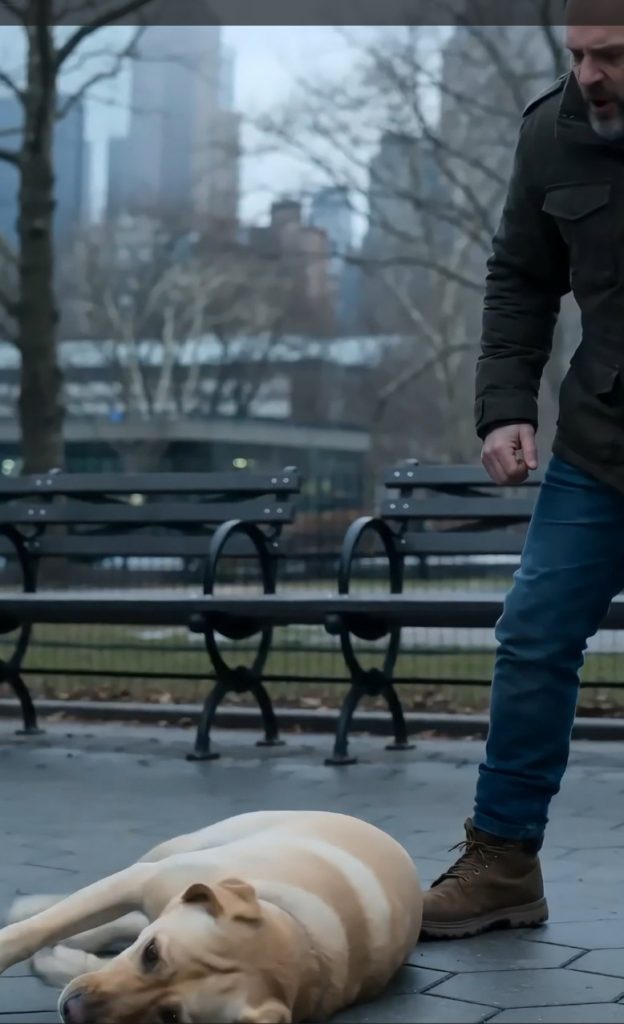
The dog yelped once, and the entire park seemed to stop breathing.
It had been an ordinary gray afternoon in the city. Cold wind moved between the glass towers. Bare trees stood over the stone walkway like witnesses too tired to speak. Three women sat near a black metal bench with paper coffee cups warming their hands, their conversation drifting quietly into the overcast air.
Then the man in the olive jacket stepped into the path.
The tan dog had only been sniffing near the trash receptacle, thin tail low, eyes cautious but not aggressive. It looked like the kind of stray people walked past without seeing, a soft-bodied, frightened creature surviving on scraps and luck.
The man saw him.
And chose cruelty.
“Get away from here, idiot!” he shouted.
His boot struck the dog’s side with enough force to send the animal tumbling across the cold pavers.
The dog landed with a frightened cry, curled low, and tried to lift its head. Its legs trembled. Its ears flattened. It did not growl. It did not fight. It only looked around with wide, confused eyes, as if still trying to understand why pain had arrived from nowhere.
The three women gasped.
A cyclist slowed.
Someone muttered, “Hey, what’s wrong with you?”
The man only sneered. “It’s a stray. Relax.”
That was when the woman in black turned around.
She had been standing near the edge of the walkway, her long dark hair moving slightly in the wind, her hands resting at her sides. She wore a black tactical jacket, black jeans, and boots polished dull by weather rather than vanity. She did not look surprised.
She looked still.
Too still.
Her eyes moved from the trembling dog to the man who had hurt him.
And something in the air changed.
The man noticed her staring. “What?”
She walked toward him.
Not fast.
Not loud.
Each step landed evenly on the hexagonal stones.
Behind her, the three women rose from the bench and stood in a silent line, their faces hard with disgust. The city towers loomed beyond them. The wind dragged a paper napkin along the path.
The woman stopped a few feet from the man.
Her voice was calm enough to make the moment colder.
“You think you’re better than this innocent creature?”
The man laughed under his breath. “Lady, mind your business.”
The dog whimpered again.
The woman’s eyes did not leave his face.
“You just made it mine.”
He stepped toward her as if size had always been enough.
It had been, probably. With animals. With strangers. With people too shocked to intervene.
But not this time.
The woman moved once, controlled and sudden, and the man stumbled backward before his arrogance could become another act of violence. His shoulder hit the stone edge of a planter, and he froze, breath knocked out of him more by shock than pain.
The woman stood between him and the dog.
“Stay down,” she said.
The man looked up at her.
For the first time, he seemed afraid.
Not because she had struck him.
Because she had recognized him.
Act II
Her name was Mara Vale, though most people in the neighborhood knew her only as the woman who fed the dogs under the bridge.
Every morning before work, she walked two blocks east with a canvas bag of food, blankets, and small paper cups of water. She knew which dogs would approach and which needed distance. She knew which ones hated hats, which ones trusted children, which ones limped more when the temperature dropped.
People called her kind.
They were only half right.
Mara had built her life around animals because people had once failed the one creature she loved most.
Six years earlier, she had been a city animal control officer. Not the kind people imagined. She did not spend her days chasing frightened dogs with nets. Most of her job was patience. Calls from apartments. Loose pets after storms. Neglect cases no one wanted to name. Homes where animals were treated like furniture until they became inconvenient.
Her partner had been a tan mixed-breed dog named Benny.
Not an official K9. Not a police dog. Just a rescue who followed her everywhere with one torn ear and the solemn expression of an old man in a young dog’s body.
Benny had found three abandoned litters, alerted Mara to a gas leak in a basement shelter, and once led her to a missing elderly woman who had fallen behind a church fence.
He was gentle with everyone.
Even people who did not deserve gentleness.
Then one winter night, Mara answered a call about a dog being beaten behind an apartment complex. By the time she arrived, the man was gone. Benny ran ahead and found the injured dog beneath a staircase.
Mara found something else.
A boy watching from a laundry room window, silent and pale, hands pressed against the glass.
The boy knew the man.
The dog knew the man too.
Mara filed the report. She pushed for charges. She handed over photographs, witness notes, veterinary records, and the boy’s statement.
The case disappeared.
Not officially.
It simply dissolved.
The man had connections. His cousin worked city contracts. His landlord changed the security footage. The boy’s mother stopped answering calls. The department supervisor told Mara to “use discretion” because resources were limited.
Three weeks later, Benny was found outside Mara’s apartment building, badly hurt after someone forced open the back gate.
He survived the night.
Not the morning.
Mara left animal control two months later.
People assumed grief made her quit.
That was not true.
Grief made her stay awake long enough to build something better.
She started a small nonprofit called Second Light Rescue, named after the way animals look when they realize the worst moment is over and the next hand reaching toward them will not hurt. She learned the law. She learned evidence procedure. She learned how abusers hide behind paperwork, charm, and the assumption that no one will fight very hard for a stray.
She also learned how to protect herself.
Quietly.
Carefully.
Not to become violent.
To become impossible to intimidate.
And the man lying on the cold park stones had been in her files for years.
His name was Victor Crane.
He had been reported seven times.
Kicking a dog outside a corner store.
Throwing rocks at cats near a loading dock.
Threatening a volunteer who tried to photograph him.
Each complaint ended the same way.
No witness willing to testify.
No clear video.
No injured animal recovered in time.
No case.
Victor learned from every escape.
He learned that public cruelty shocked people into stillness.
He learned that if he shouted first, others backed away.
He learned that animals could not speak.
But he had never met Mara face-to-face.
Not until the gray afternoon in the park, when he hurt a tan dog in front of her and assumed the world would look away again.
Mara knelt beside the dog without turning her back fully on Victor.
“It’s okay,” she whispered.
The dog trembled harder when her hand came near, then relaxed slightly as she stopped short and let him smell her fingers.
“Easy. I’m not going to hurt you.”
One of the women from the bench crouched beside her. “I called emergency vet services.”
“Good,” Mara said.
Victor groaned and pushed himself up on one elbow.
“This is insane,” he snapped. “You attacked me.”
Mara looked at him then.
“No,” she said. “I stopped you.”
He wiped his mouth with the back of his hand and laughed bitterly. “You don’t know who I am.”
Mara’s expression did not change.
“Yes,” she said. “I do.”
And that was the first time Victor Crane stopped smiling.
Act III
The dog’s name, they learned later, was Milo.
Not a stray.
Missing.
A twelve-year-old Labrador mix with cloudy eyes, arthritis in one hip, and a blue collar hidden beneath the fold of his fur. His owner was an elderly woman named Edith Rowe who lived four blocks from the park and had been walking the neighborhood since sunrise with a leash in one hand and a photograph in the other.
Milo had slipped through a broken yard gate that morning.
Edith thought she had lost him forever.
When the emergency vet van arrived, Milo was wrapped in a blanket and lifted carefully from the pavement. Mara stood close, one hand resting lightly near his head as if promising he would not be alone.
Victor tried to leave during the confusion.
The three women blocked his path without touching him.
Not dramatically.
Just enough.
One of them held up her phone.
“I recorded everything,” she said.
Victor’s face tightened. “Delete it.”
“No.”
He stepped toward her.
Mara rose.
He stopped.
Sirens appeared two minutes later, red and blue washing over the gray stones. A pair of officers approached, already looking tired in the way officers did when they expected a messy public argument.
Victor straightened immediately.
Performance came naturally to him.
“This woman assaulted me,” he said, pointing at Mara. “I defended myself. These people are lying.”
Mara said nothing at first.
She only handed one officer her business card and then opened a folder on her phone.
“Victor Crane,” she said. “Seven prior animal cruelty complaints. Three witness statements withdrawn after intimidation. Two pending civil reports from my organization. One active restraining order from a volunteer he threatened last March.”
The officer looked up sharply.
Victor’s mouth opened.
Mara continued. “Today’s incident was recorded by multiple witnesses. The injured dog has been transported for medical evaluation. His owner is being located now. I’d also like your body camera on while I provide my statement.”
The officer glanced at Victor.
Victor’s face had lost color.
The second officer moved closer to him. “Sir, stay where you are.”
The wind cut through the park.
Mara looked down at the spot where Milo had been curled on the pavement. A faint smear of melted snow and dirt marked the stone. Nothing dramatic. Nothing that would make headlines by itself.
That was always the problem.
Cruelty often arrived in moments too small for the world to name properly.
A kick.
A shout.
A frightened animal crawling away.
A neighbor saying it was not worth getting involved.
Mara had spent years collecting those small moments until they made a map.
And every path led back to men like Victor.
Then Edith Rowe arrived.
She came half-running, half-stumbling, with a wool hat crooked on her gray hair and her coat unbuttoned despite the cold.
“Milo?” she cried. “Where’s my Milo?”
Mara turned instantly. “He’s alive. He’s on his way to Westbridge Emergency Vet. I’ll take you.”
Edith gripped her arm. “Was he hit by a car?”
Mara hesitated.
Victor stared at the ground.
“No,” Mara said gently. “A man hurt him.”
Edith looked past her.
At Victor.
For one terrible moment, the old woman’s face emptied. Not from confusion. From recognition.
“You,” she whispered.
Mara went still.
Victor lifted his head.
Edith’s hands began to shake.
“You came to my house,” she said. “Last week.”
The officers turned toward her.
Victor shook his head. “I don’t know this woman.”
Edith’s voice trembled, but it did not break. “You said I had to sell.”
Mara looked at Victor, then back at Edith. “Sell what?”
“My home,” Edith whispered. “He said the new development would take the block anyway. He said people like me should move before we became a problem.”
The park seemed to grow colder.
Mara understood then.
Milo had not been random.
Neither had Victor.
And the dog lying in an emergency van was only the first visible wound in a much larger plan.
Act IV
Westbridge Emergency Vet smelled of antiseptic, wet fur, and coffee left too long on a warming plate.
Milo lay on a padded exam table while Dr. Anika Shah checked him with careful hands. Edith stood beside him, whispering his name over and over as if each repetition stitched him back to the world.
Mara stayed near the door.
Not because she did not care.
Because rage needed distance if it was going to become useful.
Milo was bruised and frightened, but he would survive. The vet said it plainly, and Edith collapsed into the nearest chair, crying into both hands.
Mara turned away before her own tears could rise.
Her phone buzzed.
A message from one of Second Light’s volunteers.
You need to see this. Crane is tied to Northpoint Urban Renewal. They’re buying properties near the park. Edith’s block is next.
A second message followed.
Complaints about stray dogs increased around every property they targeted. Same pattern. Scare elderly residents. Make the neighborhood seem unsafe. Push them to sell.
Mara stared at the screen.
The shape of it became clear and ugly.
Victor was not only cruel.
He was useful.
Men like him always found someone willing to pay for cruelty if it served a cleaner-looking profit.
By sunset, Mara was in Second Light’s tiny office above a bakery, spreading documents across the conference table. Three volunteers worked beside her. The women from the park came too, still shaken, still determined, uploading their videos and writing statements before fear could soften their memory.
Edith sat in the corner with a blanket around her shoulders, Milo’s leash looped through her fingers.
“I thought I was losing my mind,” she said quietly. “They kept calling. Sending letters. People came by and took pictures of my porch. Then Milo started barking at night. I thought maybe I was too old to live alone.”
Mara looked up.
That was the cruelty behind the cruelty.
Not just harming a dog.
Making a woman doubt her right to remain in the life she had built.
“You’re not too old,” Mara said. “You were targeted.”
Edith closed her eyes.
Mara gathered the evidence into a single file.
The park video.
Victor’s prior complaints.
The development map.
The property letters.
Doorbell footage from Edith’s neighbor showing Victor on the block.
A recorded voicemail threatening “consequences” if Edith refused the offer.
By morning, the story was no longer small.
A local reporter Mara trusted published the first piece. By noon, residents from three blocks came forward. By evening, Northpoint Urban Renewal issued a polished statement denying knowledge of Victor Crane’s conduct and expressing “concern for the wellbeing of all community members, including pets.”
Mara read it once and closed the laptop.
Concern.
That was the word people used when they wanted compassion without responsibility.
Victor was arrested two days later after one of the park videos went viral and two former Northpoint contractors confirmed he had been hired as an “independent relocation consultant.”
The title almost made Mara laugh.
Almost.
At the courthouse hearing, Victor arrived with a lawyer and a clean shirt. He looked smaller without his rage. Less like a monster. More like what he really was: a coward who had mistaken helplessness for permission.
Edith came too.
So did the women from the park.
So did Mara.
When the judge asked whether Edith wanted to make a statement, she stood with both hands wrapped around Milo’s leash.
Milo was not in the room. He was recovering at home on a soft bed beside the radiator.
But the leash was enough.
“My dog did nothing to that man,” Edith said. “Neither did I. We were simply in the way of something he wanted.”
Victor stared at the table.
Edith’s voice grew stronger.
“I used to think cruelty was loud because it was powerful. Now I think it is loud because it is afraid of being seen clearly.”
Mara looked at her then.
And for the first time since the park, the anger in her chest eased into something steadier.
Justice had arrived late.
But this time, it had arrived with witnesses.
Act V
Milo came home on a Thursday afternoon.
The whole block was waiting.
Edith tried to tell people not to fuss, but someone had tied blue ribbons around the fence, and Mrs. Alvarez from the corner brought chicken soup, and two teenagers from the apartment building had fixed the broken gate without being asked.
Milo stepped carefully from Mara’s car, wearing a soft support wrap and looking deeply offended by the attention.
The crowd laughed gently.
Edith cried anyway.
Mara helped her up the front steps and watched Milo cross the threshold into the little house Victor had tried to make feel temporary.
It was not temporary.
Not anymore.
The investigation into Northpoint widened. Emails surfaced. Payments were traced. City council meetings grew crowded with residents who had spent years thinking they were alone. Development permits were paused. Contracts were reviewed. People who once ignored Edith’s block suddenly discovered strong opinions about community protection.
Mara did not trust sudden public virtue.
But she knew how to use it.
Second Light Rescue opened a neighborhood reporting line for animal abuse and intimidation. Volunteers began walking elderly residents’ dogs during icy mornings. A pro bono legal group stepped in to help tenants and homeowners understand their rights.
And in the center of it all was Milo.
Milo, who had wanted only to sniff a trash can in peace.
Milo, whose frightened cry had made strangers stop.
Milo, who became the face of a fight no one had known how to name.
Three weeks after the attack, Mara returned to the park.
The day was cold again, but brighter. The sky had opened in pale strips of winter sunlight. The same black benches lined the stone path. The same skyscrapers rose behind the bare trees.
For a moment, Mara stood where Milo had fallen.
She could still hear the yelp.
She could still see Victor’s boot.
She could still feel that old helpless fury, the one that had begun with Benny and lived under her ribs for six years.
A soft bark pulled her back.
Edith was walking slowly toward her with Milo at her side.
The dog moved carefully but proudly, his tail wagging in small sweeps. When he reached Mara, he leaned his body against her leg.
Mara crouched and stroked his head.
“Well,” she whispered, “look at you.”
Edith smiled. “He insisted on coming.”
“I believe that.”
“He’s stubborn.”
“The good ones usually are.”
They sat together on the bench, Milo between them, watching people move through the park with a little more awareness than before. A young man stopped to ask if Milo was the dog from the news. Edith nodded. He crouched, asked permission, and let Milo sniff his hand before touching him.
That mattered to Mara.
Permission.
Gentleness.
The small things that separate care from control.
A little girl passed with her mother and pointed at Milo. “Is he the brave dog?”
Edith smiled down at him.
“Yes,” she said. “But he shouldn’t have had to be.”
The mother nodded, understanding more than the child could.
Later, when the park grew quiet, Mara walked to the trash receptacle where Milo had been standing before everything happened. She placed a small sticker on the side.
See cruelty? Say something. Silence protects the wrong one.
It was not dramatic.
It was not enough.
But it was a beginning.
That evening, Mara returned to the Second Light office and unlocked the old wooden box she kept beneath her desk.
Inside was Benny’s collar.
She took it out for the first time in months and held it in both hands. The leather had softened with age. His tag was scratched almost smooth.
For years, she had carried the belief that she failed him.
Failed to protect him.
Failed to make the system care.
Failed to turn grief into justice fast enough.
But the truth was more complicated, and kinder.
Benny had not made her weak.
He had made her unwilling to look away.
Mara placed his collar beside a printed photograph of Milo sitting on Edith’s porch, wrapped in sunlight and looking thoroughly unimpressed by fame.
Then she wrote a new note for the case file.
Milo Rowe. Survived. Case active. Community mobilized.
She paused.
Then added one more line.
This time, they saw.
Outside, the city moved under cold streetlights. Cars hissed over wet pavement. Office windows glowed above sidewalks where strangers hurried home, carrying groceries, briefcases, flowers, nothing at all.
Somewhere, Edith locked her repaired gate.
Somewhere, Milo slept beside the radiator.
Somewhere, Victor Crane sat in a cell, finally learning that fear could travel both ways.
And in a small rescue office above a bakery, Mara Vale turned off the light, picked up tomorrow’s case folder, and prepared to keep fighting.
Not because every animal could be saved.
Not because every cruel man could be stopped in time.
But because on one gray afternoon, a helpless dog cried out in the middle of a public park, and the world had a choice.
This time, someone stepped forward.