Act I
The first thing Daniel Hale heard when he stepped into his mansion was not music, not laughter, not the soft hum of the house he had spent years building.
It was his daughter crying.
He froze beneath the crystal chandelier, one hand still gripping the handles of two glossy shopping bags. The marble foyer stretched in front of him, spotless and bright, reflecting the sunlight from the tall arched windows. Everything looked perfect from a distance.
Then he saw Clara.
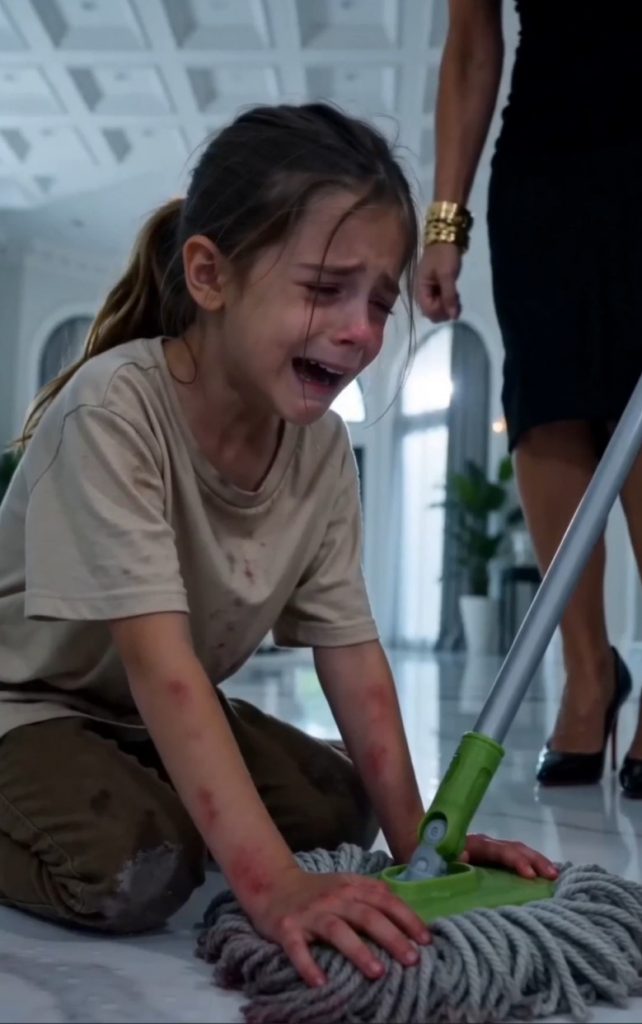
She was on her knees in the middle of the white marble floor, swallowed by an oversized beige shirt that hung off one shoulder. Her hair was tied back in a messy ponytail, strands sticking to her flushed cheeks. A wet mop lay abandoned beside her like evidence someone had forgotten to hide.
Her tiny hands trembled against the floor.
Daniel took one step forward, but the voice that cut through the room stopped him cold.
“Shut up!”
Vivienne stood over Clara in a black dress, gold jewelry flashing at her throat and wrists. She looked flawless, the way she always did when Daniel came home. Perfect hair. Perfect lipstick. Perfect smile.
But she was not smiling now.
She bent down until her face hovered inches from Clara’s.
“Clean it again,” she snapped.
Clara’s small body shook. She tried to lift the mop, but her fingers curled weakly around the handle and slipped. The sound of the wood tapping against the marble echoed through the foyer.
“I’m trying,” Clara whispered.
Vivienne straightened, smoothing her dress as if the child’s pain had inconvenienced her.
“Stop crying.”
Daniel could not breathe.
He had left that morning believing Clara was safe. He had kissed her forehead while she was still half-asleep, tucked beneath a pink blanket, clutching the stuffed rabbit her mother had given her before she died.
He had asked Vivienne to make sure Clara rested. She had been pale for days. Quiet. Too quiet.
Vivienne had touched his arm and said, “Of course, darling. You know I love her like my own.”
Now Clara slowly turned her palms upward.
They were red and swollen from scrubbing.
“My hands hurt,” she whimpered.
Vivienne’s face changed. Not with guilt. Not with fear.
With satisfaction.
She leaned close enough that only Clara was supposed to hear.
“Your father won’t believe you.”
The shopping bags slipped from Daniel’s hand.
They hit the marble with a heavy, echoing thud.
Vivienne spun around.
Daniel stepped forward, his eyes locked on hers.
“I do.”
And in that moment, the perfect house began to crack.
Act II
Vivienne’s mouth opened, but no words came out at first.
“You’re home?” she finally breathed.
Daniel did not answer her.
He crossed the foyer, dropped to his knees, and took Clara’s hands into his own. The little girl flinched at first, as if kindness had become unfamiliar. Then she saw his face and broke.
“Daddy…”
The word almost destroyed him.
He gathered her carefully against his chest. Clara clung to his suit jacket with the weak desperation of a child who had been holding herself together for too long.
Daniel looked over her shoulder at Vivienne.
“Go upstairs,” he said.
Vivienne blinked. “Daniel, you don’t understand what happened.”
“I understand enough.”
“No,” she said quickly, her voice sharpening again. “She made a mess. She spilled juice everywhere after I told her not to run through the foyer. I was teaching her responsibility.”
Daniel looked down at the marble.
There was no juice.
Only water. Soap. The faint streaks of a floor scrubbed again and again until it shone like glass.
“She’s six,” he said.
Vivienne gave a brittle laugh. “Exactly. Old enough to learn that tears don’t fix everything.”
Clara buried her face deeper into Daniel’s jacket.
That small movement told him more than any explanation could.
For months, there had been signs. Little things he had forced himself not to see because grief had made him desperate to believe the house could become whole again.
Clara stopped asking for bedtime stories when Vivienne was nearby.
She stopped wearing the dresses her mother had sewn little blue flowers onto.
She began apologizing before she asked for anything.
Once, Daniel had found her standing outside the kitchen at midnight, barefoot, holding an empty glass. When he asked what she was doing, she whispered, “I was waiting until it was okay to drink water.”
He had thought she was confused from a nightmare.
He had not known the nightmare lived in his own house.
Daniel had married Vivienne eleven months after Elena died. Too soon, his sister Margaret had warned him. Too soon, his friends had whispered behind his back.
But grief does not always look like crying in dark rooms. Sometimes it looks like signing papers because someone beautiful tells you she can help you breathe again.
Vivienne had entered his life like a rescue.
She organized the funeral reception when Daniel could barely stand. She sent meals. She remembered the names of relatives he forgot to call. She sat beside Clara and brushed her hair with gentle hands whenever Daniel was watching.
And Clara, still shattered by the loss of her mother, had tried to accept her.
For a while, Daniel thought she had.
Then the housekeepers started leaving.
The first one quit without notice. The second said she had family trouble. The third, Mrs. Alvarez, had worked for Daniel’s family for fifteen years and left with tears in her eyes.
When Daniel asked why, she would only say, “Please watch your daughter more closely.”
Vivienne called it jealousy.
“She hates me because I changed things,” she said. “Old staff always resent new wives.”
Daniel believed her because believing anything else meant admitting he had failed the one person Elena had trusted him to protect.
Now Clara sat on the marble floor in his arms, shaking.
And Vivienne, who had once worn Elena’s pearls to a charity dinner without asking, stood above them like she was the victim.
Daniel lifted Clara into his arms.
Vivienne stepped forward. “Daniel, don’t be dramatic. You’re scaring her.”
He turned slowly.
“No,” he said. “You are.”
The color drained from her face.
But Daniel did not yet know the worst part.
Act III
The doctor arrived within twenty minutes.
Daniel had called him from the foyer while carrying Clara upstairs. Vivienne followed, protesting the entire time, her heels clicking sharply behind them.
“This is humiliating,” she hissed. “You’re bringing a doctor here because a child cried over chores?”
Daniel did not look at her.
He placed Clara on his bed, not hers. The master bedroom had once belonged to him and Elena, but after the funeral, he had stopped sleeping there. Vivienne had redecorated the room in black, gold, and glass, erasing every soft trace of the woman who had lived there before her.
Tonight, Daniel wanted Clara as far away from Vivienne’s rooms as possible.
The doctor examined Clara gently. He asked simple questions. Had she eaten? Had she slept? Had this happened before?
Clara kept glancing at Vivienne.
Daniel noticed.
So did the doctor.
“Mrs. Hale,” the doctor said carefully, “I need a few minutes with the child and her father.”
Vivienne stiffened. “I am her mother.”
Clara whispered, “No.”
The room went silent.
It was the smallest word, but it landed like a verdict.
Vivienne’s expression hardened for half a second before she caught herself.
Daniel saw it.
After the doctor left, Clara fell asleep curled beneath Daniel’s coat. He sat beside her until her breathing steadied.
Then he walked into the hallway and found Vivienne waiting near the staircase.
She had recovered her mask.
Her lipstick was perfect again. Her hair was smooth. Her voice came out soft and wounded.
“You embarrassed me in front of the staff,” she said.
Daniel stared at her. “You hurt my daughter.”
“I disciplined her.”
“You threatened her.”
Vivienne’s eyes flashed. “You heard one sentence.”
“I heard enough.”
She stepped closer. “Be careful, Daniel. Grief makes people irrational. You know Clara has always been delicate. Elena spoiled her. You spoiled her. That child lies when she wants attention.”
Daniel’s jaw tightened.
Vivienne reached for his hand. “I have been trying to help you. I gave up everything to come into this house and raise another woman’s child.”
Daniel pulled his hand away.
That was when Margaret arrived.
Daniel’s older sister entered without knocking, still wearing her coat, a brown envelope clutched in one hand. Her face was pale with anger.
“I told you,” Margaret said.
Vivienne turned. “This is family business.”
Margaret lifted the envelope. “So is this.”
Daniel frowned. “What is that?”
Margaret looked at Clara’s closed bedroom door, then back at him.
“Mrs. Alvarez came to me three weeks ago,” she said. “She was afraid to go to you because Vivienne threatened to accuse her of stealing.”
Vivienne laughed. “That woman was unstable.”
Margaret ignored her. “She kept notes. Dates. Things she saw. Things Clara told her. She also gave me copies of letters.”
Daniel reached for the envelope.
Vivienne moved fast.
Too fast.
She tried to snatch it from Margaret’s hand, but Daniel stepped between them.
For the first time that night, Vivienne looked truly afraid.
Daniel opened the envelope.
Inside were photographs, handwritten pages, and three letters addressed to him in childish handwriting.
He recognized Clara’s uneven letters immediately.
Daddy, please come home early.
Daddy, I’m sorry I was bad.
Daddy, I miss Mommy. Please don’t be mad.
Daniel’s hands shook.
“I never got these,” he said.
Margaret’s voice softened. “Because Vivienne took them from Clara’s desk before the driver could mail them.”
Daniel looked at his wife.
Vivienne said nothing.
Margaret pulled out one more paper.
“This is the part you need to see.”
It was a copy of a petition drafted by Vivienne’s private attorney. Daniel scanned the first page, confusion turning to horror.
Temporary guardianship.
Behavioral instability.
Recommendation for residential schooling.
Clara Hale to be removed from the home environment.
Daniel looked up slowly.
“You were trying to send my daughter away.”
Vivienne’s mask finally slipped.
“She doesn’t belong here,” she said.
The truth had entered the room.
And it was colder than anything Daniel had imagined.
Act IV
For a long moment, nobody moved.
Then Daniel spoke in a voice so low it barely sounded like him.
“Say that again.”
Vivienne’s chin lifted.
“She doesn’t belong here,” she repeated. “She never did. This house is frozen around a dead woman and a spoiled little girl who uses tears to control you.”
Margaret stepped toward her. “Careful.”
“No,” Vivienne snapped. “I am done being careful. I am done living under Elena’s portrait. Done hearing the staff whisper about how kind she was. Done pretending that child doesn’t look at me like I’m trespassing.”
Daniel’s eyes narrowed. “You are trespassing.”
Vivienne flinched.
“This house belonged to Elena’s family before it belonged to me,” Daniel said. “And after her death, it was placed in trust.”
Vivienne’s face changed.
Daniel saw it immediately.
She knew.
Margaret turned to him. “Daniel…”
He held up the legal petition. “That’s why, isn’t it? Clara wasn’t just inconvenient. She was in your way.”
Vivienne said nothing.
But silence can confess.
Daniel had spent years managing companies, contracts, inheritance structures, and boardroom betrayals. He knew the language of greed when he saw it. Vivienne had not wanted a family.
She had wanted access.
Elena’s father had built the estate long before Daniel became wealthy in his own right. When Elena died, her will left the mansion and a controlling portion of the family foundation to Clara, protected until her eighteenth birthday.
Daniel remained trustee.
If Clara were declared unstable, removed, or placed under outside care, Vivienne could push Daniel to restructure everything “for the child’s benefit.”
Daniel looked at the petition again.
It was not discipline.
It was strategy.
The next morning, the house changed.
Daniel called his attorney before sunrise. By eight, Vivienne’s lawyer was on speakerphone, denying everything with the polished panic of a man who knew the floor had vanished beneath him.
By nine, the security team reviewed camera footage from the foyer, kitchen, hallways, and staff entrances.
Vivienne had forgotten one thing.
The mansion had been renovated after Elena’s death because Daniel feared intruders, not because he suspected his wife. The cameras did not record private bedrooms, but they recorded the public rooms clearly.
They showed Clara scrubbing the foyer for nearly two hours.
They showed Vivienne walking past her with coffee.
They showed the mop slipping from Clara’s hands.
They showed Vivienne leaning down and screaming.
And finally, they showed Daniel entering with shopping bags in his hand, stopping as his wife told his daughter he would never believe her.
When Vivienne saw the footage, her confidence collapsed.
“That’s edited,” she said.
The attorney did not answer.
Daniel stood at the far end of the study, Clara asleep upstairs with Margaret beside her. He had not let Vivienne near her since the night before.
“You have one hour to pack what belongs to you,” Daniel said.
Vivienne laughed, but it cracked halfway through. “You can’t throw me out.”
“I can.”
“I’m your wife.”
“You were.”
Her eyes filled with sudden, calculated tears.
“Daniel, please. I made mistakes. I was overwhelmed. You were never home. You left me alone with a grieving child and expected me to fix what Elena broke by dying.”
Daniel’s face went still.
Margaret looked ready to cross the room, but Daniel raised one hand.
“Do not say her name again.”
Vivienne’s tears stopped as quickly as they had started.
There she was.
The woman beneath the gold.
Cold. Furious. Exposed.
“You’ll regret this,” she whispered.
Daniel stepped closer.
“No,” he said. “I already regret the months I didn’t see my daughter clearly. I won’t regret protecting her now.”
Vivienne packed two suitcases.
She tried to take Elena’s pearl earrings from the upstairs dressing room, but Margaret caught her at the door and held out her hand.
“Those stay,” Margaret said.
Vivienne smiled bitterly. “You people worship ghosts.”
Margaret’s voice turned ice-cold.
“No. We remember love. That’s why you never understood this family.”
By noon, Vivienne was gone.
But the damage she left behind did not disappear with the sound of her car pulling away.
That evening, Clara finally woke and asked the question Daniel feared most.
“Daddy, am I bad?”
Act V
Daniel sat beside Clara’s bed with the stuffed rabbit in his lap.
The question hollowed him out.
He had negotiated with billionaires, stood before hostile boards, buried the woman he loved, and still nothing had ever made him feel as helpless as his daughter waiting for him to decide whether she was worth loving.
He moved slowly, making sure she could see every gesture before he reached for her hand.
“No,” he said. “You are not bad.”
Clara’s lower lip trembled.
“She said Mommy left because I cried too much.”
Daniel closed his eyes.
For one second, grief and rage moved through him so sharply he had to breathe before he spoke.
Then he opened the drawer beside the bed and took out a small blue box.
Clara recognized it immediately.
“Mommy’s box,” she whispered.
Inside were letters Elena had written during the final weeks of her illness. Some were for Daniel. Some were for Clara when she got older.
Daniel had never been brave enough to read them all.
Now he opened one addressed in Elena’s soft handwriting.
For Clara, on a day when she forgets how loved she is.
Daniel read it aloud.
Not all of it. Just enough.
Elena told Clara that she had been the best thing that ever happened to her. That crying did not make someone weak. That kind people sometimes had loud hearts because they felt the world deeply.
Clara listened without moving.
When Daniel finished, she touched the paper with two fingers.
“Mommy wrote that?”
“She did.”
“For me?”
“For you.”
Clara’s face folded, and Daniel held her while she cried. This time, nobody told her to stop.
In the weeks that followed, the mansion became quiet in a different way.
Not empty.
Healing.
The black curtains in the master bedroom came down. Elena’s piano was uncovered. The white sofas Vivienne had forbidden Clara to sit on became the place where she built blanket forts with Margaret on rainy afternoons.
Mrs. Alvarez returned, not as a servant, but as Clara’s daytime caregiver, with Daniel’s full trust and an apology he delivered in person.
“I should have listened,” he told her.
The older woman looked at him for a long moment.
“Yes,” she said. “You should have.”
Then she hugged him.
Daniel did not fight the truth. He let it humble him. He changed his schedule. He moved his office into the library and stopped pretending money could replace presence.
At night, he learned Clara’s new fears one by one.
She was afraid of spilling things.
Afraid of being too loud.
Afraid of asking for seconds at dinner.
So Daniel spilled orange juice on purpose one morning and said, “Look at that. The world didn’t end.”
Clara stared at him.
Then, slowly, she laughed.
It was small at first. Rusty. Almost surprised to exist.
But it was laughter.
Vivienne tried to return once.
She arrived three months later wearing white, as if innocence were a costume she could put on for court. Her attorney argued that Daniel had overreacted, that household discipline had been misunderstood, that a grieving father had been manipulated by bitter staff and family.
Then Daniel’s lawyer played the foyer footage.
The courtroom went silent when Vivienne’s own voice filled the room.
Your father won’t believe you.
Daniel did not look at Vivienne.
He looked at Clara, sitting safely beside Margaret with headphones on, coloring in a notebook. She did not have to hear it again. Not today. Not ever.
The judge granted Daniel full protective custody and issued an order keeping Vivienne away from Clara and the estate.
The guardianship petition was dismissed.
The trust remained untouched.
And for the first time since Elena’s death, Daniel felt that justice had not arrived as thunder.
It arrived as a locked door.
As a child sleeping through the night.
As a house no longer ruled by fear.
Months later, on Clara’s seventh birthday, Daniel filled the foyer with flowers.
Not the cold white arrangements Vivienne used to order for parties where nobody laughed. These were wild and bright, spilling over tables in yellows, pinks, and blues. Clara wore a soft lavender dress and carried her stuffed rabbit under one arm.
Children ran across the marble floor in socks.
Someone dropped cake.
A little boy knocked over a cup of punch.
Clara froze when the red juice spread across the white marble.
Daniel saw her face change.
He walked over, crouched beside the spill, and dipped one finger into the juice.
Then he tapped the tip of Clara’s nose.
She gasped.
The room paused.
Daniel smiled.
“It’s just a floor,” he said.
For one heartbeat, Clara looked like she might cry.
Then she burst into laughter.
The sound rose toward the chandelier, filling every polished corner of the mansion. It moved through the foyer where she had once knelt trembling. It passed the fireplace, the sofas, the windows, the place where Daniel had dropped the bags and finally seen the truth.
Margaret wiped her eyes.
Mrs. Alvarez crossed herself quietly.
And Daniel, watching his daughter laugh with juice on her nose and sunlight in her hair, understood something Elena had known all along.
A house is not made perfect by marble.
It is made safe by love.
That night, after the guests left and the flowers began to droop in their vases, Clara climbed into Daniel’s lap in the library.
“Daddy?”
“Yes, sweetheart?”
“Will you believe me next time?”
Daniel held her closer.
“There won’t be a next time like that,” he said. “But yes. Always.”
Clara nodded, satisfied, and rested her head against his chest.
Outside, the mansion glowed softly against the dark.
Inside, for the first time in a very long time, Clara slept without fear.