Act I
The prison cafeteria was built to erase men.
Every table was bolted to the concrete. Every light buzzed the same cold note overhead. Every orange jumpsuit blurred into the next until names, histories, and regrets all seemed to disappear beneath the hum of fluorescent tubes.
But at the last table, Marcus Kane had made one small thing human.
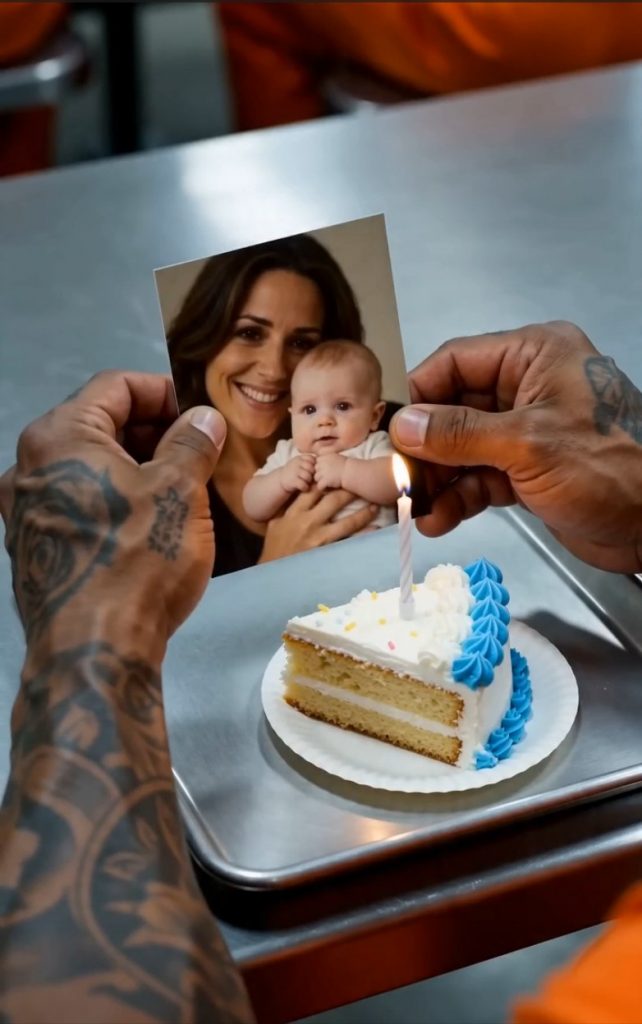
A slice of cake sat on his metal tray.
It was barely cake at all, just a square of white sponge with blue frosting scraped thin across the top. In the center, Marcus had pressed a single white birthday candle. His tattooed hands, scarred from old labor and prison work, moved with surprising gentleness as he struck a match.
The flame trembled.
He cupped one hand around it, protecting it from the draft.
Across the cafeteria, men stopped chewing.
Not because of the candle.
Because of Marcus.
He was the kind of inmate even loud men avoided. Bald, broad-shouldered, silent, with eyes that had learned to say nothing because words in prison were often used as traps. He had spent sixteen years behind concrete walls and had never once begged, never once bragged, never once asked another man to pity him.
But every year on April 12, he traded two weeks of commissary for a slice of cake.
Every year, he lit one candle.
Every year, he placed the same photograph beside it.
The photo was faded now, the corners soft from being touched too often. A young woman smiled from inside it, dark hair brushing her shoulders, one arm wrapped around a chubby baby with pale hair and curious eyes.
Marcus stared at them as if the cafeteria had vanished.
For a moment, he was not inmate 77421.
He was a husband.
A father.
Then Sergeant Briggs saw the candle.
Briggs stood in the center aisle with his arms crossed over his chest, broad and smug in his dark blue uniform. His silver badge caught the light. So did the stripes on his sleeve, though everyone in the room knew rank had only made his cruelty more organized.
He began walking toward Marcus.
Metal spoons slowed.
Conversations died.
Marcus did not look up.
Briggs stopped at the end of the table and looked down at the tray.
“Well,” he said, loud enough for the nearby rows to hear. “Isn’t this touching.”
Marcus’s jaw tightened.
“It’s her birthday.”
Briggs glanced at the photograph.
“The woman?”
Marcus’s hand rested beside the picture.
“The baby.”
A few inmates looked away.
Briggs smiled.
Then, with one fast sweep of his hand, he knocked the entire tray off the table.
The cake, candle, and photograph flew across the concrete.
The metal tray hit the floor with a violent clatter that echoed down the hall.
“You don’t need that,” Briggs said. “Eat what you’re given.”
The candle rolled until its tiny flame died.
Marcus’s right hand clenched on the table.
Every tattoo along his forearm shifted as his muscles tightened. His breathing slowed. His eyes lifted, red-rimmed and wet, but hard enough to make the nearest guard reach for his radio.
For one second, the whole cafeteria waited for the explosion.
Marcus stood.
Briggs smiled wider, daring him.
But Marcus did not swing.
He stepped past the guard, knelt on the concrete, and reached for the photograph.
That was when he saw it.
The picture had split open at the corner.
And something that had been hidden inside for sixteen years slid onto the floor.
Act II
Before Marcus Kane became a number, he built houses.
He framed walls, repaired roofs, and came home every evening smelling like sawdust, sweat, and cold air. His wife, Anna, used to laugh when he tried to wash his hands before touching the baby because no amount of soap could fully clean the work from his skin.
“You’re holding her like she’s made of glass,” Anna would say.
Marcus always answered the same way.
“She is.”
Their daughter’s name was Lily.
She had been born during a spring storm, tiny and furious, screaming before the doctor finished saying she was healthy. Marcus cried when they placed her in his arms. Anna teased him for it for months.
Then everything changed.
Marcus was arrested two weeks after Lily’s first birthday.
The police said he had been part of an armored truck robbery outside a private bank. They said a guard had been injured. They said Marcus’s truck had been seen near the scene. They found marked bills in his garage, hidden inside a toolbox he had not opened in months.
Marcus told them it was impossible.
He had been home that night.
Anna knew it. The baby had a fever. They had both stayed awake until dawn, taking turns holding Lily against their chests while she cried.
Anna was supposed to testify.
She never made it to court.
Three days before the hearing, she vanished with Lily.
The prosecutor called it abandonment.
Marcus called it impossible.
Anna would never leave without a message. Never leave their wedding photo on the mantel. Never leave Lily’s stuffed rabbit in the crib.
But the court did not care about what a grieving husband believed.
It cared about evidence.
And all the evidence had been arranged beautifully against him.
The main witness was a young deputy named Clayton Briggs.
He testified that Marcus had been nervous during a traffic stop weeks before the robbery. He testified that he had seen Marcus speaking with known criminals. He testified with the calm confidence of a man who understood that a uniform could make lies sound official.
Marcus was convicted.
The judge gave him life with eligibility for review after twenty years.
Anna and Lily were declared missing.
Over time, the world moved on.
His lawyer stopped answering calls. His brother sold the house. His mother died before the first appeal was filed. Every letter Marcus wrote to Anna came back undelivered until he stopped writing because there was nowhere left to send hope.
Only the photograph remained.
It had arrived at the prison in his first property box, sealed in a thin plastic sleeve by intake. Marcus never removed it. He was afraid of damaging the last good thing he had.
He touched it every night.
He spoke to it when grief made him foolish.
And every April 12, he lit a candle for Lily.
Not because he knew she was alive.
Because he could not survive if he stopped acting like she might be.
Sixteen years passed.
Deputy Clayton Briggs became Sergeant Briggs after transferring into corrections. He gained weight, authority, and a reputation for finding the softest part of a man and pressing there until something cracked.
He remembered Marcus.
Of course he did.
That was why he hated the photograph.
Not because it broke a rule.
Because it survived.
And now, on the concrete floor of the prison cafeteria, the photograph had finally opened.
What slipped out was not large.
Just a narrow strip of paper, folded twice, yellowed with age.
Marcus picked it up with shaking fingers.
Briggs saw it.
His smile disappeared.
And Marcus realized the guard was not angry anymore.
He was afraid.
Act III
“Give me that,” Briggs said.
Marcus did not move.
The cafeteria had gone so quiet that the buzzing lights sounded louder. Men leaned forward over their trays. A young inmate near the wall whispered, “What is it?”
Briggs stepped closer.
“I said give it to me.”
Marcus unfolded the paper.
The handwriting hit him first.
Anna’s.
His vision blurred so badly that the words broke apart before he could read them.
He blinked hard.
Marcus, if this reaches you, Briggs lied. Lily is alive. I hid the proof where we first promised forever. Trust no one from the old precinct. I love you. I’m sorry.
The room tilted.
For sixteen years, grief had lived inside Marcus as a locked room.
Now the door opened.
Lily is alive.
Briggs lunged for the paper.
Marcus pulled his hand back and rose to his feet.
The motion was slow, controlled, and somehow more frightening than any attack would have been. The guard froze half a step away, suddenly aware of every inmate watching.
“Touch me,” Marcus said quietly, “and everyone here sees why.”
Briggs’s face darkened.
“You think a scrap of paper means something?”
Marcus looked at him.
“It meant enough for you to panic.”
Another guard moved toward them, uncertain.
Briggs snapped, “Back off.”
That mistake turned every eye in the cafeteria toward him.
Captain Morales, the shift supervisor, entered from the far door a moment later, drawn by the silence more than the noise. She was a woman with sharp eyes and no patience for men who mistook a uniform for ownership of the truth.
“What happened?” she asked.
Briggs answered too quickly.
“Kane created a disturbance.”
Marcus held up the paper.
“No,” he said. “He found one.”
Morales crossed the floor.
Briggs stepped in front of her.
“It’s inmate property. I’ll handle it.”
She looked at him.
“Move.”
For a second, he did not.
Then he did.
Morales took the paper from Marcus carefully, as if she understood that it was not just evidence. It was sixteen years of breath held in a man’s chest.
She read it once.
Then again.
Her expression changed.
“Where did this come from?”
Marcus pointed to the photograph on the floor.
“My wife hid it inside the sleeve.”
Morales turned to Briggs.
“Why did you knock his tray down?”
Briggs lifted his chin.
“Contraband candle.”
Morales looked at the dead candle on the concrete.
Then at the cake.
Then at the photo of a woman and baby.
“Was the candle dangerous, Sergeant?”
He said nothing.
An inmate from the second table spoke up.
“He does this every year, Captain. Never bothers nobody.”
Another added, “Briggs came looking for him.”
The room stirred.
Morales raised one hand, and the silence returned.
She looked back at the paper.
“Where is ‘where we first promised forever’?”
Marcus’s throat worked.
“The chapel.”
Briggs’s face hardened.
Marcus continued, voice rough.
“Anna and I got married in an old chapel near Briar Street. It closed before my trial.”
Morales folded the note.
“This is going to the warden.”
Briggs reached for it.
“Captain, with respect, this is not—”
She cut him off.
“You lost the right to tell me what this is when you put your hands on his property.”
Marcus knelt again and picked up the photograph.
The plastic sleeve was torn. The corner of Anna’s smile had bent. He smoothed it with his thumb as if apologizing to her.
Then he looked at Briggs.
For sixteen years, Marcus had believed the worst thing the guard had taken was his freedom.
Now he knew better.
Briggs had helped take the truth.
And the truth was finally breathing.
Act IV
The chapel on Briar Street had not held a wedding in twenty years.
Its windows were boarded. Its pews were stacked in the back. Rain came through the roof in two places, and weeds climbed the stone steps where Marcus had once stood in a cheap suit holding Anna’s hands.
But the building still existed.
Two days after the cafeteria incident, Captain Morales stood inside it with a county investigator, a forensic technician, and a court-appointed attorney named Rebecca Sloan, who had been assigned to Marcus’s case after Morales refused to let the note vanish into internal paperwork.
Marcus was not allowed to go.
He waited in his cell with the photograph on his bunk and his hands clasped so tightly his knuckles ached.
The words kept returning.
Lily is alive.
Alive meant somewhere.
Somewhere meant findable.
Findable meant he had not spent sixteen years lighting candles for a ghost.
At the chapel, Rebecca found the hiding place.
Not under the altar. Not behind a loose brick. Somewhere simpler.
Inside the hollow leg of the old guestbook table, where Marcus had carved A + M on their wedding day because Anna dared him to do something reckless in a church.
The table leg held a sealed plastic packet.
Inside were photographs, bank records, and a small digital storage card wrapped in tissue.
The video on the card changed everything.
It was grainy and dated, pulled from a garage camera across the street from the armored truck robbery. The image was not perfect, but it was enough.
Marcus was not there.
His truck was, but he was not driving it.
The man who stepped out had a build close to his, a cap pulled low, and a deputy’s jacket visible when the wind caught his collar.
Clayton Briggs.
There were more records too.
Payments routed through a shell account.
Reports edited after submission.
A witness statement from Anna saying Briggs had threatened her if she testified.
And one final note from Anna, written in the same hand as the paper hidden behind the photograph.
He said if I spoke, Lily would disappear. I am taking her to my sister. If I cannot come back, make sure Marcus knows I tried.
Marcus read that note three days later in a small legal room beneath a buzzing light.
He did not cry at first.
He sat perfectly still while Rebecca Sloan explained the emergency motion, the reopened case, the review board, the outside investigation. Words moved around him like weather.
Then she placed a second photograph on the table.
It was recent.
A young woman stood in a bookstore doorway, dark hair falling around her shoulders, pale eyes steady on the camera.
“She goes by Lily Hart now,” Rebecca said softly. “Anna’s sister raised her in Oregon. She’s safe.”
Marcus stared at the picture.
The baby from the old photograph had grown into a woman.
He touched the edge of the paper with one finger.
“Does she know?”
Rebecca nodded.
“She knows you didn’t abandon her.”
The sentence broke him.
Not loudly. Not dangerously. Just a man folding forward under the weight of a truth too heavy to hold upright.
Captain Morales, standing by the door, looked away to give him privacy.
Sergeant Briggs was arrested before sunset.
He did not shout in the cafeteria then. He did not swagger down the aisle. He did not call anyone poor, weak, guilty, or forgotten.
He walked in handcuffs past the same tables where he had built a kingdom out of fear.
No one cheered.
Marcus did not even look at him.
He was looking at the photograph of Lily.
The birthday candle had gone out.
But the wish had survived.
Act V
Freedom did not arrive all at once.
It came in documents.
In hearings.
In men in suits saying words like misconduct, suppression, and wrongful conviction, as if polished language could soften sixteen stolen years.
Marcus sat through all of it.
He listened as lawyers described his life like a file. He watched officials who had never known Anna say her name with careful respect now that evidence forced them to. He heard Briggs’s testimony collapse under the weight of records he had never expected anyone to find.
The conviction was vacated on a gray morning in November.
Marcus stood before the court in a plain navy jacket that did not fit right because prison had changed the shape of him. His hands remained clasped in front of him. His face gave little away.
Then the judge said he was free to go.
A sound moved through the courtroom.
Not applause.
Breath.
Rebecca touched his arm. “Marcus.”
He did not move.
After sixteen years of being told when to stand, sit, eat, sleep, speak, and stay silent, freedom felt almost unreal. Too large. Too bright. Too fragile to trust.
Then he saw her.
At the back of the courtroom stood a young woman with dark hair and pale eyes, holding a faded photograph in both hands.
The same photograph.
Anna and the baby.
Lily.
Marcus turned slowly.
For a moment, neither of them walked.
What do you say to a daughter whose first steps you missed? Whose birthdays you marked with prison cake? Whose life was protected by a mother who never got to explain?
Lily moved first.
She crossed the courtroom with both hands trembling.
Marcus stood as if afraid any sudden motion might make her disappear.
She stopped in front of him.
“You’re taller than I thought,” she said.
It was such an ordinary sentence that he almost laughed.
Instead, his eyes filled.
“You look like your mother.”
Lily’s face crumpled.
Then she stepped into his arms.
Marcus held her carefully at first, the way he had held her when she was made of glass. Then her arms tightened around him, and he understood she was real.
Not a photograph.
Not a candle.
Not a wish whispered into concrete.
His daughter.
Alive.
Outside the courthouse, cameras waited, but Marcus ignored them. Lily walked beside him. Rebecca kept reporters at a distance. Captain Morales stood near the steps in civilian clothes, no longer part of the case but unwilling to miss the ending.
Marcus stopped when he saw her.
“You could have looked away,” he said.
Morales shook her head.
“Too many people already had.”
He nodded once.
It was the closest he could come to saying everything.
Weeks later, Marcus returned to the old chapel on Briar Street with Lily.
The city had agreed to preserve it until the case was fully closed. The boards had been taken off the windows, and pale winter light fell through dusty glass onto the floor.
Lily walked slowly to the front.
“Mom married you here?”
Marcus nodded.
“She said the roof leaked romance.”
Lily smiled through tears.
“That sounds like her.”
Marcus reached into his coat pocket and pulled out a small white candle.
Lily looked at it.
“For my birthday?” she asked.
“For all the ones I missed.”
They placed it on the old guestbook table, beside the carved letters A + M.
Marcus lit it.
The flame rose small and steady.
For once, no guard came to knock it down.
For once, no concrete walls swallowed the moment.
Lily stood beside him, shoulder touching his arm, and together they watched the candle burn in the place where a hidden truth had waited sixteen years to be found.
Marcus thought of Anna then.
Not as a faded face in a prison photograph.
But as the woman who had loved fiercely enough to hide evidence where memory lived. The woman who had run to save their child. The woman who had left him one final message when the world tried to make him believe he had been abandoned.
He closed his eyes.
“Thank you,” he whispered.
Lily slipped her hand into his.
Outside, the city moved on, loud and careless.
Inside the chapel, time felt different.
Not restored. Nothing could give Marcus back the years.
But something had been returned.
His name.
His daughter.
The truth.
And the photograph, once torn open on a prison floor by an act of cruelty, now sat safely in Lily’s hands.
Not as the last piece of a lost life.
As the first proof that love had outlasted every lie.