Act I
The coins hit the floor before Clara Bennett looked down.
One bounced under the white tablecloth.
Another spun in a bright silver circle beside her black shoes.
The rest scattered across the polished wooden floor of Maison Verity, sharp little sounds cutting through candlelight, cutlery, and soft restaurant music like tiny pieces of shame.
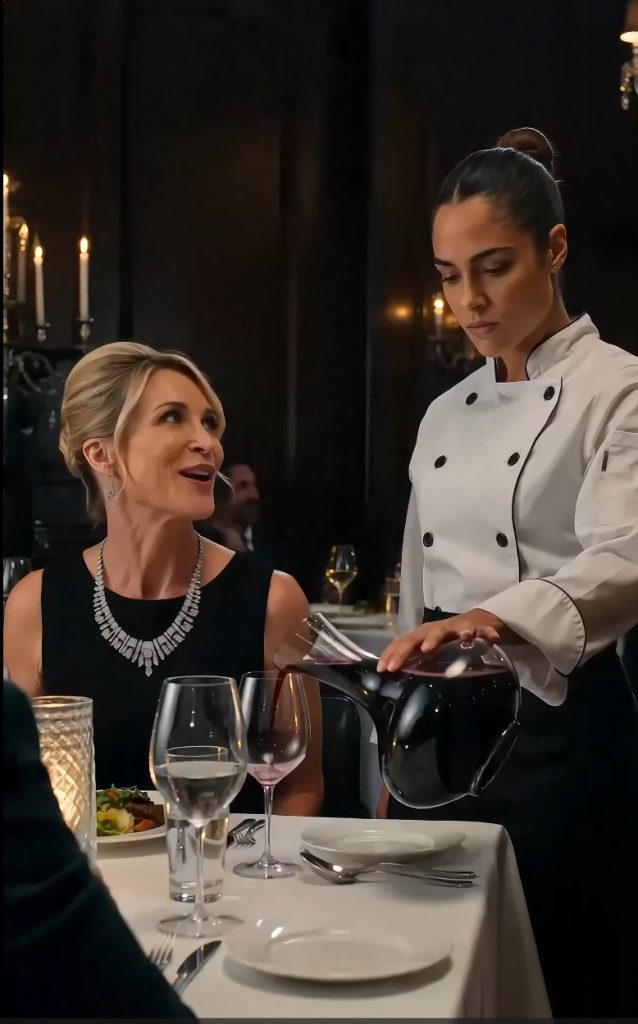
Clara stood beside the table in a white double-breasted jacket and black apron, one hand still wrapped around the neck of a bottle of red wine.
She had been pouring carefully.
Professionally.
Silently.
Until Victoria Hale leaned forward with diamonds at her throat and cruelty in her smile.
“Wait,” Victoria said, loud enough for the nearby tables to hear. “Weren’t you our old class president? And now you’re just a waitress?”
The man beside her laughed.
Graham Mercer.
Dark beard. Green suit. Blue shirt. The same lazy arrogance he had worn since boarding school, now dressed in better tailoring.
Clara did not answer.
The wine stream remained steady.
Victoria tilted her head, enjoying the attention.
“You used to give all those speeches about changing the world.”
Graham reached into his pocket, pulled out a handful of coins, and threw them at Clara’s feet.
“There’s your tip,” he said. “I used to think you were so smart. Serve us properly, okay?”
The room tightened.
A few diners looked over.
A waiter near the service station froze.
Clara’s jaw moved once.
But she still did not bend for the coins.
Victoria’s smile widened.
“Oh, don’t be proud now. Pride is for people who still have options.”
Something in Clara’s face changed.
Not loudly.
Not obviously.
Just enough.
She set the bottle down, lifted Graham’s wine glass, and threw the red wine straight into his face.
Gasps erupted across the restaurant.
Graham recoiled, chair scraping back, wine dripping down his beard and shirt. Victoria jerked away as if the humiliation had splashed onto her diamonds too.
Clara leaned close to him.
Her voice was low.
Cold.
Clear.
“Have we all gotten used to humiliating people?” she said. “Today you’re going to learn respect.”
Graham stared at her, stunned and wet and suddenly less powerful than he had looked ten seconds earlier.
Victoria opened her mouth to call for the manager.
But behind Clara, the kitchen doors swung open.
And the executive staff stepped out in silence.
Act II
At Westbridge Academy, Clara Bennett had been the kind of girl people praised when adults were watching.
Class president.
Scholarship student.
Debate captain.
The girl who organized food drives, corrected teachers politely, and graduated with a speech about dignity that half the auditorium applauded and the other half ignored.
Victoria Hale had sat in the front row that day wearing pearls.
Graham Mercer had sat two seats behind her, whispering jokes into his hand.
They came from families whose names were printed on buildings. Clara came from a rented apartment above her father’s failing bakery.
Her father, Martin Bennett, made bread before sunrise and fixed broken ovens after midnight. He was not polished. He was not wealthy. But he could make a room smell like safety.
Every morning before school, he packed Clara lunch in a paper bag and wrote one sentence on the napkin.
Stand straight. No one owns your spine.
Clara kept those napkins in a shoebox beneath her bed.
She needed them at Westbridge.
Because rich children rarely bullied with fists when reputations worked better.
Victoria called her “charity royalty” after Clara won the student election. Graham once tipped a cafeteria tray near her shoes and told her service work was in her blood. Their friends laughed, but never when teachers could hear.
Clara learned restraint early.
She learned that anger from poor people was called attitude.
Anger from wealthy people was called confidence.
The year everything broke, Clara discovered that Westbridge’s scholarship fund was missing money. Not rumor. Not gossip. Records. Transfers. Donations routed through shell invoices connected to a foundation owned by Victoria’s father and a development firm tied to Graham’s family.
Clara brought the documents to the headmaster.
Two weeks later, her father’s bakery was audited.
Then sued.
Then accused of falsifying supplier records for a school catering contract he had never even been awarded.
The story spread through town faster than truth could catch it.
Bakery owner investigated.
Scholarship student’s father under fraud review.
Questions raised over charity funds.
Clara knew who had done it.
She could not prove it.
Her father lost the bakery before the case collapsed. By then, the damage was permanent. Vendors stopped extending credit. Customers stopped coming. Men in suits came to collect equipment from the kitchen while Martin stood in the doorway with flour still beneath his fingernails.
The night the ovens were taken, Clara found him sitting on the floor.
“I’m sorry,” he said.
She knelt beside him.
“For what?”
“For not being powerful enough to protect you.”
Clara never forgot that.
Not because he failed.
Because he believed power was the only language cruel people understood.
Years later, she would learn he was partly right.
But only partly.
Power mattered.
Proof mattered more.
Act III
Maison Verity had once been Bennett Bakery.
Not to customers now, of course.
Now it was a fine-dining restaurant with dark wood walls, linen tables, candlelight, and a waiting list that powerful people bragged about surviving. But beneath the polished floor was the old bakery foundation. Behind the wine room, a bricked-over arch still held the outline of where Martin Bennett’s ovens used to stand.
Clara bought the building under an investment company name no one connected to her.
She did not do it with inherited money.
She did it with ten years of work.
After Westbridge, she cooked wherever people would hire her. Hotel kitchens. Night cafés. Catering trucks. Private dining rooms where clients praised the food and ignored the woman carrying it.
She saved.
Studied.
Built a reputation under the name C. Bennett because she learned that people tasted differently when they did not know who had fed them.
By thirty-one, Clara had become one of the most sought-after private chefs in the city.
By thirty-two, she had enough backing to open Maison Verity.
The name was deliberate.
Verity meant truth.
And Clara had designed the restaurant not only as a place to serve food, but as a stage for the truth she had spent years collecting.
Because her father’s case had not ended cleanly.
The charges were dropped, yes. Quietly. Without apology. Without headlines. But Clara never accepted quiet as justice. She kept digging through public filings, donor records, old catering contracts, and foundation reports.
One missing scholarship fund became three.
Three became seven.
The Hale Foundation and Mercer Development had spent years moving money through fake community projects, school renovation budgets, and supplier invoices. When anyone questioned it, blame landed on someone disposable.
A baker.
A clerk.
A bookkeeper.
A scholarship kid’s family.
Clara had proof now.
Not feelings.
Proof.
And tonight, Victoria Hale and Graham Mercer were dining at Maison Verity because they believed they had been invited to an exclusive donor preview for a new youth culinary scholarship.
In a way, they had.
They just did not know the scholarship was named after Martin Bennett.
They did not know reporters were seated at Table 6.
They did not know the city’s deputy attorney general was in the private dining room behind the wine wall.
They did not know Clara owned the restaurant.
And they certainly did not know that every table in the room had gone quiet not because a waitress threw wine, but because everyone who worked there knew exactly who she was.
Victoria finally stood.
“Get your manager,” she snapped. “Now.”
Clara turned toward her.
“I am the manager.”
Graham wiped wine from his face with a linen napkin.
“You’re insane.”
The kitchen doors opened wider.
A gray-haired man in a black suit stepped out, followed by the maître d’, the executive sous-chef, and two servers. None of them looked surprised.
The gray-haired man stopped beside Clara.
“Chef Bennett,” he said quietly, “the guests in the private room are ready.”
Victoria blinked.
Chef.
Graham lowered the napkin.
Clara picked up one of the coins from the floor and placed it on the table beside his untouched plate.
Then she said, “So am I.”
Act IV
The wine wall slid open.
That was when Victoria truly began to understand.
Behind the glass shelves and candlelit bottles was a private dining room filled with people she recognized in pieces.
A local journalist.
A former Westbridge accountant.
Two city investigators.
An attorney who had once represented the scholarship board.
And at the head of the table, Clara’s father’s old bakery sign, restored and mounted against the wall.
BENNETT BAKERY
Fresh Bread. Honest Work.
Victoria’s hand moved toward her necklace.
Graham tried to stand.
Two security staff stepped forward, not touching him, not threatening him, simply existing between him and the exit.
Clara walked into the private room, then turned back toward the dining area.
Her voice carried without needing to rise.
“Fifteen years ago, my father was accused of fraud because someone needed a poor man to hold a rich family’s crime.”
Victoria’s face tightened.
“This is defamation.”
Clara looked at her.
“Then sit down and enjoy the evidence.”
A low murmur moved through the restaurant.
The screens in the private room switched on.
Financial records appeared.
Donation transfers.
Fake invoices.
Supplier names.
Signatures.
Dates.
Then a video.
It was grainy, old, copied from a storage drive Clara had spent years trying to recover. In it, Graham’s father spoke with Victoria’s father in the Westbridge board office. Their words were clipped and cold.
The Bennett contract is perfect. Small vendor. No legal team.
If anything surfaces, the baker takes the hit.
And the girl?
She’ll learn ambition has a ceiling.
Clara stood absolutely still.
She had heard the recording before.
Still, each word found the old wound.
Graham whispered, “That’s not admissible.”
The deputy attorney general, seated calmly with a glass of water, said, “It is now part of a larger evidentiary review.”
Victoria turned on Graham.
“You told me this was handled.”
Graham’s eyes widened.
“I told you?”
That was the first crack between them.
Cruel people often survived by standing together.
Truth made them count exits separately.
Clara stepped closer to the table.
“You threw coins because you thought I was someone beneath you.”
She looked at Victoria.
“You laughed because you thought my fall was proof that yours could never happen.”
Victoria’s lips trembled with rage.
“You were waiting for this?”
Clara answered honestly.
“Yes.”
The room held its breath.
“Not for the wine,” Clara said. “Not for a scene. Not for revenge the way you understand it. I was waiting for a room where people like you could not whisper your way out.”
Graham slammed a hand on the table.
“You assaulted me.”
Clara looked at the wine on his shirt.
“Then file a complaint. I’ll file mine with years of documentation.”
He stared at her.
She leaned slightly closer.
“You told me to serve properly. So I am. Tonight’s first course is accountability.”
No one laughed.
That made it stronger.
Victoria sat down slowly, as if her legs could no longer support the weight of being seen.
Act V
The story broke before dessert.
Not because Clara wanted spectacle.
Because the truth had finally gathered enough witnesses to stop being called a grudge.
By midnight, the Hale Foundation released a statement full of careful sorrow and no responsibility. By morning, Mercer Development’s stock began to fall. By the end of the week, Westbridge Academy announced an independent investigation into twenty years of scholarship funds.
The old accusations against Martin Bennett were formally withdrawn from every public record.
That was the sentence Clara cared about most.
Not the headlines.
Not the cameras.
Not the viral clip of Graham Mercer dripping wine in a restaurant full of people too stunned to rescue him.
The sentence.
All claims against Martin Bennett were unsupported and should not have been pursued.
Unsupported.
Such a small word for a life they had crushed.
Clara printed the letter and brought it to her father’s grave on a gray morning with rain threatening at the edge of the sky. She placed it beneath a small stone so the wind would not take it.
“They finally said it,” she whispered.
There was no answer.
Only leaves moving across the cemetery path.
She sat there for a long time.
When she returned to Maison Verity that evening, the staff had set one table in the old bakery corner. No guests. No cameras. Just a candle, a loaf of warm bread, and her father’s favorite chipped blue plate.
The gray-haired maître d’, Thomas, nodded toward it.
“For him,” he said.
Clara touched the back of the chair.
Then, for the first time since the night of the wine, she cried.
Quietly.
Privately.
Without needing to stand straight.
The legal process lasted months.
Victoria Hale’s father resigned from three boards before indictments were announced. Graham Mercer tried to distance himself from the original scheme, then emails surfaced showing he had helped bury follow-up complaints years later.
Victoria claimed she had been young and knew nothing.
Clara did not argue with that.
She simply released a copy of a message Victoria had sent the night Clara withdrew from Westbridge.
Poor Clara. Some people are born to lead assemblies, not lives.
It was cruel.
Not criminal.
But sometimes cruelty explained what paperwork could not.
Victoria disappeared from society pages for a while.
Graham lost more than money.
He lost the illusion that money could keep people laughing when the joke turned against him.
As for Clara, people expected her to apologize for the wine.
Interviewers asked carefully.
Lawyers advised restraint.
Publicists suggested language like emotional overwhelm and regret for the optics.
Clara gave one statement.
“I regret that a dining room had to witness disrespect before it witnessed dignity. I do not regret refusing to bend for coins.”
That line became the one people remembered.
But inside Maison Verity, the staff remembered something else.
After the investigations began, Clara gathered every server, cook, dishwasher, host, and runner in the dining room before service. They stood between candlelit tables while rain tapped softly against the windows.
Clara held a silver coin in her palm.
One of Graham’s.
“I kept this,” she said.
No one spoke.
“Not because it hurt me.”
She looked around the room.
“Because it reminded me how quickly some people forget that service is work, not permission to degrade someone.”
She placed the coin in a small frame near the staff entrance.
Beneath it, a brass plaque read:
No one bends for disrespect here.
From then on, every new employee saw it before stepping onto the floor.
The restaurant became known for its food, but also for something rarer.
Its boundaries.
Guests who snapped fingers were corrected.
Guests who insulted staff were asked to leave.
Guests who believed money purchased cruelty discovered their reservation could vanish faster than their temper.
Some people called Clara difficult.
She accepted that.
Difficult was often what people called a woman when she stopped making humiliation convenient.
One year later, Westbridge Academy invited Clara to speak at its graduation.
She almost refused.
Then she imagined her younger self standing on that stage with a speech full of hope, not yet knowing how expensive honesty could become.
So she went.
The auditorium had changed, but not enough. Same polished floors. Same banners. Same wealthy parents pretending opportunity was equally distributed because scholarship students were allowed to stand near their children in photographs.
Clara walked to the podium.
This time, no one laughed.
She looked at the students.
Some confident.
Some afraid.
Some already learning which rooms expected them to shrink.
“I used to believe dignity meant staying silent when people tried to humiliate you,” she said. “I thought if I stood straight enough, worked hard enough, and never showed anger, the truth would defend itself.”
She paused.
“It doesn’t. People defend truth. And sometimes that starts with refusing to pick up the coins.”
In the front row, a scholarship student looked up sharply.
Clara saw her.
Really saw her.
After the speech, the girl approached.
“Did you ever want to quit?” she asked.
Clara smiled sadly.
“Yes.”
“What stopped you?”
Clara thought of her father’s flour-covered hands. The bakery sign. The napkins in the shoebox. The wine glass. The staff standing behind her. The room finally listening.
“Someone once told me no one owns my spine,” she said.
The girl nodded as if she wanted to remember it exactly.
Years later, the clip people still shared was the dramatic one.
The coins.
The wine.
The stunned faces.
The line about respect.
But those who ate at Maison Verity knew the real story was deeper than a splash of red wine on a rich man’s shirt.
It was about a girl who had been mocked for believing she could lead.
A father who lost everything because powerful people needed a scapegoat.
A woman who spent years learning how to turn service into strength.
And a dining room full of witnesses who finally understood that the person pouring wine beside the table might be the only one in the room with enough dignity to stop the cruelty everyone else had gotten used to hearing.
Clara never picked up Graham’s coins that night.
Someone else did.
Carefully.
For evidence.
And when the last one was lifted from the wooden floor, the sound it made was small.
But to Clara, it felt like a bell.