Act I
The owner screamed about the car before he asked about the dog.
“That’s my property!”
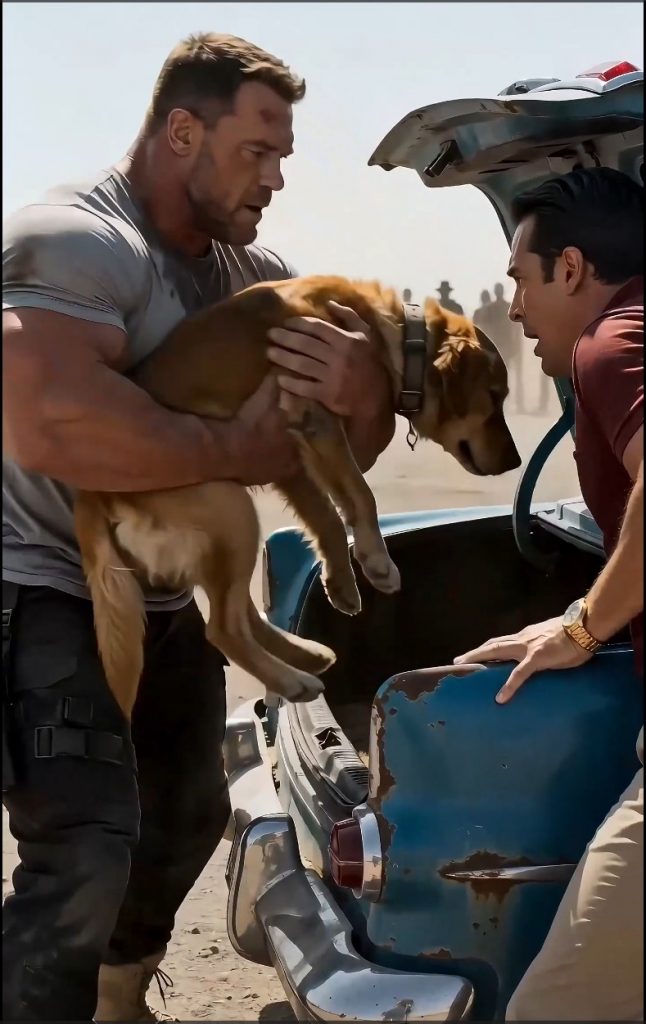
His voice cracked across the sunlit asphalt lot, sharp and ugly, as the huge man in the gray T-shirt drove the claw of an iron hammer into the seam of the blue sedan’s trunk.
The car was old, dusty, and faded by years of weather. Its paint had gone dull under the hard daylight. Around it, a small crowd stood several yards back, frozen between curiosity and fear.
The man with the hammer did not look at them.
His name was Jack Calder, and he had the kind of build that made people step aside before realizing they had moved. Broad shoulders. Weathered face. Dark hair cut short. Work boots planted on the asphalt like the ground owed him stability.
He braced both hands on the hammer handle and pulled.
Metal scraped.
The trunk groaned.
The owner, a man in a red polo with tan trousers and a gold watch flashing at his wrist, rushed toward him.
“I said stop!”
Jack pulled harder.
The trunk popped.
The sound was small, but the whole lot reacted as if something had exploded.
The lid lifted just enough for sunlight to spill into the darkness inside.
Jack leaned over it.
Then everything in his face changed.
The anger was still there, but something colder moved beneath it.
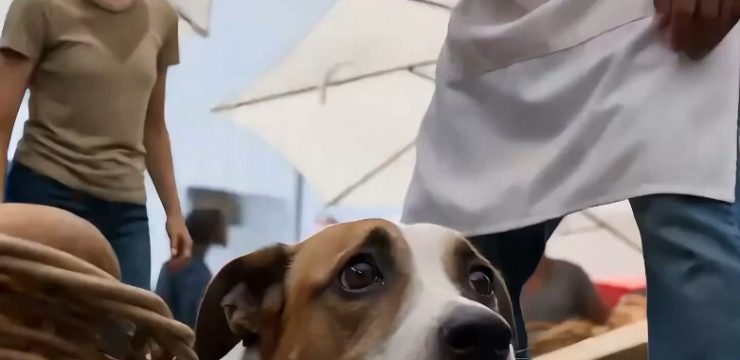
A Golden Retriever lay curled in the trunk, dirty fur pressed against the carpet lining, eyes half-open and unfocused. A thick fabric collar sat around his neck. His breathing was faint but there.
Alive.
Barely responsive.
The owner lunged forward.
Jack swung one arm out and blocked him against the side of the sedan.
“Back up.”
The owner shoved at his arm. “You have no right!”
Jack did not raise his voice.
“That dog is in a trunk.”
“He’s mine!”
Jack looked at him then.
Just once.
“You sure about that?”
The owner’s face flickered.
Not enough for most people to catch.
Jack caught it.
He reached carefully into the trunk, slid both arms beneath the Golden Retriever, and lifted him against his chest. The dog’s head rested weakly near Jack’s shoulder.
A woman in the crowd gasped.
Someone whispered, “Oh my God.”
The owner tried to look away.
Jack grabbed the front of his red polo and forced him to face what he had done.
“Look at him.”
The man trembled.
The dog gave one soft breath against Jack’s shirt.
And when Jack looked down at the collar, he saw a faded strip of blue fabric stitched with one name.
Benny.
Act II
Jack Calder knew the sound of something trapped.
It was not always loud.
Sometimes it was a scratch behind drywall. A whimper beneath flood debris. A paw against metal. A breath too weak to travel far, but desperate enough to keep trying.
He had heard it for twenty-two years as a firefighter.
He had crawled through smoke-filled hallways, lifted children out of overturned cars, carried terrified pets from burning kitchens, and once spent four hours beneath a collapsed porch because an old woman swore her dog was still under there.
The dog was.
Jack found him by listening.
Retirement did not change that part of him.
It only gave him more time to hear what other people ignored.
That afternoon, Jack had come to the asphalt lot behind Mercer Auto Storage to pick up donated tools for the animal rescue he ran outside town. The place was used for auctions, impounds, warehouse overflow, and the kind of business nobody wanted visible from the main road.
Rows of cars sat under the sun.
Most were dead machines.
One was not quiet enough.
Jack heard it while loading a box of wrenches into his truck.
A faint scrape.
Then another.
He stopped.
A man nearby laughed into a phone. A forklift beeped somewhere near the warehouse. Heat shimmered above the concrete.
There it was again.
Metal.
A weak movement from inside the blue sedan.
Jack walked toward the sound.
That was when the owner appeared from the shade beside the warehouse, too fast and too polished for a man with nothing to hide.
“Can I help you?” he asked.
Jack pointed to the car.
“Open the trunk.”
The man smiled. “No.”
“Something’s inside.”
“Tools.”
“Tools don’t breathe.”
The smile vanished.
His name, as Jack later learned, was Trent Hollis. Thirty-six. Real estate investor. Board member at two charities. The kind of man who wore gold watches to places where other people wore gloves.
Trent stepped between Jack and the sedan.
“This vehicle belongs to me.”
Jack looked at the trunk.
“Then open it.”
“Get away from my car.”
The crowd started gathering after that.
Workers. A few customers. A woman holding keys to a minivan. Two teenagers from the gas station next door. They watched with the usual hesitation people show when they can tell something is wrong but hope someone else will decide what to do about it.
Jack did not hesitate.
He went to his truck, took out the iron hammer, and walked back.
Trent shouted.
Someone started filming.
Jack slid the claw into the seam.
He had already made his choice.
If he was wrong, he would pay for the trunk.
If he was right, a living thing was running out of time.
Then the trunk opened.
And Benny came into the light.
Act III
The dog’s collar made Jack stop breathing for half a second.
Not because of the name alone.
Because of the stitching beside it.
Three crooked yellow stars.
A child’s work.
Jack had seen that collar before on a missing poster taped to the door of his rescue shelter.
Golden Retriever. Male. Name: Benny. Thick blue collar with hand-stitched stars. Missing from Westbrook Avenue after backyard gate found open. Family desperate. Needs medication and regular care. Please call Emily Hart.
Jack had remembered the poster because of the photo.
A little boy in a wheelchair had both arms around the Golden Retriever’s neck, laughing so hard his eyes were squeezed shut. The dog looked patient, proud, and completely devoted.
That was not Trent Hollis’s dog.
Jack looked at the owner.
“You stole him.”
Trent’s eyes sharpened.
“I bought him.”
“From who?”
“That’s none of your business.”
Jack shifted Benny carefully against his chest. The dog’s body was heavy with exhaustion, but his tail moved once, barely, when Jack said his name.
“Benny,” Jack murmured.
The dog’s ear twitched.
The crowd heard it.
So did Trent.
His face changed again.
Jack turned toward the woman with the minivan keys.
“Call the police. Tell them animal cruelty and possible stolen dog. Tell them we need a vet here now.”
She was already dialing.
Trent pointed at her. “Don’t you dare.”
That was the wrong thing to say.
The crowd moved.
Not forward in violence.
Forward in witness.
The teenagers stopped filming like spectators and began filming like evidence. A warehouse worker stood near the driveway so Trent’s sedan could not be quietly moved. The woman with the keys gave the dispatcher the address in a voice that shook but did not stop.
Trent’s confidence began to shrink under sunlight.
Jack crouched near the car’s shadow, still holding Benny, and checked the collar without removing it. Under the fabric was a small metal tag tucked inward, as if someone had tried to hide it.
Benny Hart.
A phone number.
Jack’s jaw tightened.
He knew the Hart family’s story.
Everyone who worked rescue in the county knew it.
Emily Hart had adopted Benny for her son, Noah, after a car accident left the boy anxious around hospitals, school hallways, and strangers touching his chair. Benny became more than a pet. He was the steady presence who slept beside Noah’s bed, nudged his hand during panic, and barked once when the boy dropped something he could not reach.
Three weeks earlier, Benny disappeared.
Emily searched neighborhoods. Posted flyers. Called shelters. Offered a reward she could not afford.
And now the dog had been found locked in the trunk of a blue sedan owned by a man who looked more offended by damaged paint than by a living creature struggling inside it.
The first police cruiser pulled into the lot six minutes later.
Trent lifted both hands immediately.
“Officer, this man attacked me and vandalized my vehicle.”
Jack looked down at Benny.
The dog’s breathing was still shallow, but steadier now under the open air.
The officer’s eyes moved from the pried trunk to the hammer on the ground, to the dog in Jack’s arms, to Trent’s gold watch.
“Sir,” the officer said to Trent, “step away from the vehicle.”
Trent laughed once.
“You can’t be serious.”
The officer’s face hardened.
“I am.”
Act IV
Benny’s microchip ended the argument.
Animal Control arrived with a scanner and a soft blue blanket. The device beeped at Benny’s shoulder, and the officer read the number over the phone to dispatch.
The answer came back fast.
Registered to Emily Hart.
Reported missing.
Active case.
Trent stopped talking.
That silence was the first honest thing he had offered all day.
The vet tech took Benny from Jack with careful hands, and Jack let him go only after the dog was safely supported. The Golden Retriever lifted his head once, confused by the movement, and Jack leaned close.
“You’re going home, buddy.”
Benny’s eyes softened.
Trent tried one final performance.
“I found him wandering. I was going to return him.”
The officer looked at the trunk.
“In there?”
Trent swallowed.
“He was agitated.”
Jack turned toward him.
“No,” he said. “You were.”
The officer asked Trent for identification. Another officer began photographing the trunk, the collar, the blue sedan, the hammer, and the scuff marks near the latch. The crowd stayed quiet now, but no one left.
That mattered.
People like Trent counted on witnesses getting uncomfortable and drifting away.
No one drifted.
Then Emily Hart arrived.
She came in a silver minivan that stopped so abruptly near the curb that the front tires chirped against the asphalt. She stumbled out before the engine fully shut off, hair pulled messily back, face pale with fear.
A boy sat in the passenger seat.
Noah.
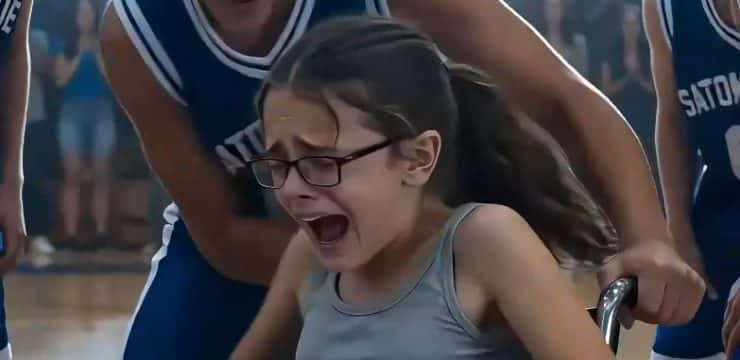
He looked about nine, small and tense, hands gripping the armrests of his wheelchair as another adult helped unfold it from the back of the van. His eyes searched the lot before anyone spoke.
“Mom?” he said. “Is it him?”
Emily saw the vet tech kneeling beside the blanket.
She covered her mouth.
“Benny.”
The dog heard her voice.
His tail moved.
Weakly.
But it moved.
Noah made a sound that cut through everyone in the lot.
Not loud.
Just broken open with relief.
Jack stepped back as Emily and Noah reached the dog. The vet tech warned them to be gentle, and they were. Emily knelt on the asphalt without caring about her clothes. Noah leaned forward from his chair and touched Benny’s ear with two fingers.
“Hey, boy,” he whispered. “I knew you didn’t leave.”
Benny pressed his nose against Noah’s hand.
That was when Jack looked away.
He had seen fires leave families with nothing. He had seen people rebuild from ashes, floods, wreckage, and hospital rooms. But there was a particular kind of cruelty in taking the one living thing that made a frightened child feel safe and treating him like an object to hide.
The officer saw Jack’s face.
“Mr. Calder,” he said quietly. “We need your statement.”
Jack nodded.
“In a minute.”
Trent, now standing beside the police cruiser, stared at the reunion with a strange kind of resentment. As if even now he could not understand why the scene was not about him.
Emily turned.
Her eyes found him.
“What did you do to my dog?”
Trent looked away.
Noah did not.
The boy’s voice was quiet, but every adult heard it.
“Benny was never yours.”
Trent’s face reddened.
The officer placed a hand near his elbow.
“Mr. Hollis, you’re coming with us while we sort this out.”
Trent tried to protest.
Then he saw Jack still standing near the trunk, hammer at his feet, arms streaked with dust, expression carved from controlled fury.
For once, Trent chose silence.
Act V
Benny spent four days at the veterinary clinic.
The clinic staff placed his blanket near a window and let Noah visit after school. At first, Benny slept more than he moved. Then he began lifting his head when Noah spoke. Then he ate from Emily’s hand. Then, on the fourth day, he stood long enough to rest his chin on Noah’s lap.
The photo of that moment traveled through town faster than the video of the rescue.
People had seen the trunk.
They needed to see the homecoming.
Trent Hollis’s story collapsed under evidence.
He had not found Benny wandering.
Security footage from a neighboring house showed his assistant opening the Hart family’s backyard gate the week Benny disappeared. Trent had been trying to force Emily to sell her small home on Westbrook Avenue, the last property holding up his planned luxury rental development.
Emily had refused.
Then Benny vanished.
At first, police treated it as a missing dog report.
Sad, but ordinary.
Trent had counted on that.
He did not count on Benny being recognized. He did not count on the collar surviving. He did not count on Jack Calder hearing the faint scrape inside the trunk and deciding the paint on a car mattered less than the breath behind it.
The charges that followed did not undo the harm, but they changed the balance.
Animal cruelty. Theft. Intimidation. Evidence tampering after investigators found messages connecting Trent to the missing dog. His company issued a statement calling the situation “deeply unfortunate.” Nobody believed it.
Emily kept her house.
The development stalled.
Then failed.
Noah returned to school with Benny two weeks later.
Not for attention. Not for pity. For routine.
Benny walked slowly beside his wheelchair, wearing the same blue collar with the crooked yellow stars. Clean now. Repaired. Visible.
When they passed the bulletin board near the entrance, Noah stopped.
Someone had taped up a drawing.
A huge man holding a Golden Retriever in one arm, standing beside a blue car under a bright sun. The hammer lay on the ground. The dog had a halo of yellow crayon stars around his head.
At the bottom, a student had written:
Some heroes hear the quiet sounds.
Noah studied it for a long time.
Then he said, “He’s bigger in real life.”
Benny wagged his tail.
Jack hated the attention.
He hated the news trucks, the interviews, the strangers calling him a hero when all he had done was open a trunk no one else wanted to challenge. But he accepted one invitation.
The Harts asked him to dinner.
He arrived with a toolbox because he noticed the porch railing was loose.
Emily laughed for the first time in weeks.
“You can just come in, Jack.”
“I will after I fix this.”
Noah watched from the doorway while Benny supervised from the welcome mat.
At dinner, Noah asked the question adults had been too polite to ask.
“Were you scared?”
Emily closed her eyes briefly.
Jack set down his fork.
“Yes.”
Noah looked surprised.
“You looked mad.”
“I was both.”
“Which one helped?”
Jack thought about it.
“Listening helped first.”
Noah nodded like that made sense.
Then he reached down and scratched Benny’s head.
“Benny listened too. He scratched so somebody would hear him.”
Jack looked at the dog.
The boy was right.
Months later, Jack hung the iron hammer on the wall of his rescue shelter.
Not as a trophy.
As a reminder.
Beneath it, he placed a small brass plaque Emily had made.
OPEN THE TRUNK.
People asked what it meant.
Jack told them.
It meant do not assume silence means nothing is wrong.
It meant do not let polished men define cruelty as property.
It meant do not wait for someone else to be brave when a living thing is trapped in plain sight.
The asphalt lot behind Mercer Auto Storage changed too.
After the video went public, the owner installed cameras and shade structures. The lot workers received training on what to do if they heard an animal in distress. The crowd who had once stood frozen became part of the story in a better way: witnesses, callers, people who stayed.
The blue sedan was impounded.
Nobody missed it.
One year later, Noah and Benny visited Jack’s shelter during an adoption event. Benny moved slower than some dogs, but proudly, with Noah beside him and the blue collar bright against his golden fur.
A little girl pointed at him.
“Is that the dog from the trunk?”
Noah looked down at Benny, then at Jack.
For a second, Jack wondered if the question would hurt.
Noah answered calmly.
“No,” he said. “That’s the dog who came home.”
Jack smiled.
That was the better story.
Not the trunk.
Not the heat.
Not the man in the red polo shouting about property.
The better story was the sunlight after the lid opened. The boy’s hand touching his dog’s ear. The tail moving. The house on Westbrook Avenue still standing. The crooked yellow stars on the collar, stitched by a child who believed his dog would never choose to leave him.
And he had been right.
Benny had not left.
He had been taken.
But he had kept breathing.
Kept scratching.
Kept waiting for someone to listen.
And on a harsh, bright afternoon in a dusty asphalt lot, someone finally did.